

Key takeaways
- Good puzzles reward a plan: predict, roll, change one thing, compare.
- Random changes can hit the target but rarely explain why.
- Change one thing at a time so cause and effect is clear.
- Roll each setting three times and use the middle result.
- Keep tiny toys away from children who still mouth things.
The best engineering puzzles for kids make you think because they reward a plan, not luck. When your child predicts, watches and changes one thing at a time, every attempt teaches something. Here's a home ramp puzzle to try two ways, plus a cheat sheet and a printable prediction table.
Why do the best engineering puzzles make you think?
Because they reward a plan, not luck. A good puzzle lets you predict, test and learn from every attempt, so each try gets you closer for a reason you can name. Random trial and error can still hit the answer, but it often leaves you unsure why it worked.
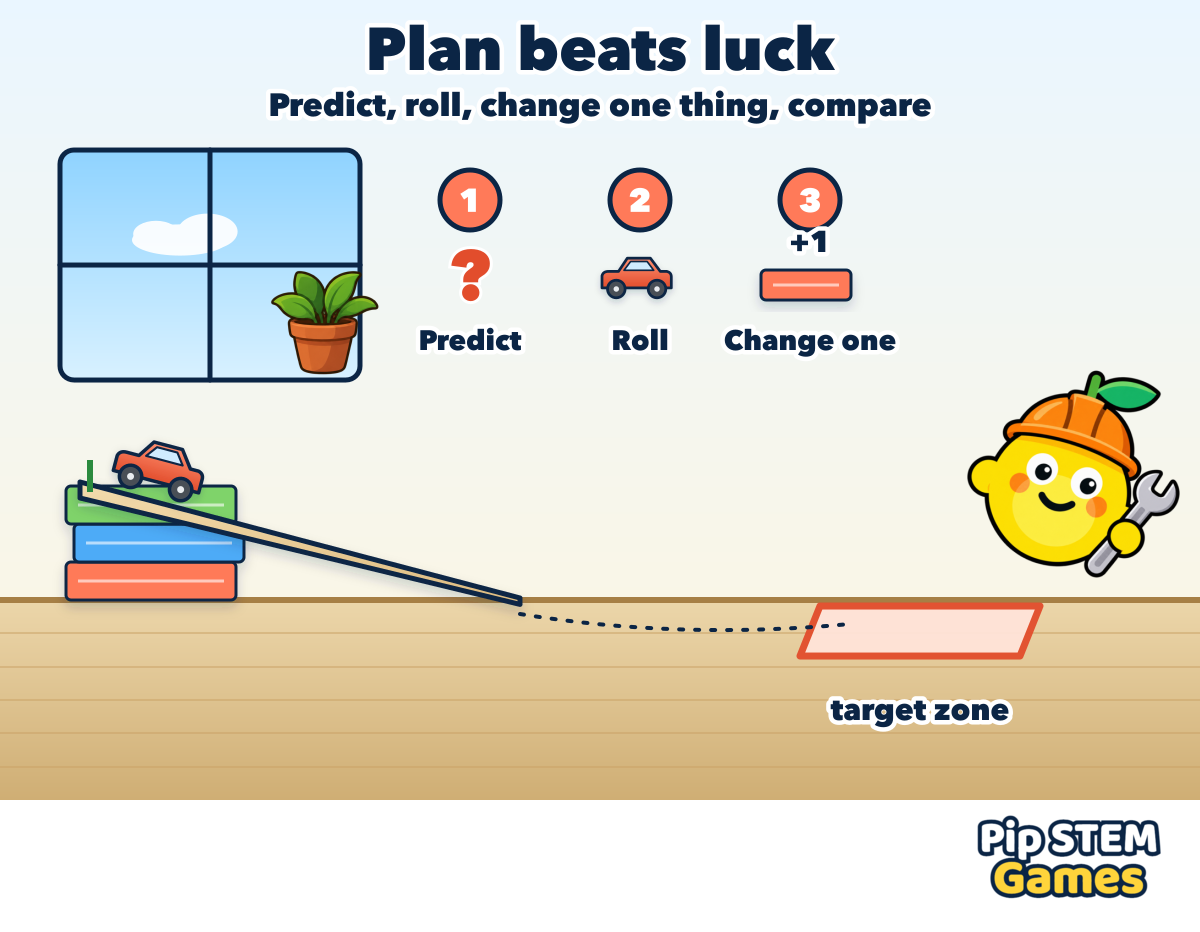
Engineers call this working deliberately. You make a guess from what you know, test it, watch closely and improve one thing at a time. The puzzle below makes that difference easy to feel. Your child solves the same ramp challenge twice, once by luck and once by plan, and counts the rolls. It's the same habit that sits behind the engineering design process.
What is the ramp puzzle?
Make a toy car stop inside a tape target zone on the floor beyond the end of a ramp, using as few rolls as you can. The goal is not speed. It's accuracy with the fewest tries.
- A firm piece of card, a tray or a plastic chopping board used flat as a ramp
- A stack of books to raise one end
- A small toy car or a short cardboard tube
- Masking tape for a start line and a target zone
- A ruler or a strip of paper to measure
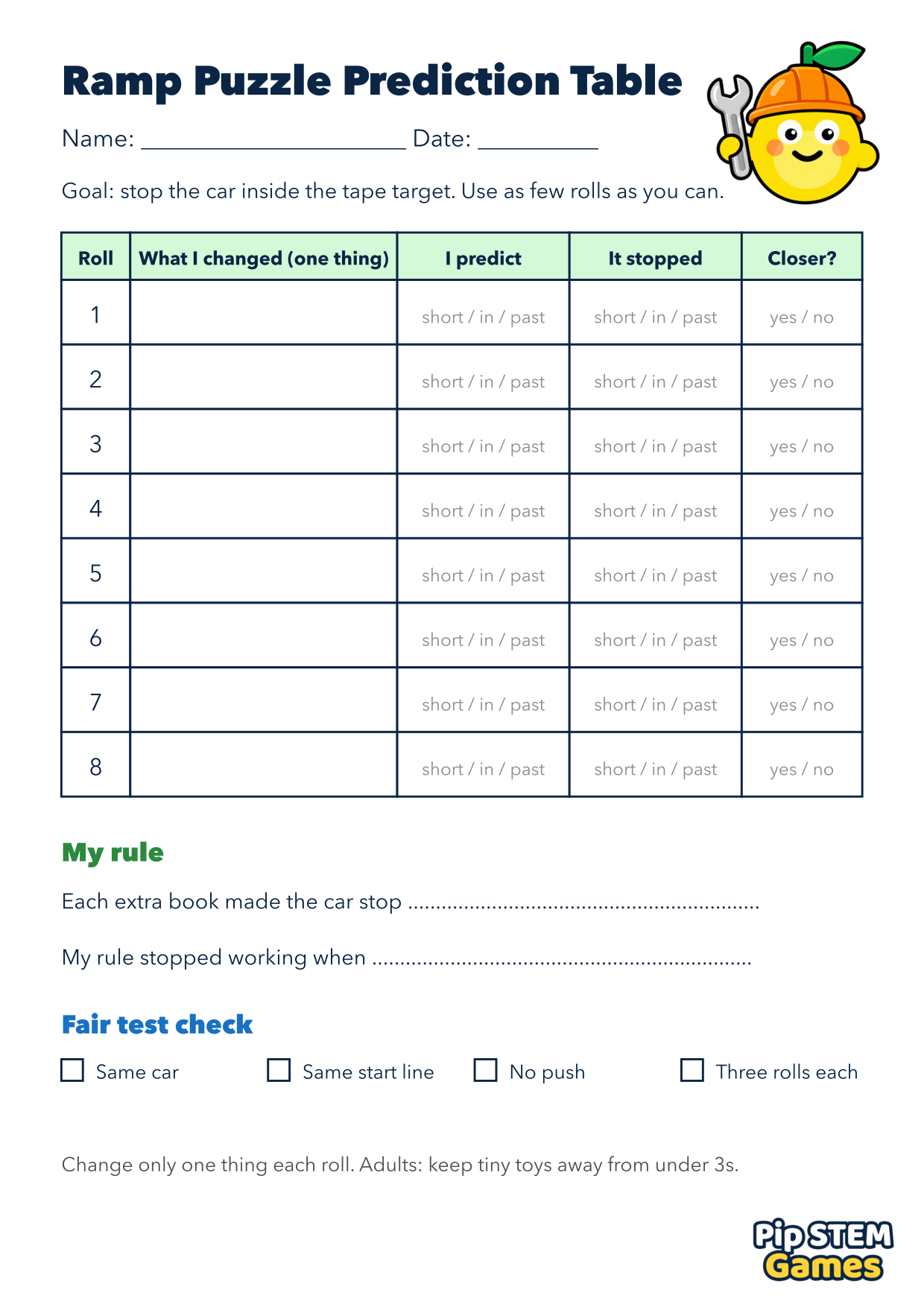
- Pen and paper for a prediction table
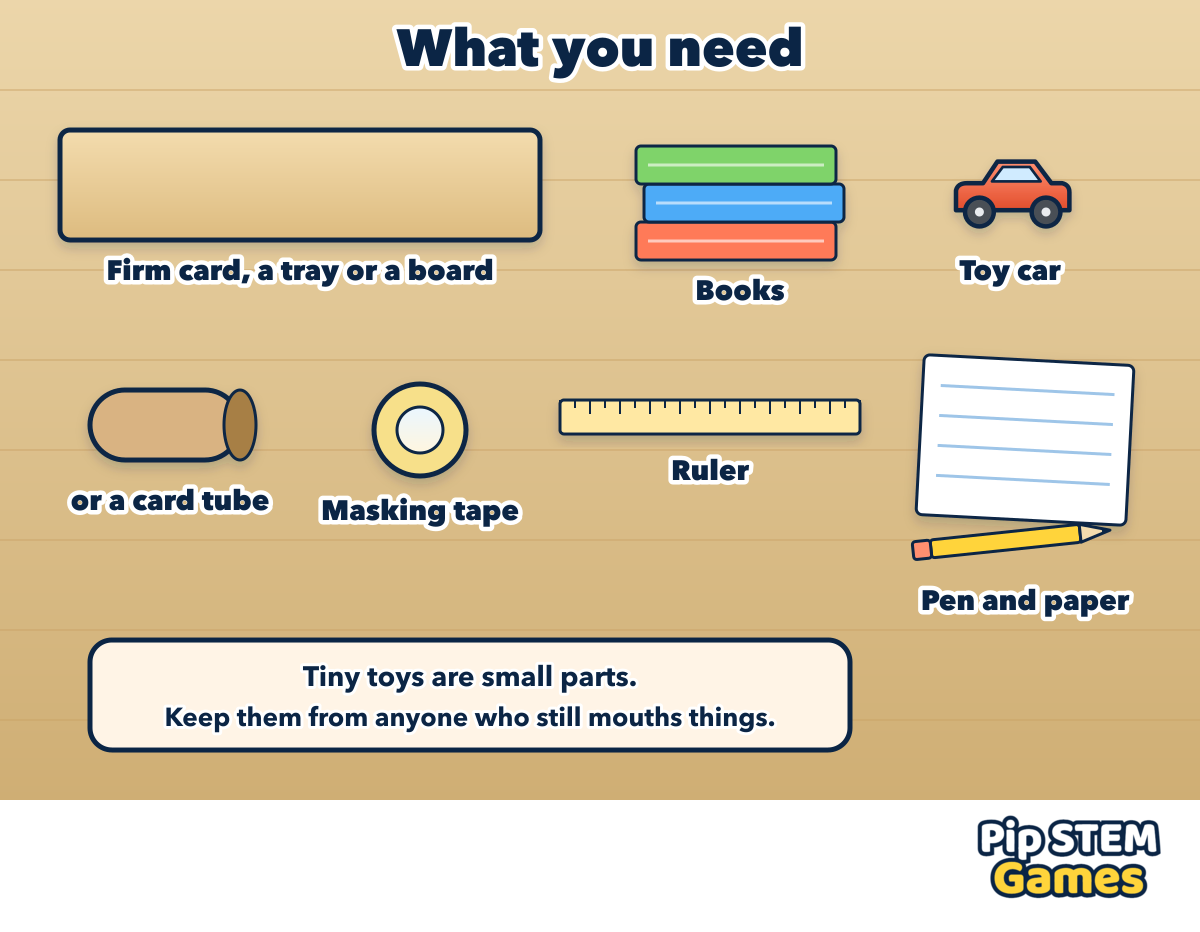
No batteries, heat or sharp tools. Safety: very small toys are a choking risk, so keep them away from anyone who still puts things in their mouth, and stay close throughout. Play on a clear floor away from stairs and keep the book stack low and steady.
How do you try the random method first?
Let your child change anything they like between rolls and count how many rolls it takes.
- Stick a tape start line near the top of the ramp.
- Tape a box on the floor beyond the ramp as the target.
- Let your child change anything: height, start spot, car or surface.
- Count every roll until the car stops in the box.
- Ask: why did that one work?
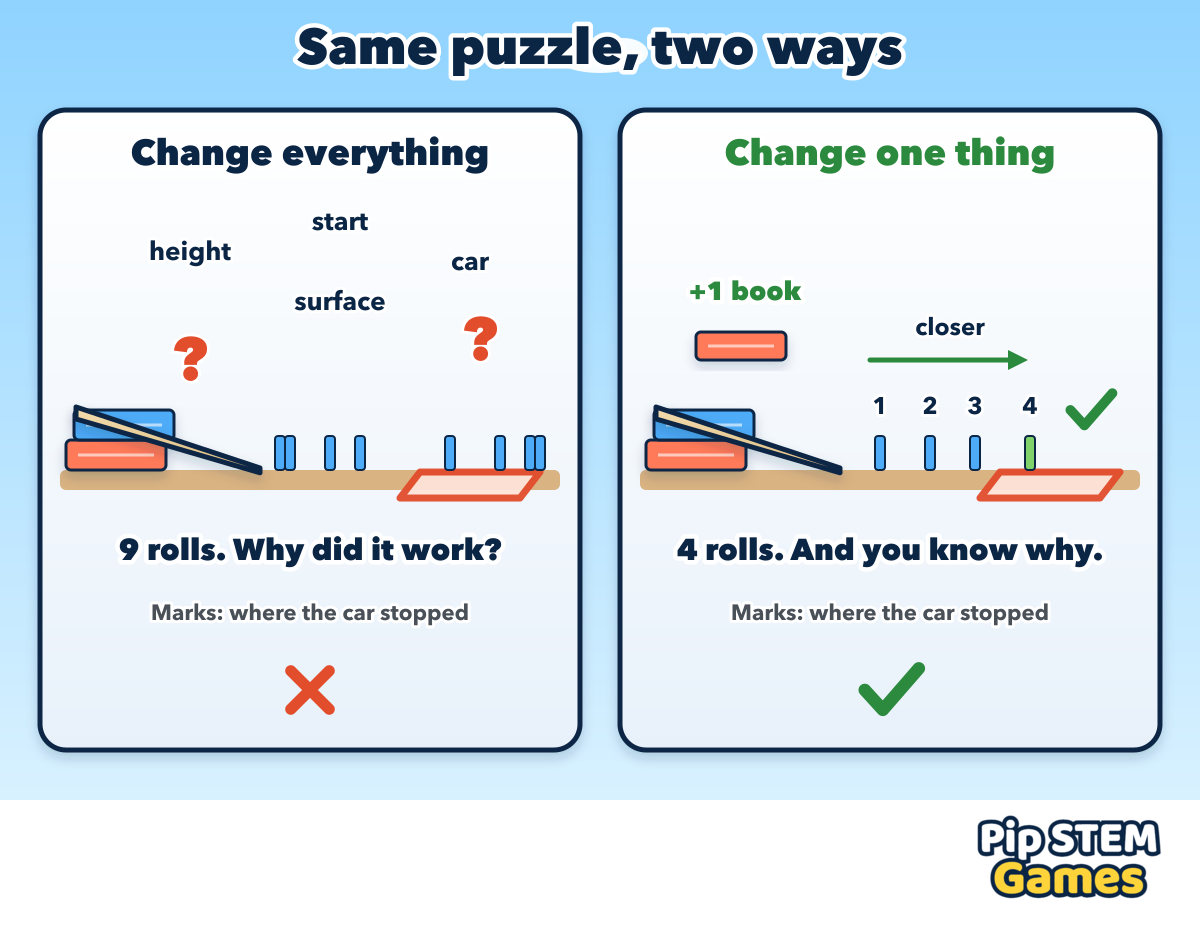
Most children change several things at once. When the car finally lands, it's usually hard to say why, because too much changed. That moment of "I don't know" is the hook for the next round.
How do you try the deliberate method?
Reset the puzzle and work in four steps. Count the rolls again.
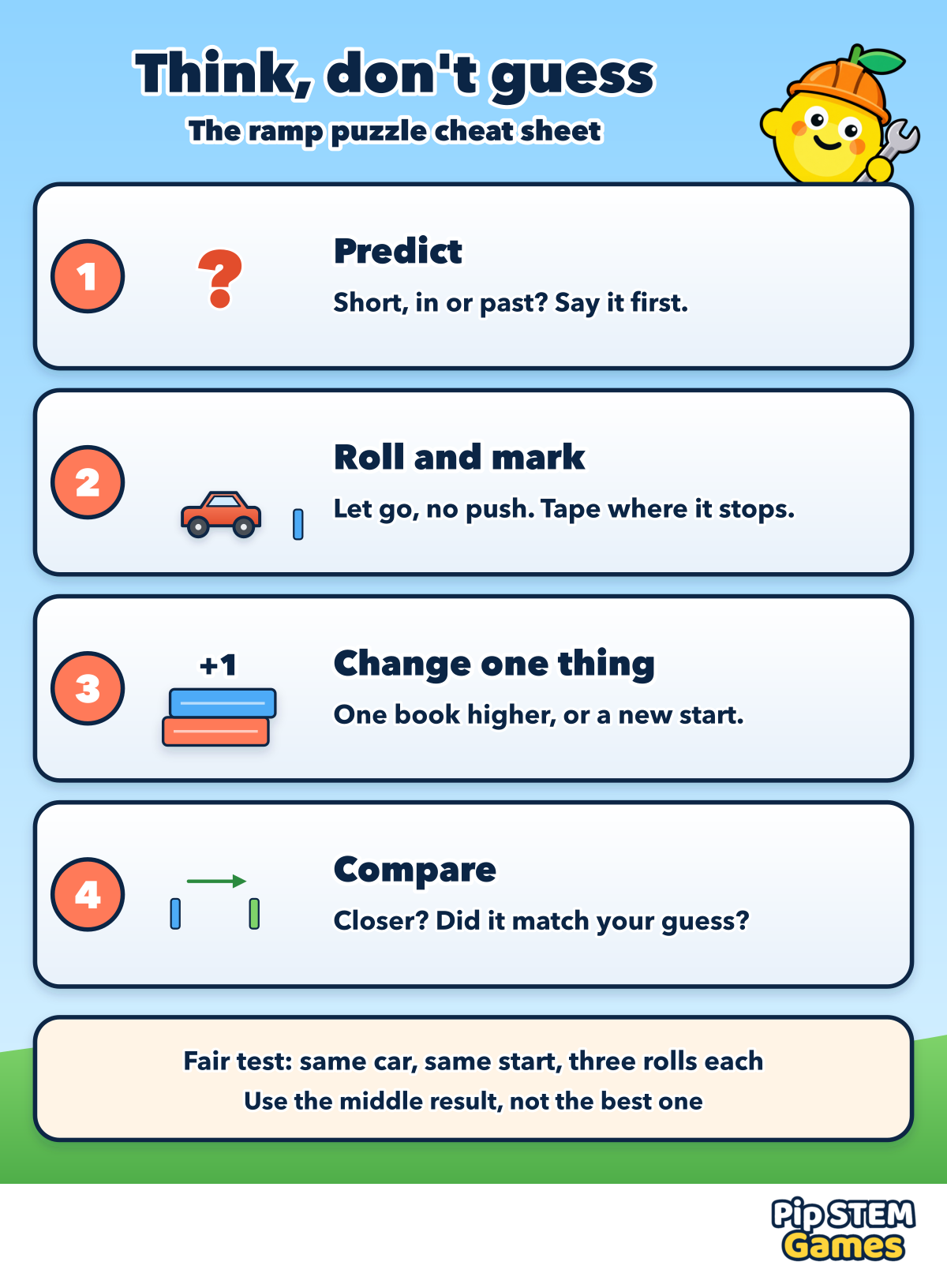
- Predict. Before each roll, say or write where the car will stop: short, in or past the target.
- Roll and mark. Let go of the car with no push. Mark where it stops with a small piece of tape.
- Change one thing. If it stopped short, add one book, or start a little higher up the ramp. Change only that.
- Compare. Look at the new mark next to the old one. Did it match your guess? Then pick the next single change.
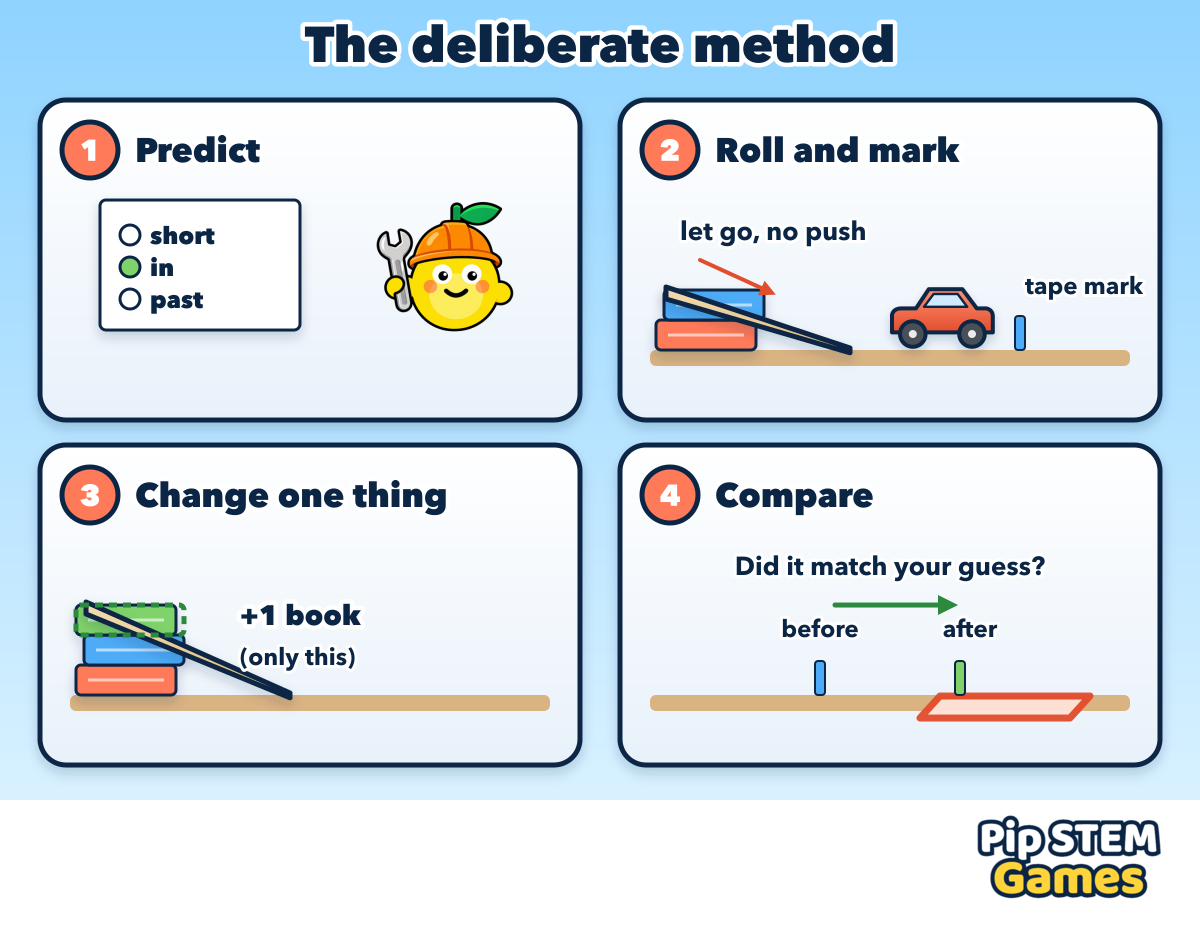
Because only one thing changes, your child can see the link between cause and effect. After a few rolls most children can predict well before they let go. Frankly, that's the real win, not the landing. If you want ready-made prompts for the compare step, try our 7 questions to ask instead of giving the answer.
How do you make it a fair test?
A fair test changes one thing and keeps everything else the same.
- Use the same car, the same start line and the same ramp surface.
- Let go the same way every time, with no push.
- Roll each setting three times and use the middle result.
- Write down what you see, not what you hoped for.
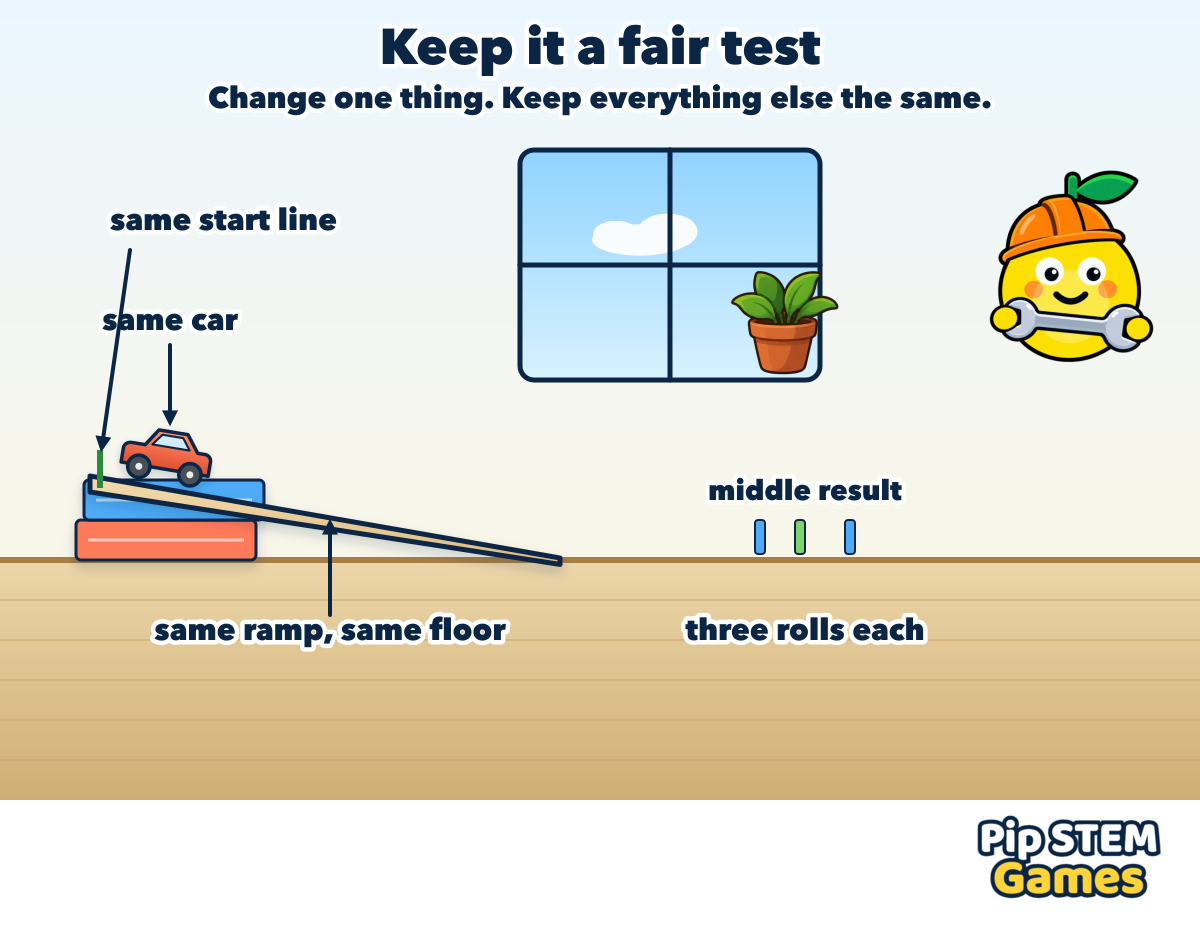
Small differences in how you let go are normal, which is why three rolls beat one. We won't promise a distance in advance. Your results depend on your ramp, floor and car, so record what you actually measure.
What if it does not work?
Most problems come from a wobbly ramp or an uneven release.
- The car veers off the side: lay a strip of tape or a ruler along each edge of the ramp as a rail.
- The car stops dead at the bottom: move the target further away, or try a smoother floor or a smoother car.
- Results change every roll: check the ramp doesn't wobble and that you let go without a push.
- It's all too easy: move the target further away or make it smaller.
Getting it wrong is part of the puzzle, and our post on why getting it wrong is part of engineering explains why we cheer misses.
How do you adapt it for different ages?
Keep the same ramp and change how much thinking you ask for.
- Ages 5 to 6: one change only, higher or lower, and talk about the guess in simple words.
- Ages 7 to 9: add the prediction table and measure with paper strips.
- Ages 10 to 12: ask them to write a rule, such as "each extra book moved the stopping point further", then test where the rule breaks.
For more levels from the same kit, see our engineering games for ages 6–8, 9–10 and 11–12.
What should you test next?
Try a different single change. Compare a bare ramp with one covered in a tea towel. Compare a light car with a heavier one of a similar shape. Or set a limit of five rolls and see if your child can hit the target by predicting carefully.
If they like the challenge, try the same idea in the Ramp Runner game, where slope and speed decide whether you make the jump. For more puzzles that reward a plan, browse 5 types of engineering games that teach problem solving.
The ramp is a simple model, not a real machine, but the habit transfers to building, coding and everyday problem solving.
Questions parents ask
What makes a good engineering puzzle for kids?
It has a clear goal, gives honest feedback after every try and rewards a plan. A ramp and target zone works well because each roll shows how close the last change got you.
Is trial and error bad?
No. Trial and error is useful, but random changes make it hard to learn. Changing one thing at a time turns trial and error into a test you can learn from.
Why change only one thing at a time?
If you change two things and the result improves, you can't tell which change helped. One change per roll makes the cause easy to see.
Why roll three times?
Small differences in how you let go change the result a little each time. Three rolls and the middle result give a fairer picture than a single roll.
What age is the ramp puzzle for?
Ages 5 to 12. Younger children make one change and talk about it; older children fill in the prediction table and write a rule, then test where it breaks.
Can we use a marble instead of a car?
Yes, but marbles are small parts, so keep them away from anyone who still mouths things. A toy car or a short cardboard tube is easier to spot and pick up.
Great STEM activities to try next...
 The Engineering Design Process for Kids: 6 Steps Families Can Use [Printable]How it works
 Why Getting It Wrong Is Part of EngineeringParent guide
 Engineering Games for Ages 6–8, 9–10 and 11–12 [Printable]By age
More to try: The £5 Engineering Activity Supplies List for Kids · 7 Engineering Projects Using Recycled Materials · Can You Solve This Engineering Game Puzzle?

Pip STEM Games
We make engineering games and workbooks for kids aged 5 to 12. Every activity here is one we'd happily run at the kitchen table: test it, watch it fail, fix it, try again.




