


Key takeaways
- Ages 6–8 trace one cause and effect: predict, roll, say what happened.
- Ages 9–10 compare two ramps in a fair test, three rolls each.
- Ages 11–12 plan to a budget of 4 card strips and hit a cup 60 cm away.
- Change only one thing at a time and use the middle of three results.
- Marbles are small parts, so an adult stays close with under 5s.
The best engineering games for kids by age use the same simple kit but ask for a bit more thinking each time: trace at 6 to 8, compare at 9 to 10, and plan to a limit at 11 to 12. Below is one marble ramp game shown at all three levels, with steps, fixes, a cheat sheet and a printable record sheet.
What makes a good engineering game at each age?
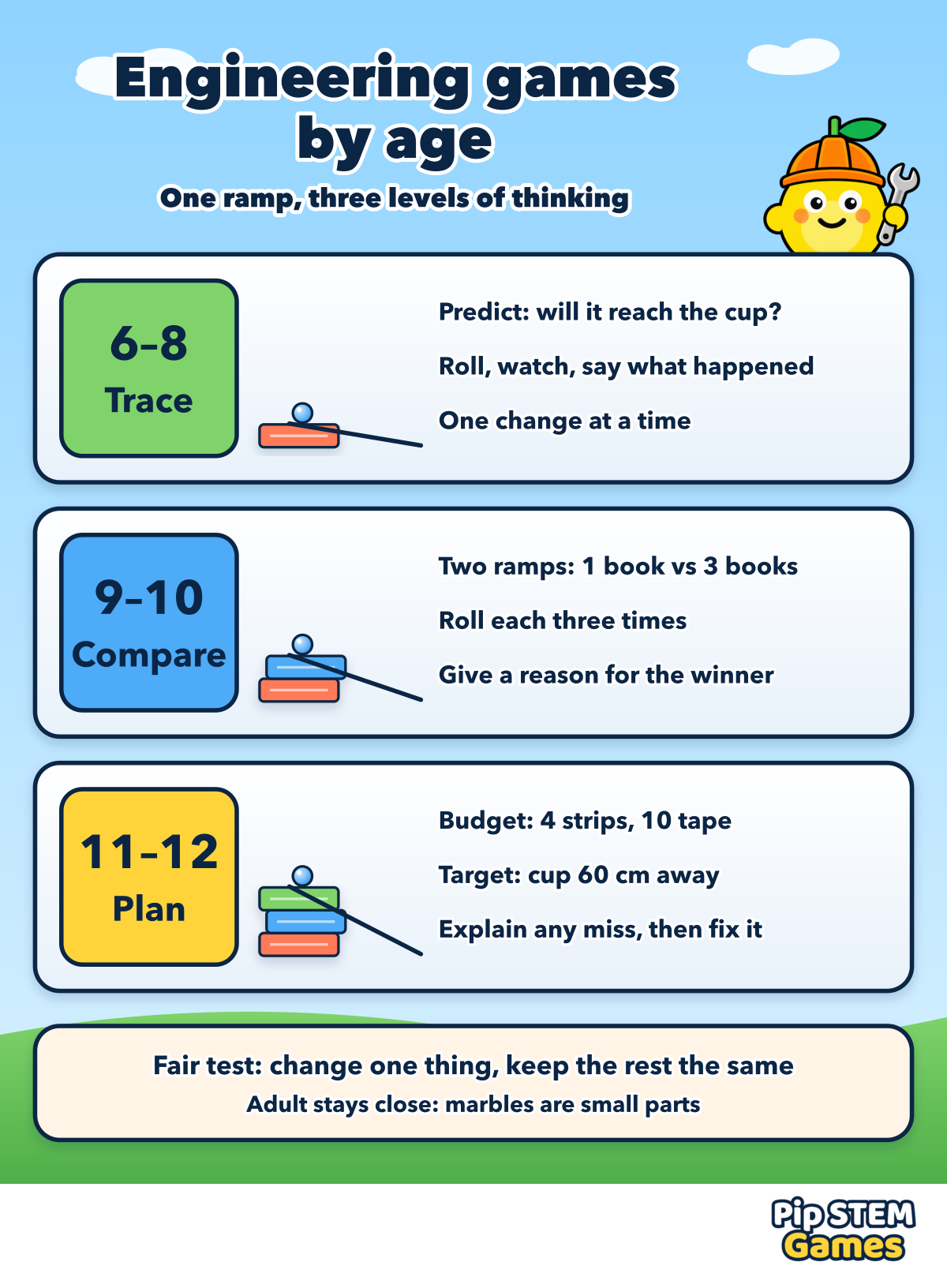
A good engineering game asks for one small step more thinking than last time. At 6 to 8 that's tracing one cause and effect. At 9 to 10 it's comparing two choices fairly. At 11 to 12 it's planning to a limit, then testing the plan.
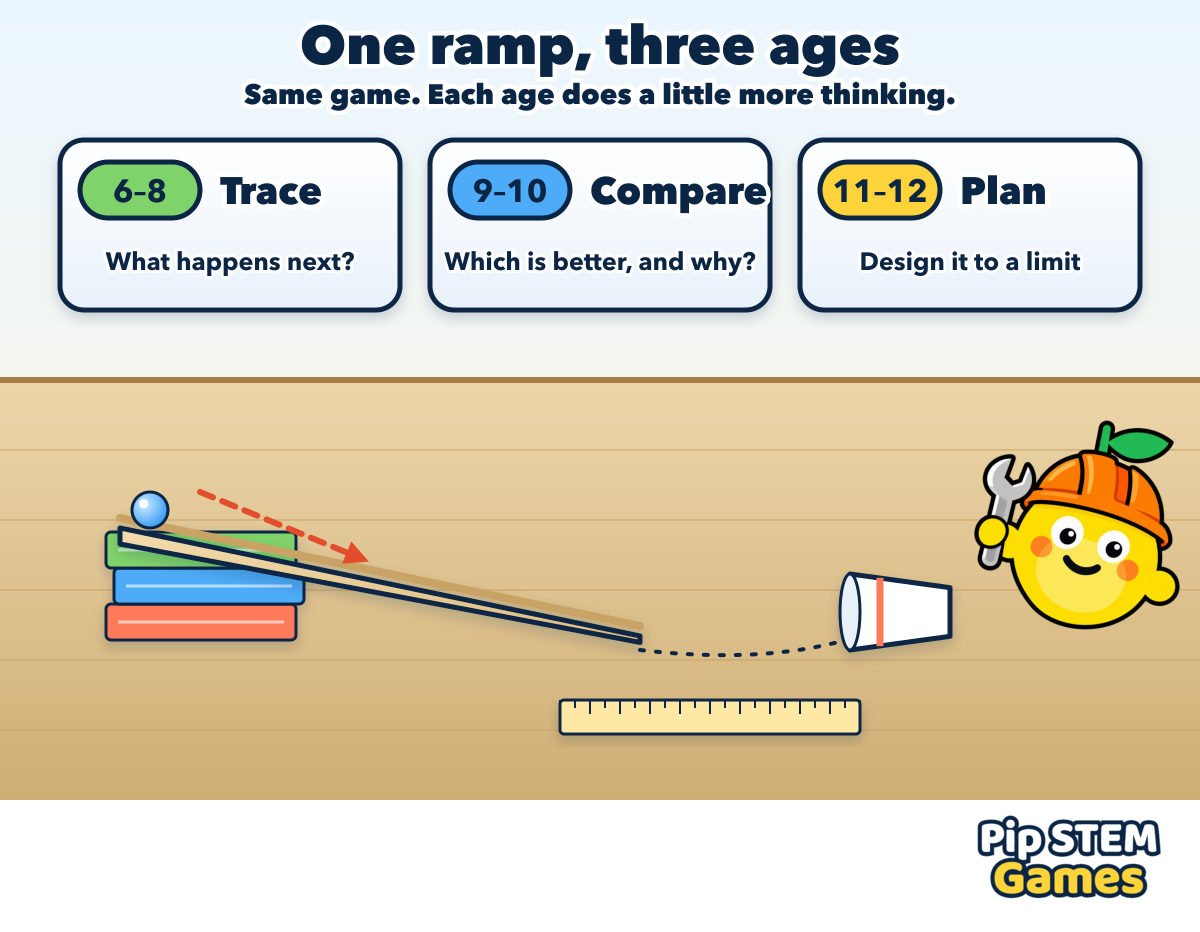
Those three verbs are a handy teaching shortcut, not a strict developmental chart. Plenty of 7-year-olds love a budget, and plenty of 12-year-olds need to go back to tracing when something new confuses them. Watch what your child does when it goes wrong. If they can say why, move up a level. If they shrug, step down.
We like a marble ramp for this because it costs nothing, it fails loudly, and you can see every result. The same idea runs through our STEM activities by age guide, if you want more builds sorted the same way.
What do you need for the ramp game?
You need a strip of stiff card, a few books, a marble and a paper cup. Everything else is optional.
- A cardboard tube, or a strip of stiff card about 60 cm long (cereal box card works)
- A marble or small ball
- 3 or 4 books of the same thickness
- A paper cup to use as a target
- A ruler or tape measure
- Masking tape
- Pencil and paper
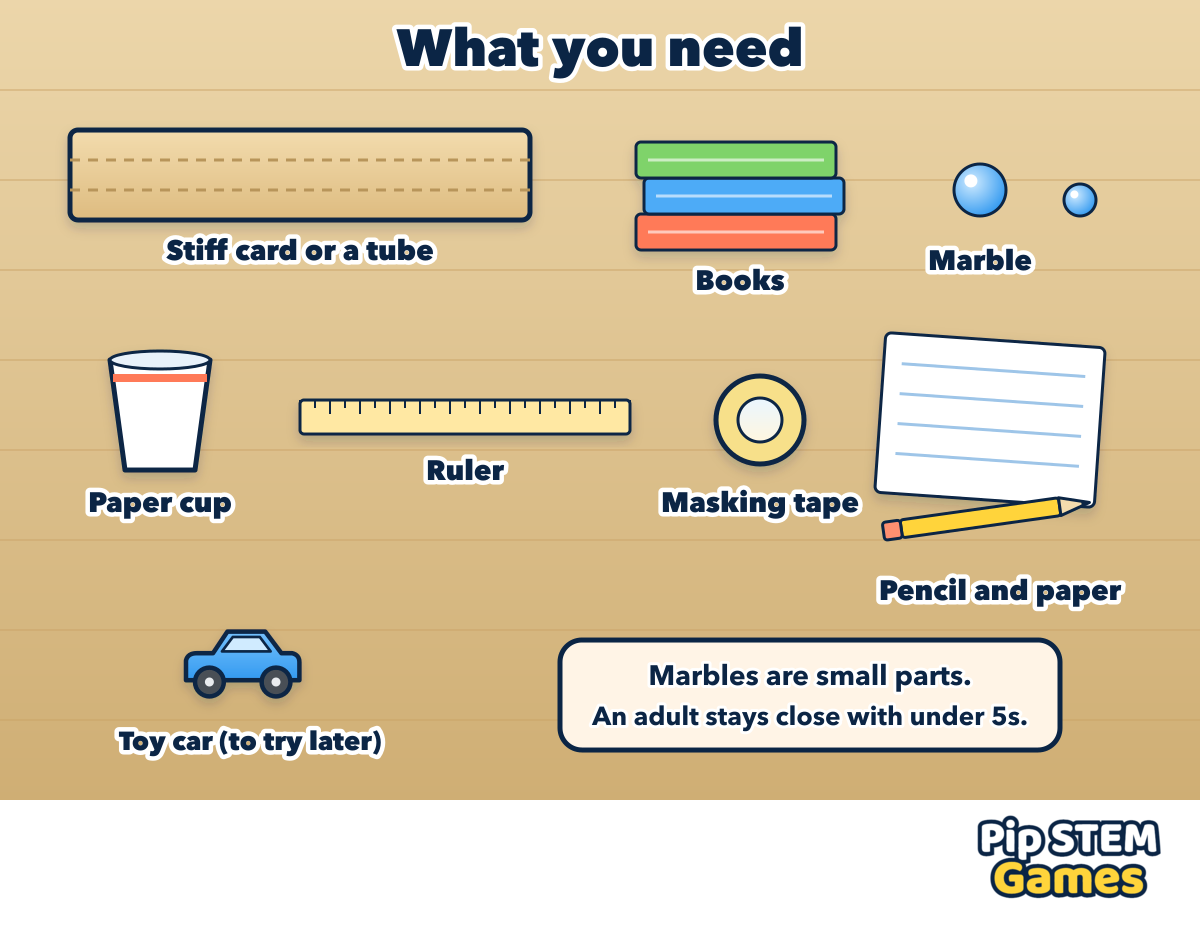
Safety: marbles are small parts and a choking risk, so an adult stays close with under 5s and anyone who still mouths things. Roll on a clear floor away from stairs, pick marbles up afterwards so nobody slips, and keep book stacks low and steady.
How do you play it with 6 to 8 year olds?
At 6 to 8, play predict, roll, say what happened. One change per round.
- Prop one end of the ramp on one book. Lay the cup on its side at the bottom, open end facing the ramp.
- Ask: will the marble reach the cup?
- Let go of the marble. Don't push it. Watch together.
- Add a second book. Ask what will change.
- Roll again and ask your child to say what they saw in their own words.
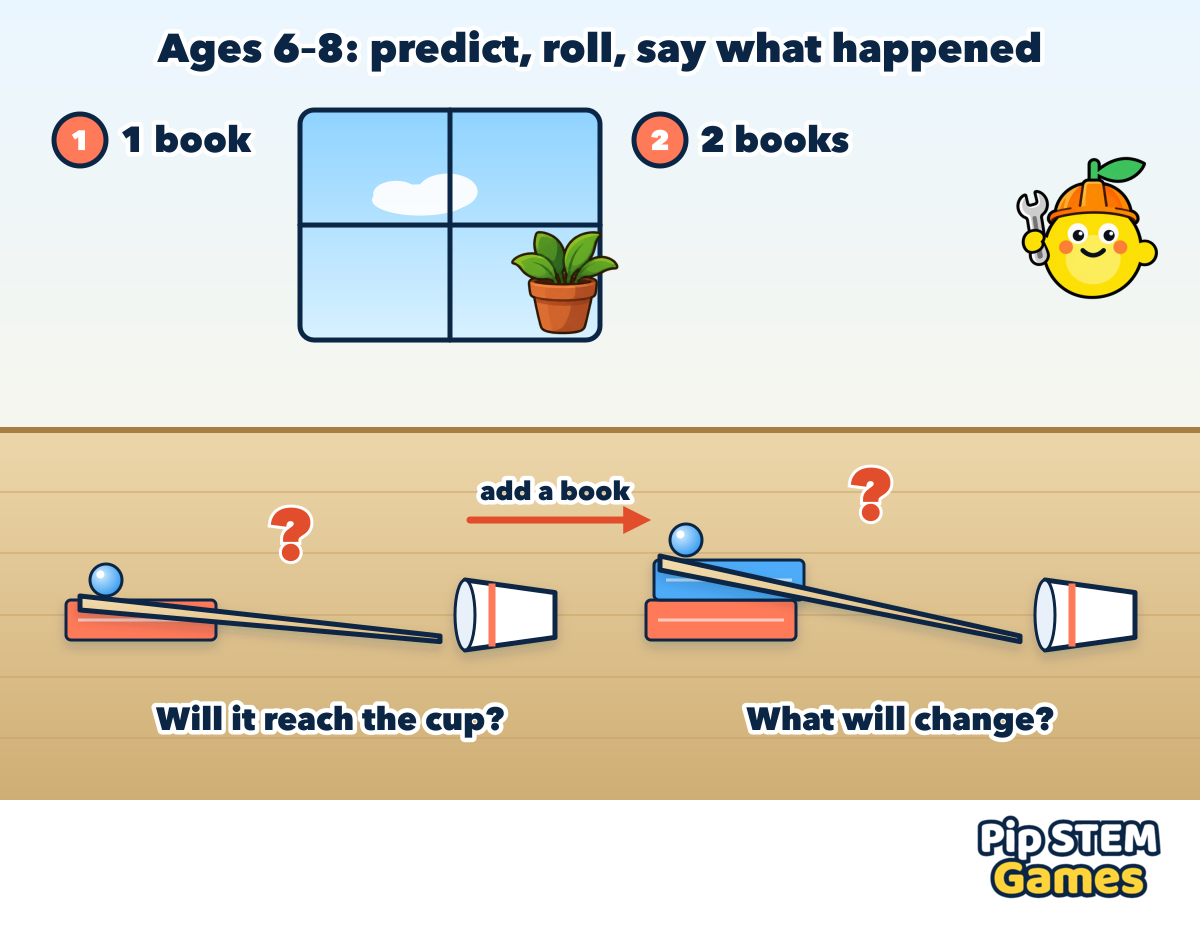
Frankly, the words matter more than the result here. "It went faster and hit the cup" is a full engineering sentence for a 6-year-old. Resist the urge to explain gravity. Ask "what did you notice?" and wait. If you want ideas for those questions, see 7 questions to ask instead of giving the answer.
How do you play it with 9 to 10 year olds?
At 9 to 10, turn it into a fair test: two ramps, one difference, three rolls each.
- Build two ramps of the same length: one on one book, one on three books.
- Stick a tape start line where each ramp meets the floor.
- Ask your child to predict which ramp sends the marble further.
- Roll the marble three times on each ramp. Mark where it stops each time with a small piece of tape.
- Measure from the start line to each mark and write the numbers down.
- Pick the middle result for each ramp and give a reason for the winner.
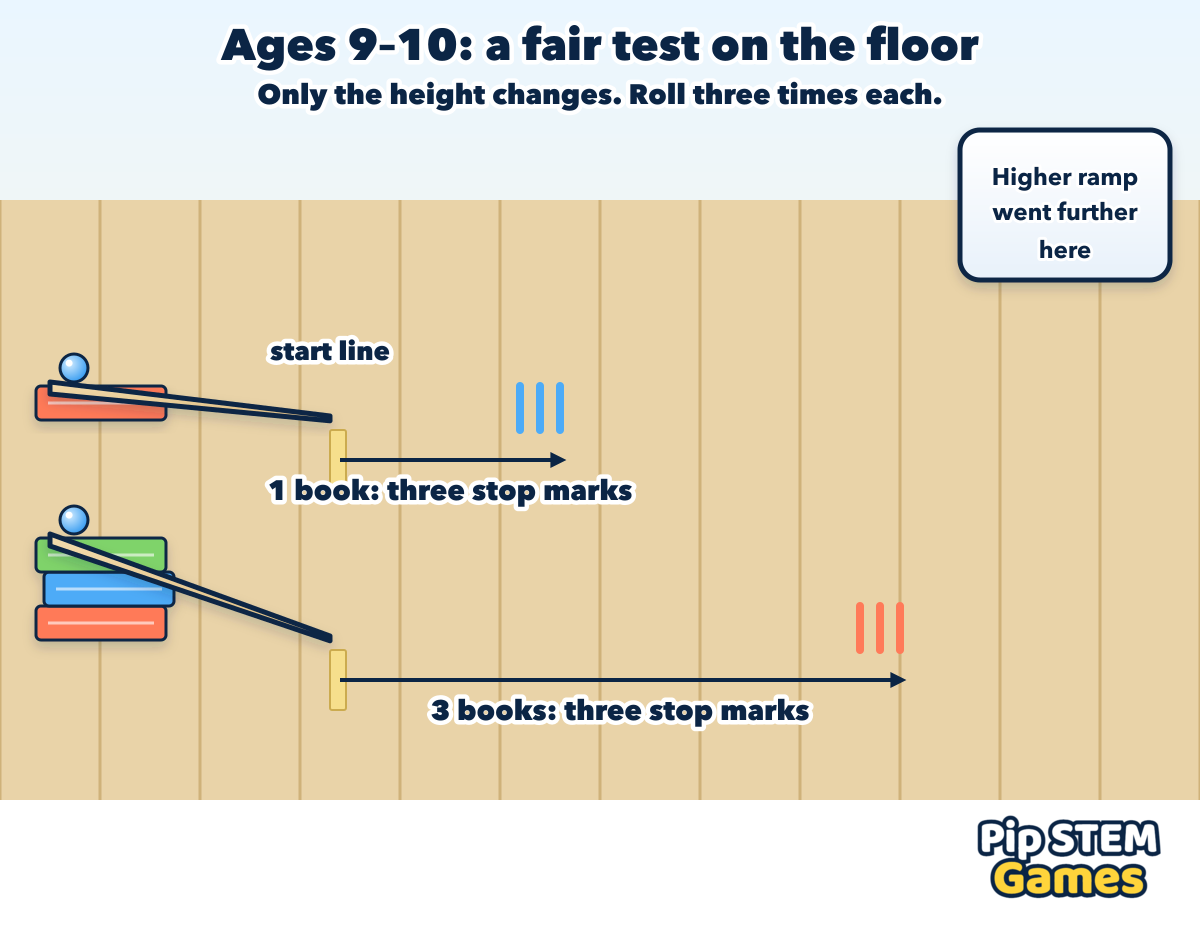
On most floors the higher ramp sends the marble further, because the marble starts higher and reaches the bottom faster. Your numbers will depend on your floor, card and marble, so trust what you measure. The useful lesson is spotting that the three rolls on one ramp are never quite the same. That's normal, and it's why we repeat.
How do you play it with 11 to 12 year olds?
At 11 to 12, give a budget and a target, then let them plan before they build.
- Set the budget: 4 card strips and 10 pieces of tape. Nothing else.
- Set the target: the marble must end up inside a paper cup lying on its side, 60 cm from the end of the ramp.
- Ask for a quick sketch and a prediction: how many books high?
- Build it and test it. Change one thing at a time.
- If the first try misses, write one sentence on why.
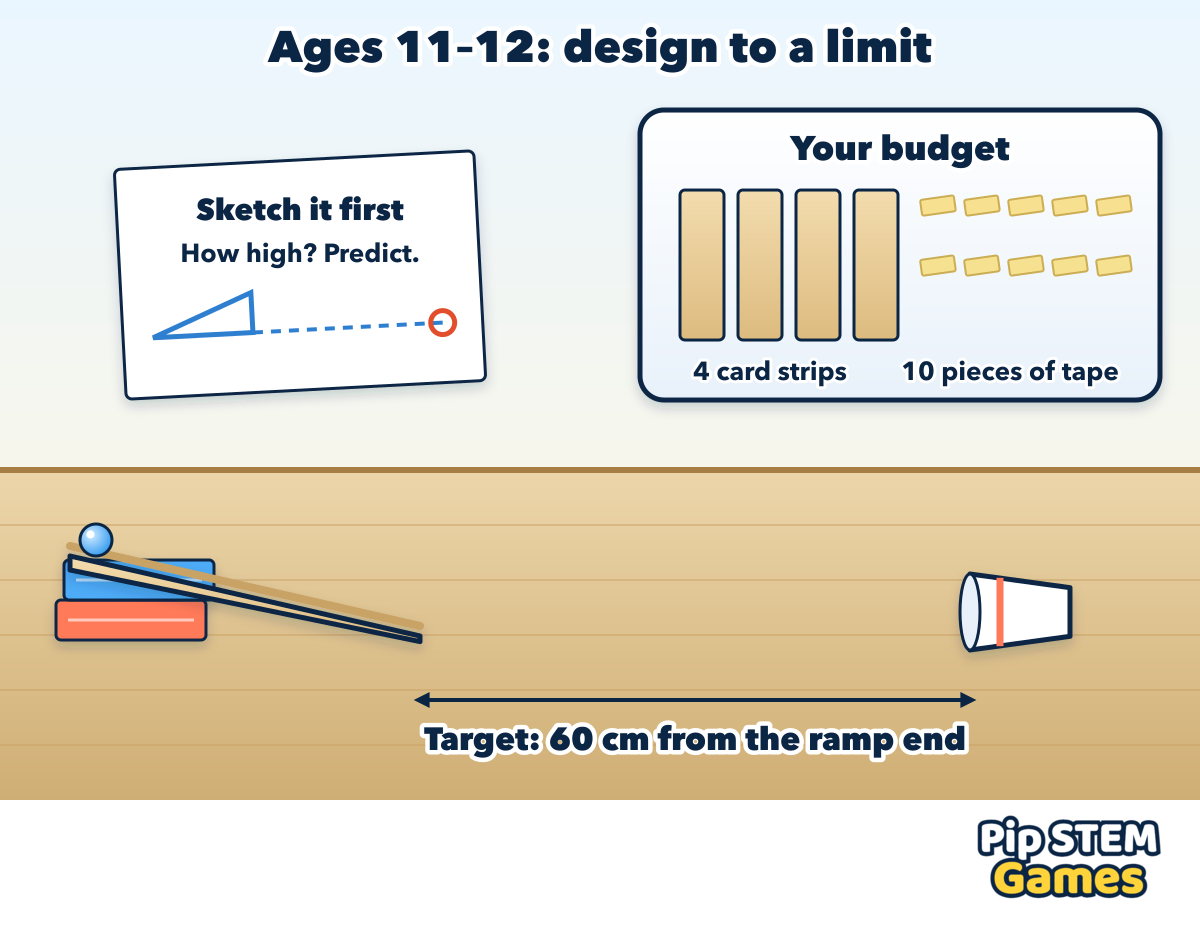
What most people get wrong here is helping too soon. A miss is the best bit, because now there's a reason to think. Short? Raise it one book. Past the cup? Lower it, or move the release point down the ramp. That loop of plan, test and fix is the engineering design process in miniature, and it's the habit our Senior Engineers workbook builds for ages 8 to 12.
How do you make it a fair test?
Change one thing and keep everything else the same. If you change the height, keep the marble, ramp length, floor and release point identical.
- Let go from the same spot every time, with no push.
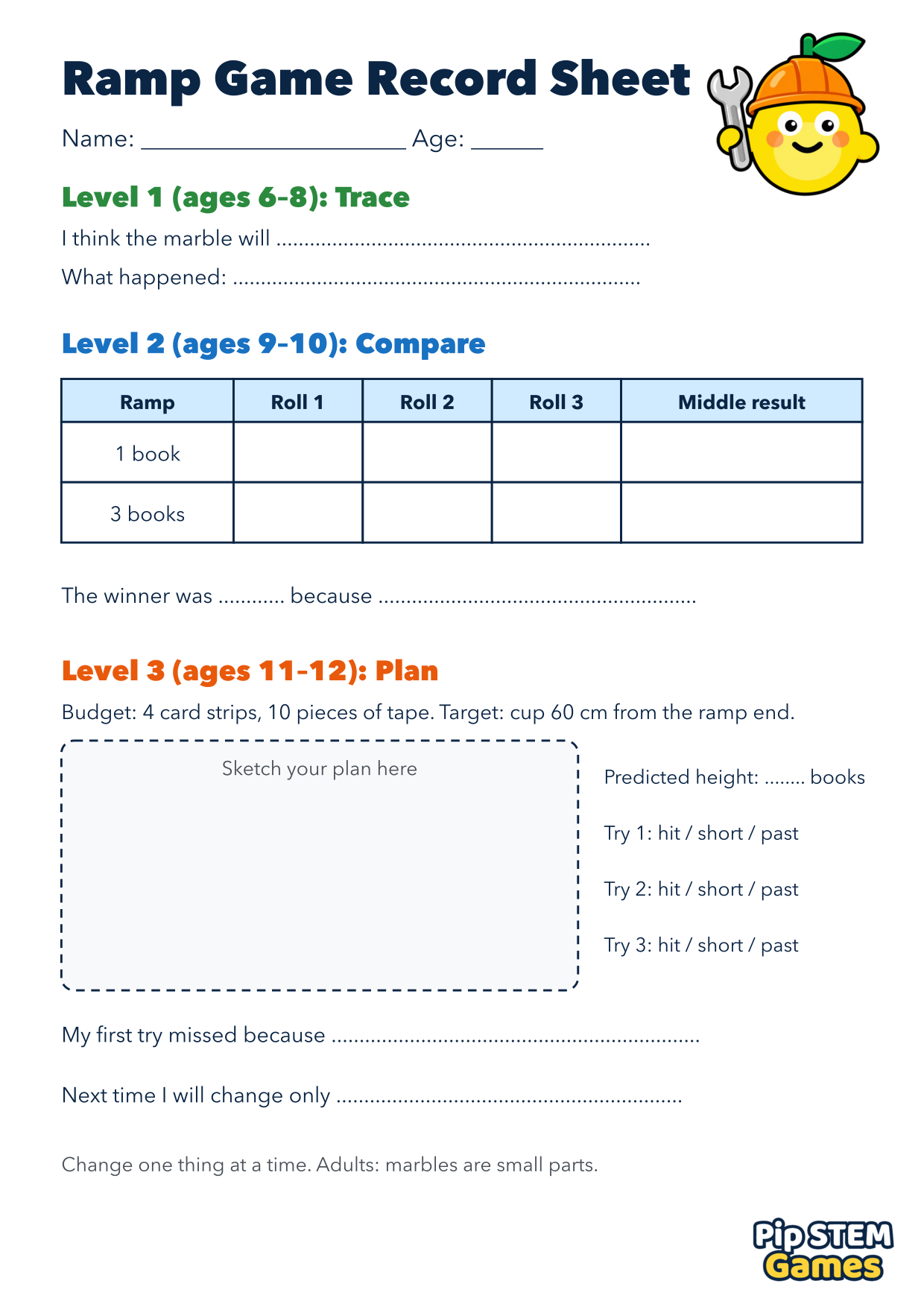
- Roll at least three times per setting.
- Use the middle result, not the best one.
- Write down what you saw, not what you expected.
Swapping two things at once is the most common slip. If you raise the ramp and swap to a heavier ball, you can't say which change did it.
What if the ramp game doesn't work?
Most problems come from a wobbly ramp or an uneven release. Here are the four we see most.
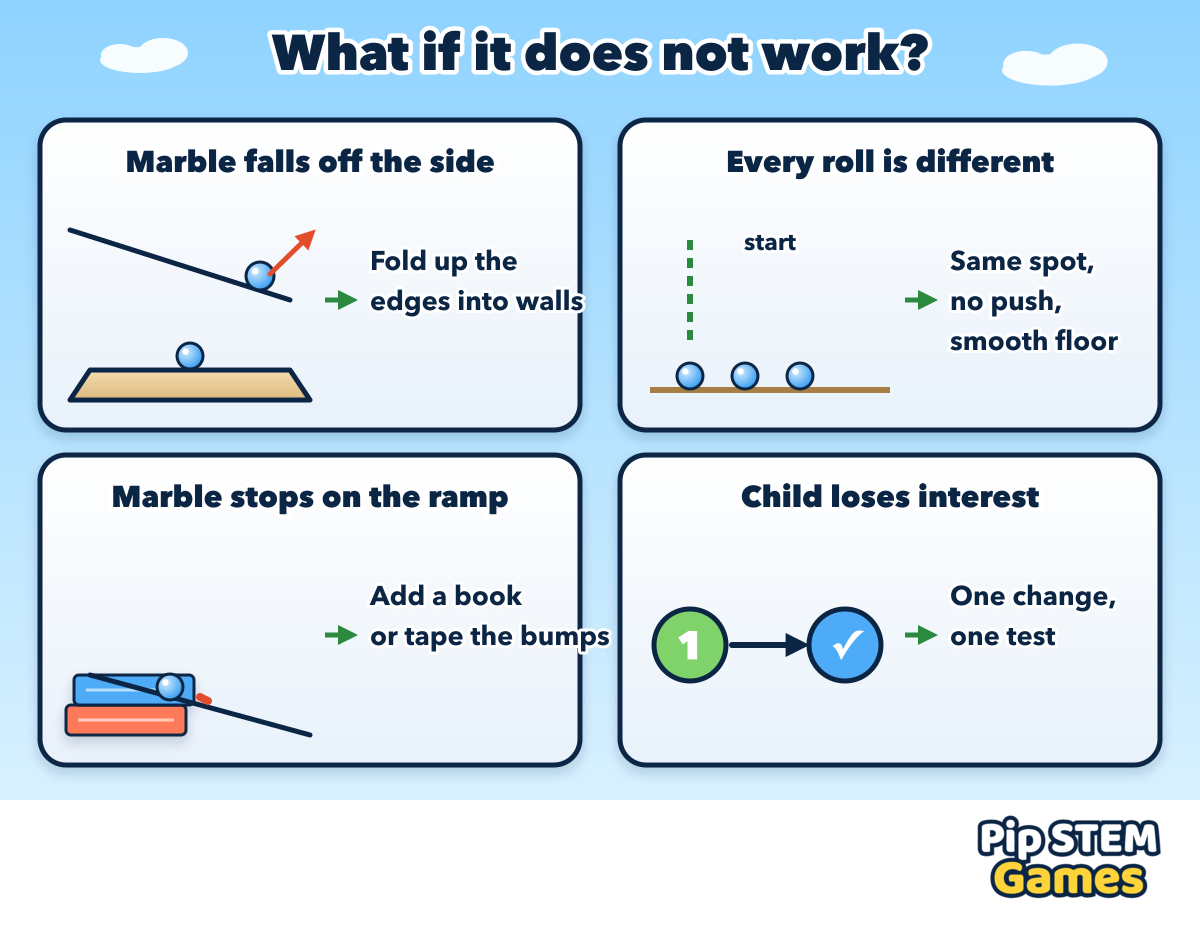
- The marble falls off the side: fold up both long edges of the card to make walls.
- Every roll is different: release from the same mark with no push, and use a smooth, hard floor.
- The marble stops on the ramp: add one more book, or smooth out bumps with tape.
- Your child loses interest: shrink the task to one change and one test.
How can siblings of different ages play together?
Give each child a job that fits their level and use one ramp. The youngest predicts and calls out the result. The middle child runs the fair test and records the numbers. The oldest sets the budget and target for the next round.
When you're ready for more, swap the marble for a toy car and ask whether the height rule still holds. Then try a tea towel over the ramp and compare. If they enjoy the race, try it in the Ramp Runner game, which uses the same slope and speed idea. For a bigger build, our cardboard marble run takes the ramp further.
This ramp is a simple model for learning how height, slope and surface change motion. It isn't a real machine, and your results will depend on your materials.
Questions parents ask
What is a good engineering game for a 6-year-old?
A marble or toy car on a card ramp is ideal. Ask them to predict whether it will reach a cup, roll it, then add one book and ask what changed. Keep it to one change per round.
What engineering games suit 9 and 10 year olds?
Games with a fair comparison work well at this age. Two ramps at different heights, three rolls each and a measured result give them a real reason to explain a winner.
How do I make engineering harder for an 11 or 12 year old?
Add a limit and a target. A budget of four card strips and ten pieces of tape, plus a cup 60 cm away, forces them to plan, predict and explain any miss.
Does a higher ramp always make the marble go further?
Usually, on a smooth floor, because the marble reaches the bottom faster. Bumps, carpet and a wobbly ramp can change the result, so measure rather than assume.
Are marbles safe for young children?
Marbles are small parts and a choking hazard, so an adult should stay close with under 5s and anyone who mouths objects. A ping-pong ball or a toy car works as a larger swap.
Can siblings of different ages play the same game?
Yes. The youngest predicts and calls out results, the middle child runs the fair test and the oldest sets the budget and target. Everyone shares one ramp.
Great STEM activities to try next...
 STEM Activities by Age: 5–7, 8–10 and 11–12Parent guide
 Why the Best Engineering Puzzles Make You ThinkActivity
 Which STEM Activities Suit Your Child's Age?Parent guide
More to try: 5 Engineering Games That Teach Problem-Solving

Pip STEM Games
We make engineering games and workbooks for kids aged 5 to 12. Every activity here is one we'd happily run at the kitchen table: test it, watch it fail, fix it, try again.




