


Key takeaways
- Ages 5 to 6 suit building and sorting, 7 to 8 suit simple mechanics and first circuits, and 9 to 12 suit fair tests and logic.
- Pick an activity your child can start at once but still has something to figure out.
- If it is too easy, add a limit. If it is too hard, sit beside them or simplify.
- An adult supervises all circuit work, with 2 AA batteries only and never mains.
- In a mixed-age group, give everyone the same challenge with different roles.
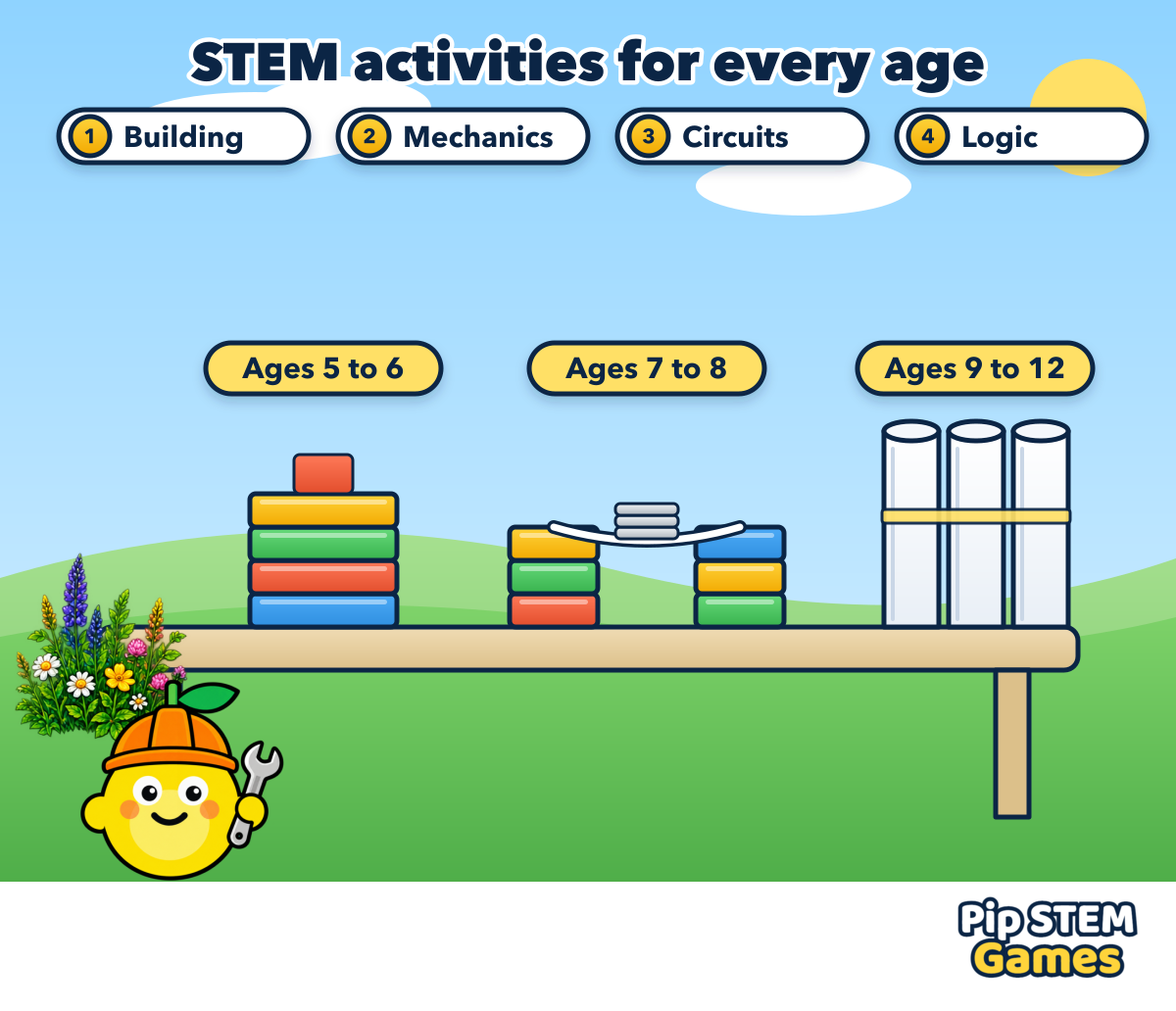
STEM activities that suit your child's age are a rough guide, not a rule. Ages 5 to 6 suit building and sorting, ages 7 to 8 suit simple mechanics and first circuits, and ages 9 to 12 suit fair tests, gears and logic puzzles. Children vary a lot, so treat these bands as a starting point and watch how your child responds.
How do I choose an activity for my child's age?
Choose an activity where your child can start straight away but still has something to figure out. If they finish in two minutes, make it harder. If they give up in two minutes, make it simpler or sit beside them. The right level usually needs a few tries and a small change of idea.
Four areas cover most home STEM play: building, mechanics, circuits and logical reasoning. Each one can be scaled up or down with the same household materials. The grid at the end of this page shows all twelve activities at a glance.
What building activities suit each age?
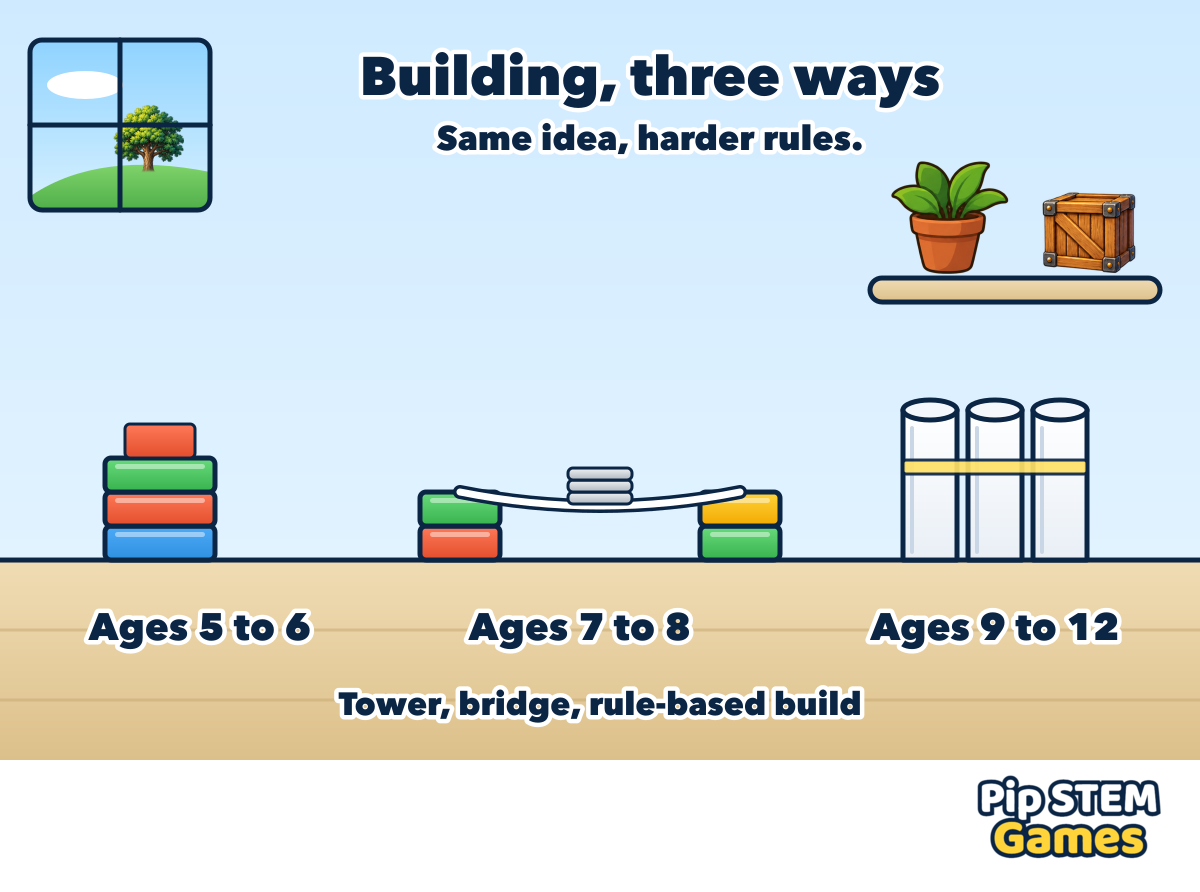
Ages 5 to 6: stack cardboard tubes, cups and boxes into a tower. Ask, "How can we make it taller without it falling?"
Ages 7 to 8: build a bridge from paper or card between two piles of books. Test how many UK 10p coins it holds.
Ages 9 to 12: set a rule such as "use only 10 sheets of newspaper and 1 metre of tape" and test a few designs fairly.
What mechanics activities suit each age?
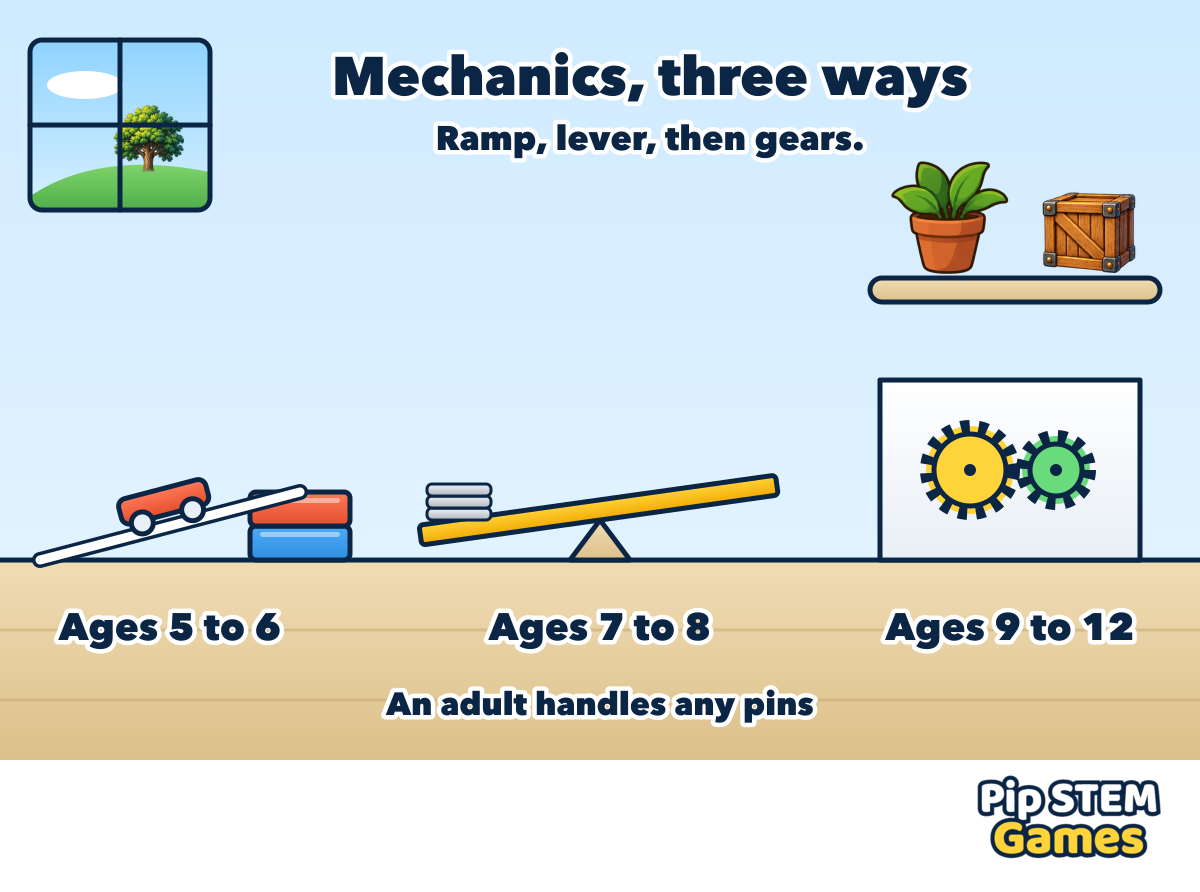
Ages 5 to 6: roll balls and toy cars down a card ramp and compare which goes furthest.
Ages 7 to 8: make a lever with a ruler over a pencil. Find where to put the pivot to lift a small object.
Ages 9 to 12: build a pulley or a gear train from card and lolly sticks, with an adult handling any pins. Count turns to see how the ratio changes speed.
What circuit activities suit each age?
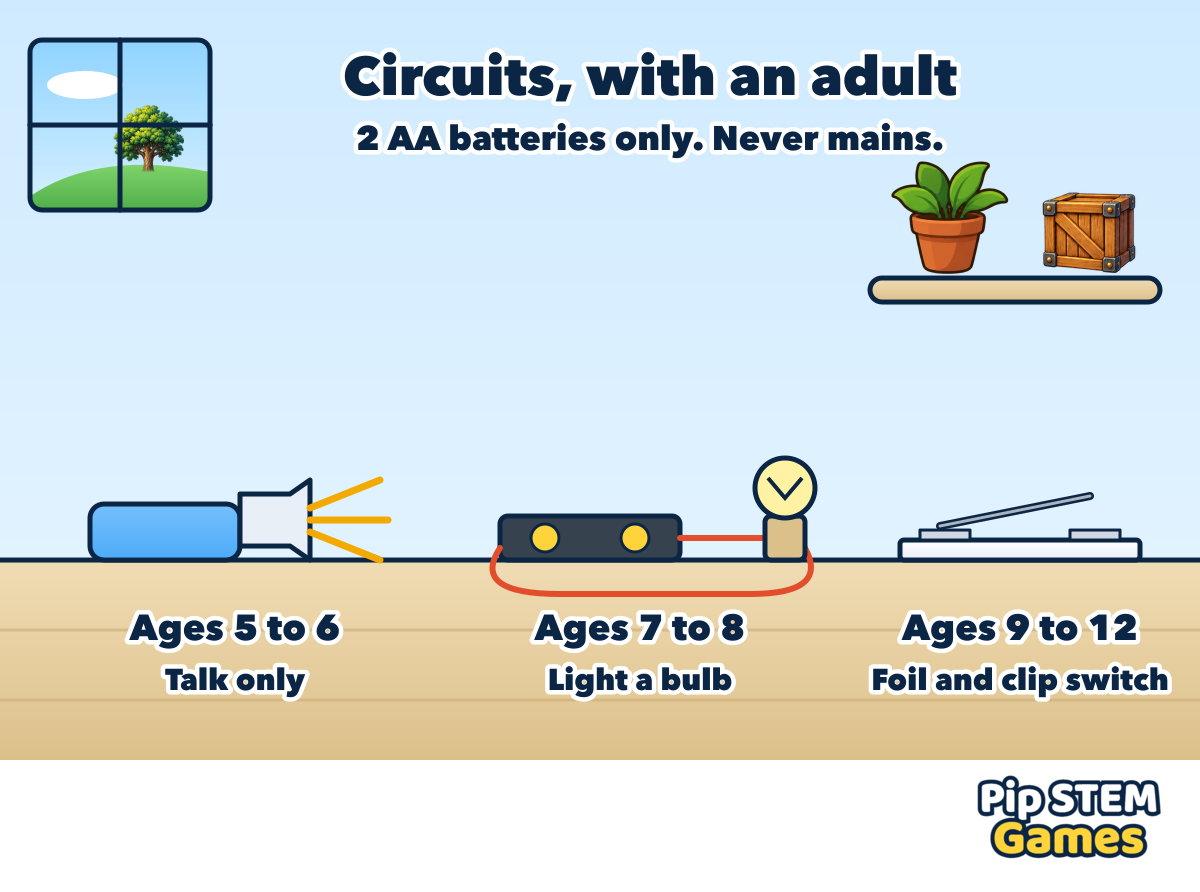
Ages 5 to 6: do not build circuits alone. Instead, talk about which toys need batteries and why a switch stops them.
Ages 7 to 8: with an adult, light a small bulb using 2 AA batteries in a battery holder that matches the bulb holder. Never use mains electricity.
Ages 9 to 12: add a switch made from foil and a paper clip. Test which household items let the bulb light and which do not.
An adult must supervise all circuit work, and batteries must be removed when finished. For the ideas behind it, see circuits for kids.
What logical reasoning activities suit each age?
Ages 5 to 6: sort buttons or pasta by colour, shape or size, then change the rule. Adults should watch closely, as buttons are small.
Ages 7 to 8: make a simple pattern with paper cups and ask what comes next.
Ages 9 to 12: write step-by-step instructions to get a friend or parent across a taped grid, then debug the instructions when it goes wrong.
What do I need?
- Cardboard tubes, boxes and paper
- Masking tape and a ruler
- UK 10p coins for weight tests
- A small bulb, bulb holder and 2 AA batteries in a matching holder
- Foil and paper clips
- Buttons or pasta for sorting
Small parts such as buttons, pins, coins and batteries need adult supervision, especially with younger children, because they are a choking risk for children under 5.
How do I know if an activity is too easy or too hard?
Watch for two signs. If your child finishes without a pause and asks for more, move up one step. If they stop, look away or say "I can't", move down one step or work on it together. A small change is usually enough, such as fewer materials, a smaller gap or a shorter time limit. Your child's reaction is a better guide than their age.
What if my child gets stuck or bored?
If they are stuck, ask one question rather than giving the answer, such as "What part is wobbling?" If they are bored, add a limit like fewer materials or a time. If the bulb will not light, check the batteries face the right way and every connection is touching bare metal. For more question ideas, read 7 questions to ask instead of giving your child the answer.
How do I make it a fair test?
Change one thing at a time. If you test two bridges, use the same paper, the same gap and the same coins. Write down what you changed and what happened. Do not trust a single try, so repeat each test three times. You can also practise on a tower game on Pip first. Your results will be your own, so do not expect a particular number.
What should we try next?
Pick the area your child enjoyed most and move up one step. A child who liked towers can try bridges. A child who liked ramps can try levers. Move up only when the current level feels easy and fun. A longer list of ideas is in STEM activities for kids.
How do I adapt this for a mixed-age group?
Give everyone the same challenge with different roles. An older child can measure and record, while a younger child places and tests. Keep the same rule for all, then let the older child add an extra limit.
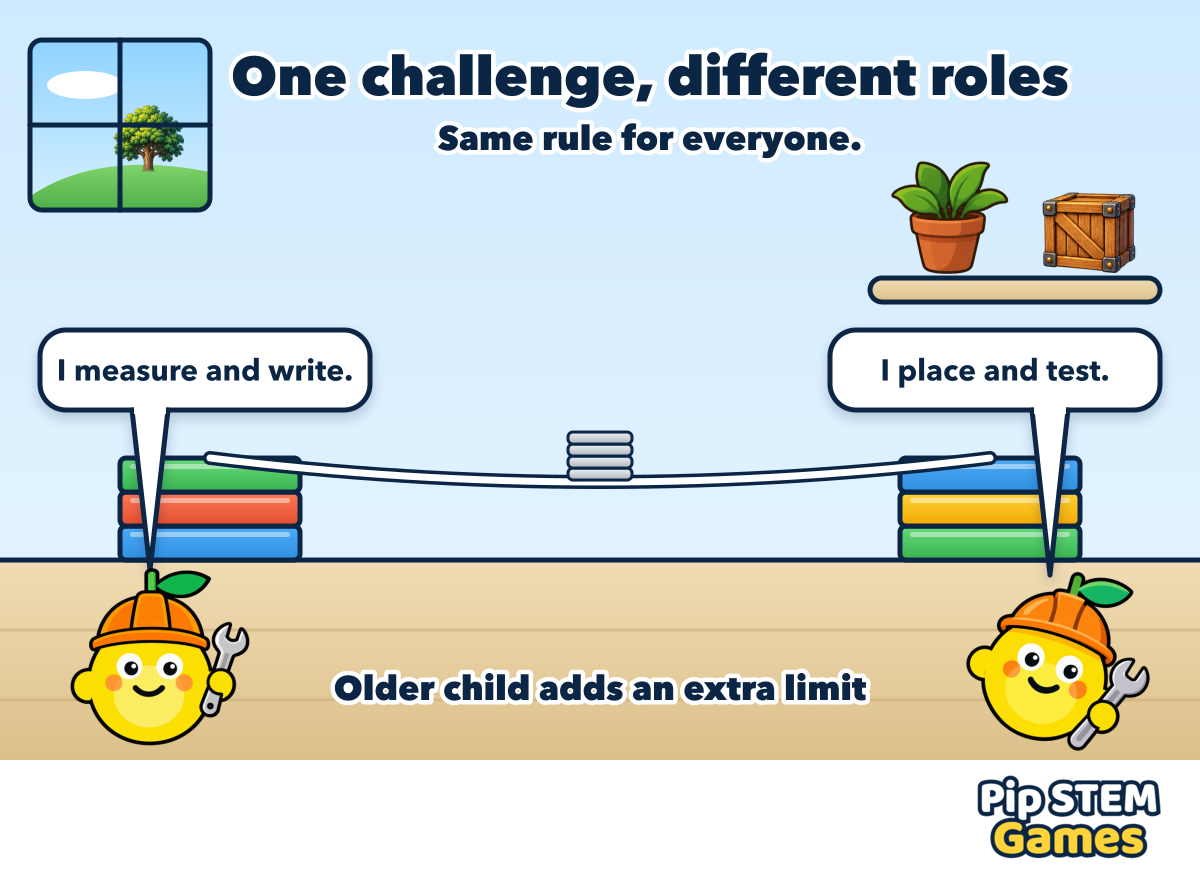
Here is the whole guide on one page. Save it or print it for the fridge.
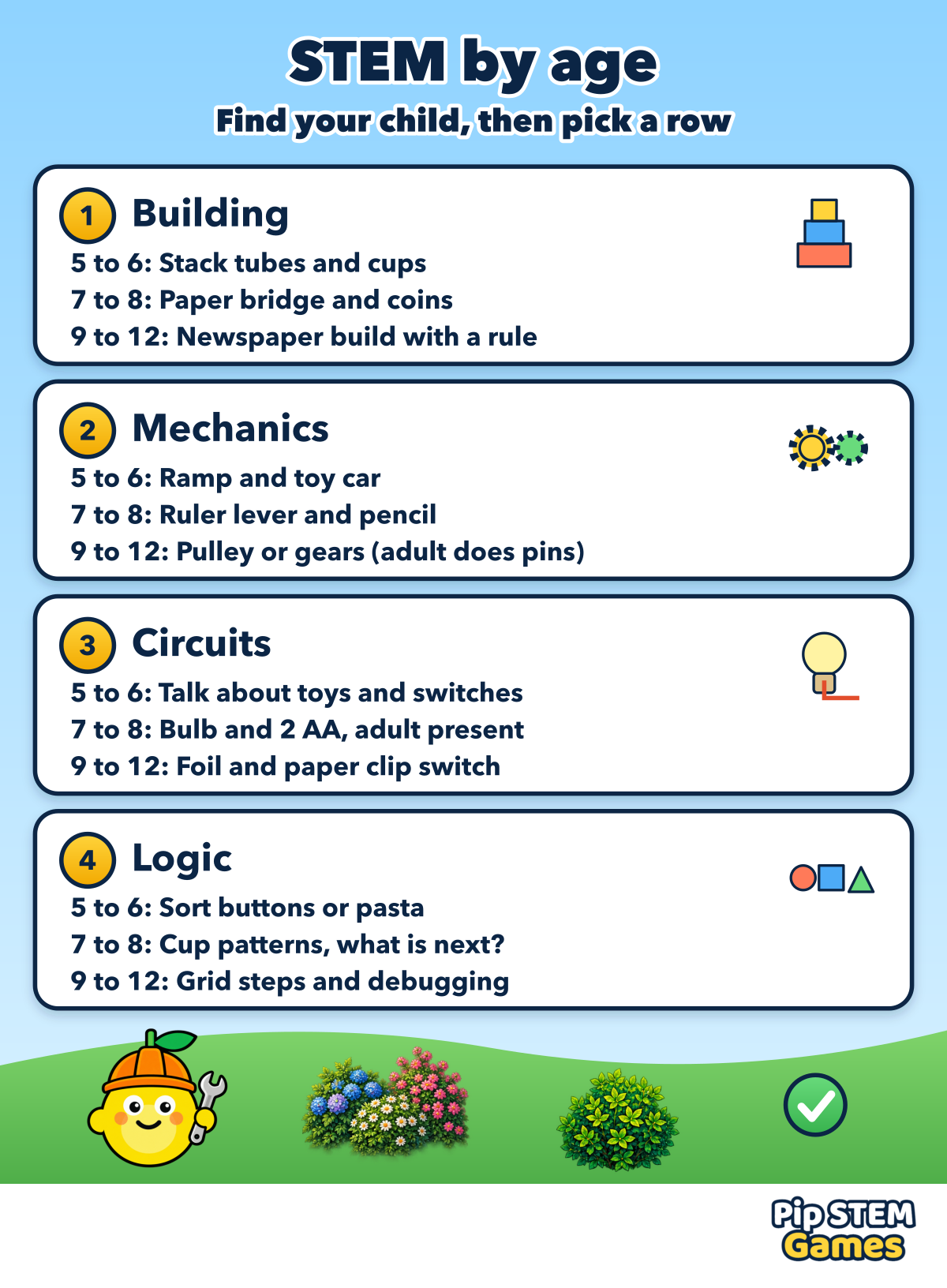
Questions parents ask
What STEM activities suit a 5 year old?
Stacking cardboard tubes and cups, rolling toy cars down a card ramp, sorting buttons or pasta by a rule, and talking about which toys use batteries. Keep an adult close with small parts.
What STEM activities suit a 7 or 8 year old?
A paper bridge between two piles of books, a ruler lever over a pencil, a bulb lit with 2 AA batteries and an adult beside them, and cup patterns that ask what comes next.
What STEM activities suit a child aged 9 to 12?
Rule-based builds, pulleys or gears with an adult handling any pins, a foil and paper clip switch, and step-by-step instructions across a taped grid with debugging.
How do I know if an activity is the right level?
Your child should start straight away but still have something to figure out. If they finish in two minutes, make it harder. If they give up in two minutes, simplify it or sit beside them.
Are circuit activities safe for children?
Yes with care. Use 2 AA batteries only, never mains electricity, keep an adult present throughout and take the batteries out afterwards.
How do I run STEM activities with mixed ages?
Give everyone the same challenge with different roles. An older child measures and records, a younger child places and tests, and the older child can add an extra limit.
Great STEM activities to try next...
 12 Easy STEM Activities for Kids to Try at Home (Ages 5 to 12)By age
 Circuits for Kids: How a Simple Circuit Works and How to Build One [Printable]Circuits
 Paper Bridge Challenge: Build a Bridge From One Sheet of Paper [Printable]Build challenge
More to try: STEM Club Ideas: 10 Activities and a Session Plan · Rainy Day STEM Activities for Ages 6 to 10 · 8 STEM Activities for KS1 (Year 1 and Year 2)

Pip STEM Games
We make engineering games and workbooks for kids aged 5 to 12. Every activity here is one we'd happily run at the kitchen table: test it, watch it fail, fix it, try again.




