


Key takeaways
- Touching gears always turn in opposite directions.
- A clockwise, B anticlockwise, C clockwise: the weight rises.
- 8 to 16 to 8 teeth gives one turn in and one turn out.
- The middle gear is an idler: it flips direction, not the overall speed.
- An adult handles split pins, clips and cutting thick card.
Here's an engineering game puzzle with three gears, a handle and a weight. Turn the handle clockwise. Which way does the last gear turn, and does the weight go up or down? You only need one rule to solve it. Then build the card model and check it with your own hands.
Can you solve this engineering game puzzle?
Yes, with one rule: two gears that touch always turn in opposite directions. In our puzzle the handle gear turns clockwise, the middle gear turns anticlockwise and the last gear turns clockwise again. The rope winds on, so the weight rises.
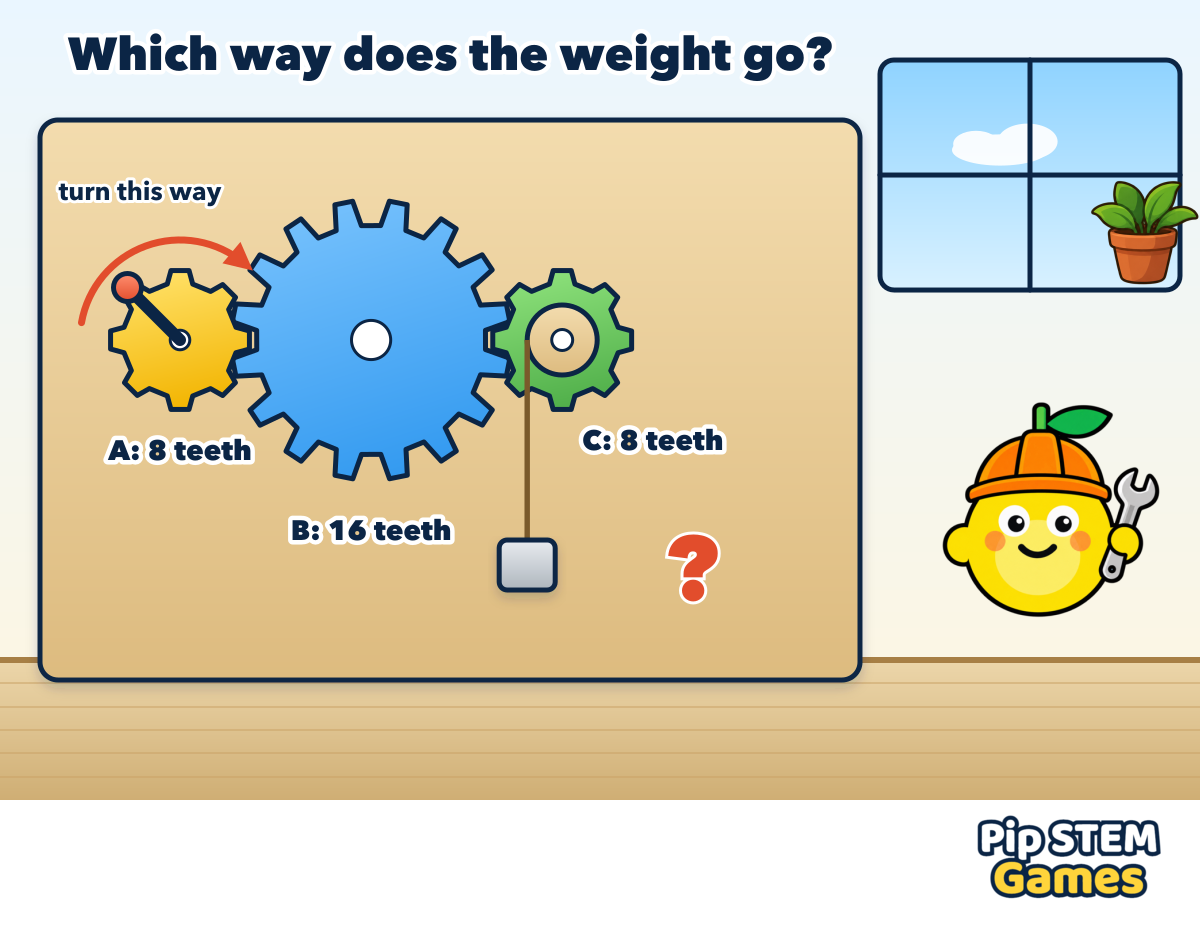
Have a go before you read on. Then build the card model below and check your answer with your own hands. It's an original puzzle we drew for families, so it's a paper model, not a real machine.
What is the puzzle?
Three gears sit in a row. Gear A has a handle and 8 teeth. Gear B, in the middle, has 16 teeth. Gear C has 8 teeth and a drum with a rope and a small weight hanging off its left side. You turn the handle clockwise.
- Which way does gear C turn?
- Does the weight go up or down?
- How many turns of the handle make gear C turn once?
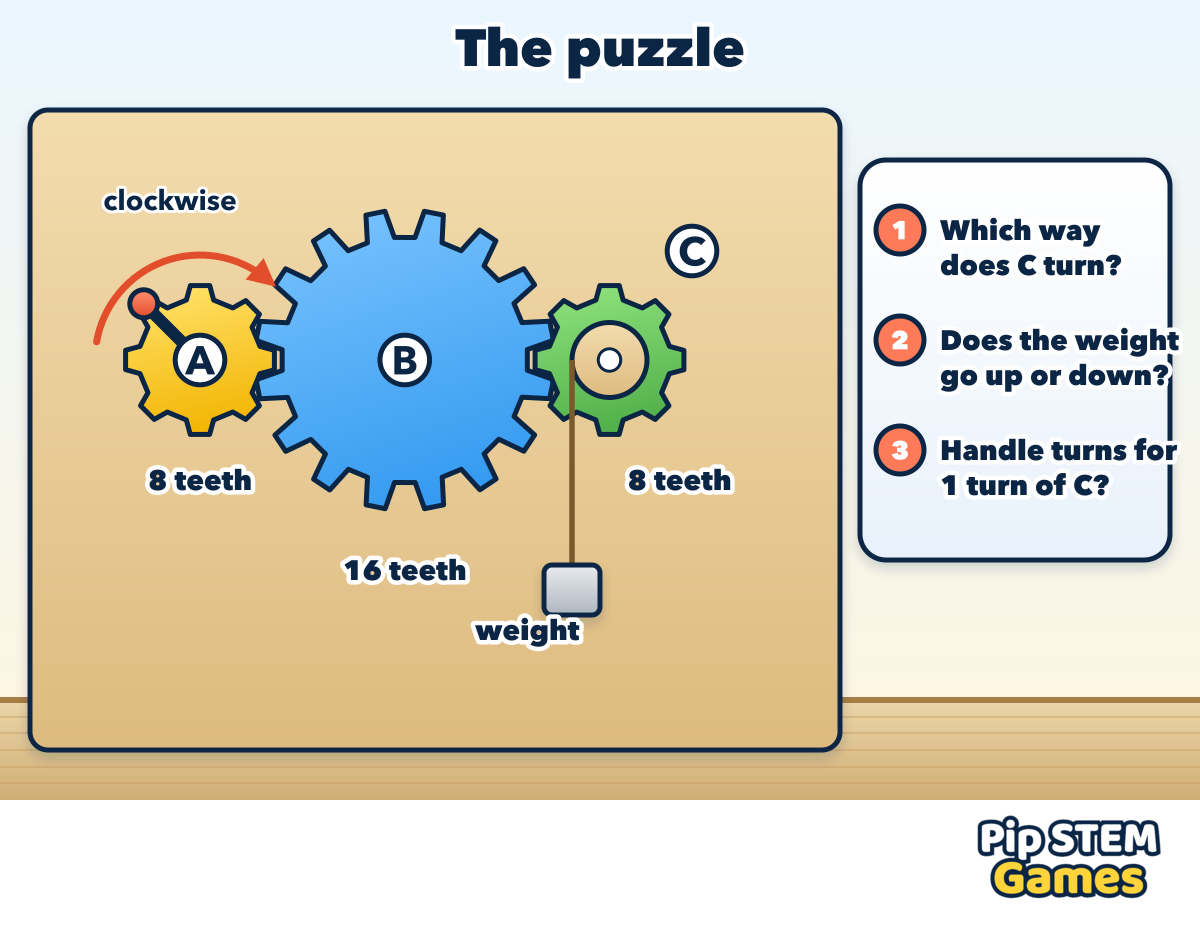
Ask your child to answer out loud before anyone touches anything. A guess said out loud is a prediction, and predictions are what make a puzzle worth solving.
How do you solve it?
Use the touching rule and trace it with your finger, one gear at a time.
- Gear A turns clockwise, because you turn the handle that way.
- Gear B touches A, so B turns anticlockwise.
- Gear C touches B, so C turns clockwise.
- A clockwise drum's left side moves upwards. The rope hangs off the left, so it winds on and the weight rises.
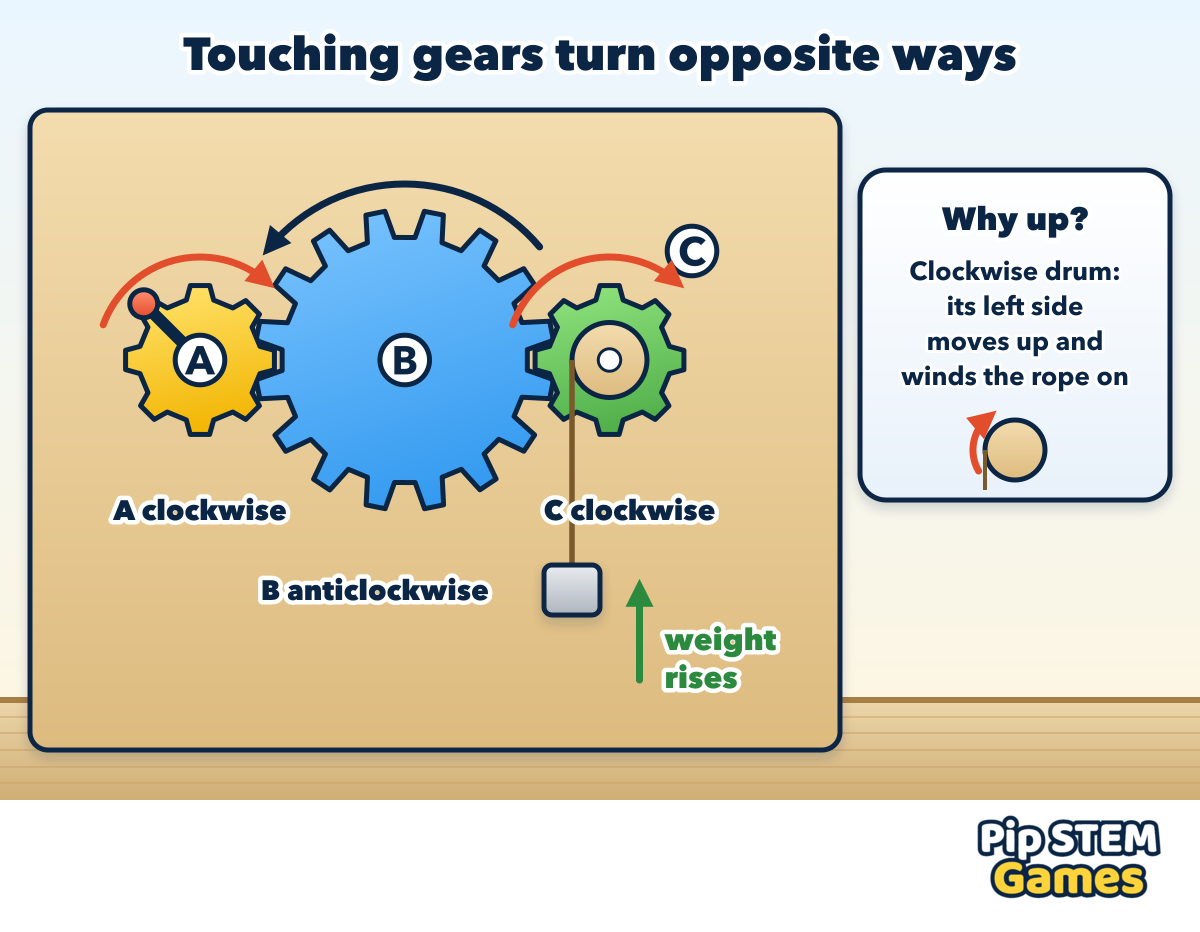
Why opposite? Where two gears meet, their teeth push against each other. The tooth on one gear moves down, so it pushes the other gear's tooth down too. That turns the second gear the other way around its centre. For more practice, try our which way does the last gear turn puzzle.
How many turns does the handle need?
One. One turn of the handle gives one turn of gear C. Here's how to count it.
- Gear A has 8 teeth, gear B has 16. Two turns of A push 16 teeth past the meeting point, so B turns once.
- Gear B has 16 teeth, gear C has 8. One turn of B pushes 16 teeth past, so C turns twice.
- So 2 turns of A make 2 turns of C. That's 1 turn of A for each turn of C.
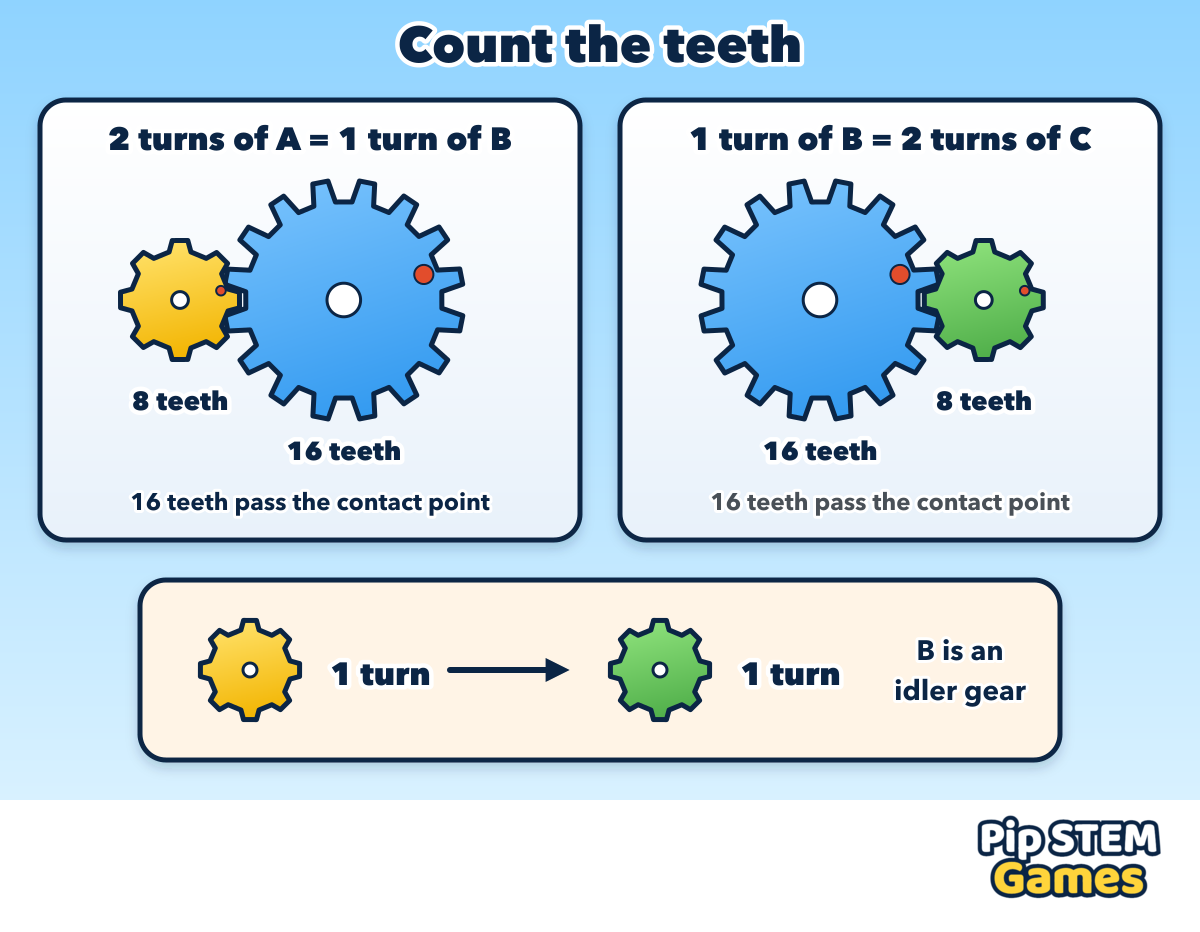
The middle gear only flips the direction. Engineers call it an idler gear. It slows things down by half on the way in and speeds them up by double on the way out, so the two cancel. Our post on how gear puzzles help children understand machines has more on this.
What do you need to build the model?
It's a paper and card model, and it suits readers of about 8 to 10 with an adult nearby.
- Thick card from a cereal box
- Three paper plates or card circles, one twice as wide as the other two
- Safety scissors, with an adult to cut thick card
- Three split pins, or drawing pins pushed into a corkboard by an adult
- A felt tip pen
- Thread and a small paper clip as the weight
- Tape
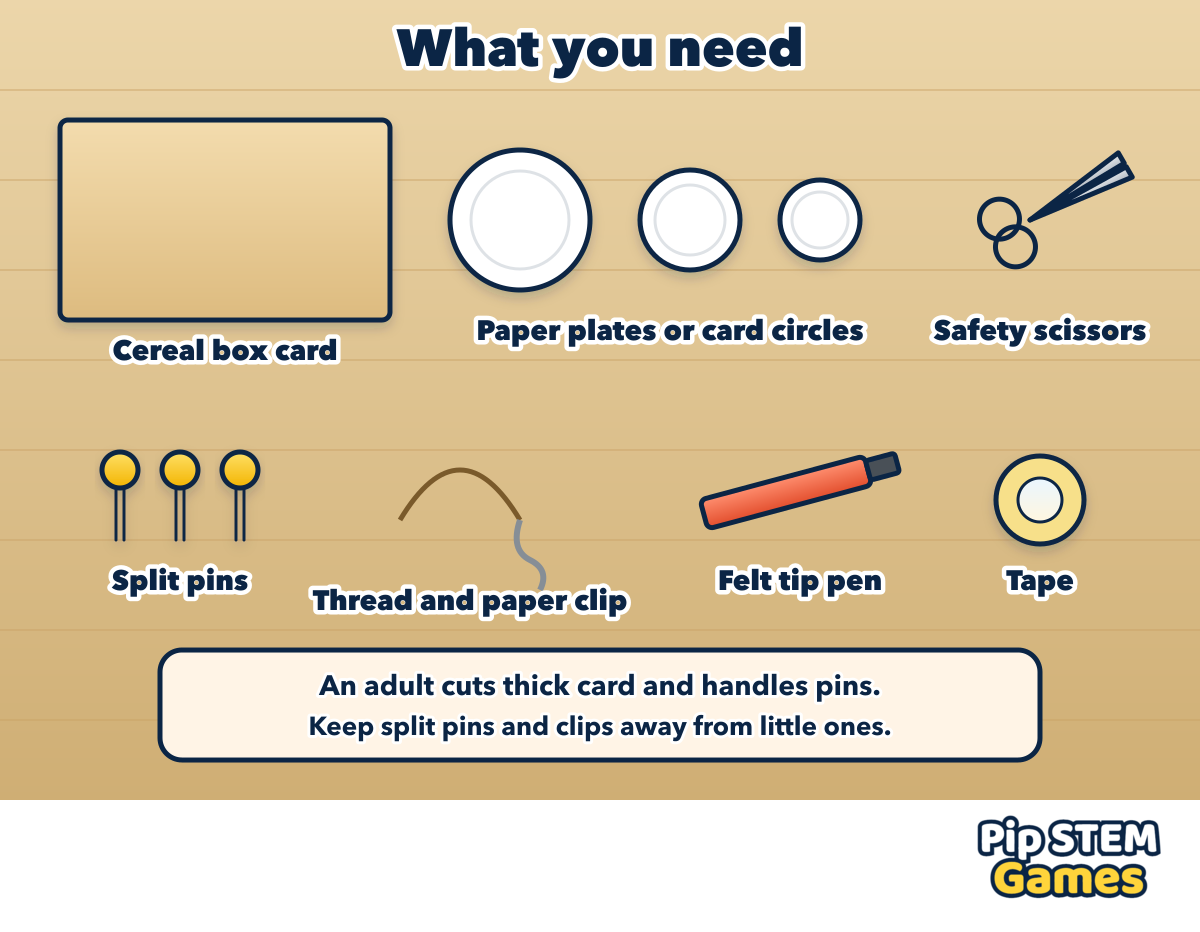
Safety: split pins and paper clips are small parts, so an adult handles them and keeps them away from younger brothers and sisters. An adult cuts the thick card and makes any holes.
How do you build and test it?
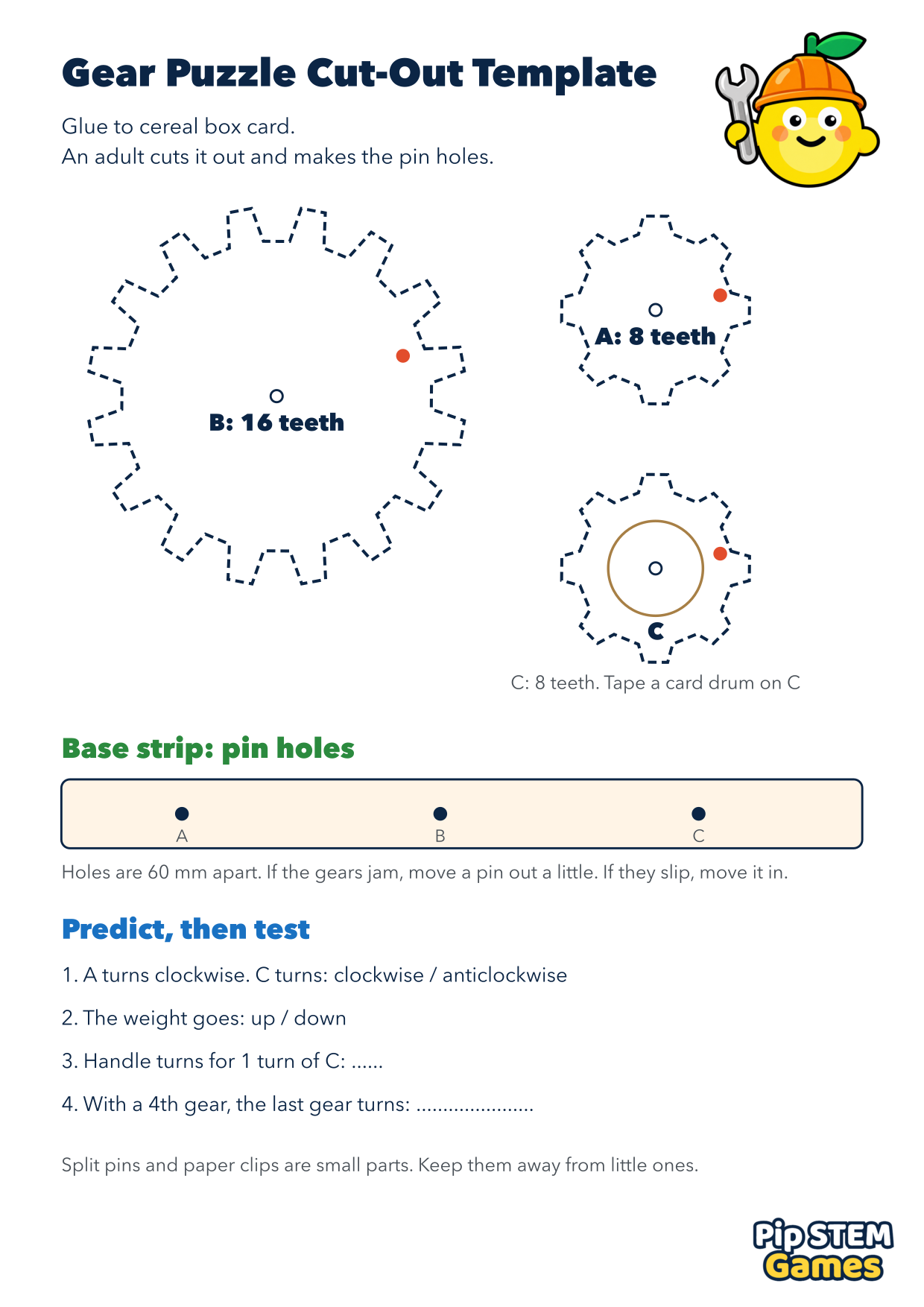
Use our printable template below, or draw your own gears.
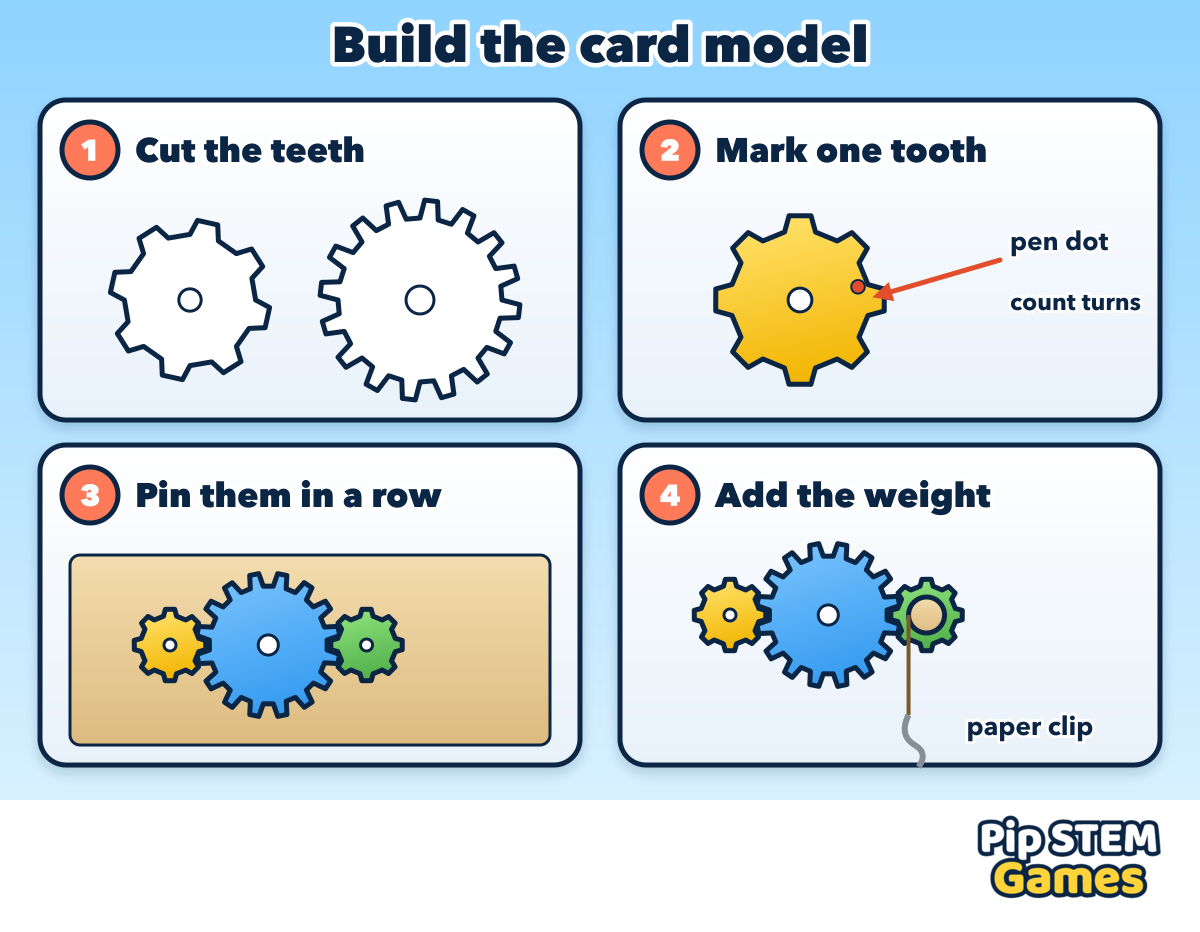
- Cut three card gears. Cut 8 notches around gear A, 16 around gear B and 8 around gear C. Keep the notches the same size so the teeth fit together.
- Draw a dot on one tooth of each gear so you can count turns.
- Pin the gears in a row on a card base so the edges just touch.
- Tape a small card drum to the front of gear C. Tape a thread to it, wind on a few turns from the left side, and hang the paper clip.
- Predict first. Say which way each gear turns and whether the clip will rise.
- Turn gear A slowly clockwise and check.
Count turns by watching the dots. When the dot on A has gone round once, where is the dot on C?
What if it does not work?
- The gears slip: the teeth are too shallow. Cut deeper notches, or glue a strip of corrugated card around the edge.
- The gears jam: they're too close. Move a pin a little further out.
- The clip falls: tape the thread more firmly and use a lighter clip.
- The gears wobble: put a small card washer behind each one so it sits flat.
A jam is useful. Ask your child what's stopping it before you fix it. If they spot the problem, that's real engineering. Our five-step fix-it checklist helps with that.
How do you make it a fair test?
Change one thing at a time. Keep the same weight, the same thread and the same slow handle speed. Try the puzzle with 2 gears, then 3, then 4, and write down whether the last gear turns the same way as the handle.
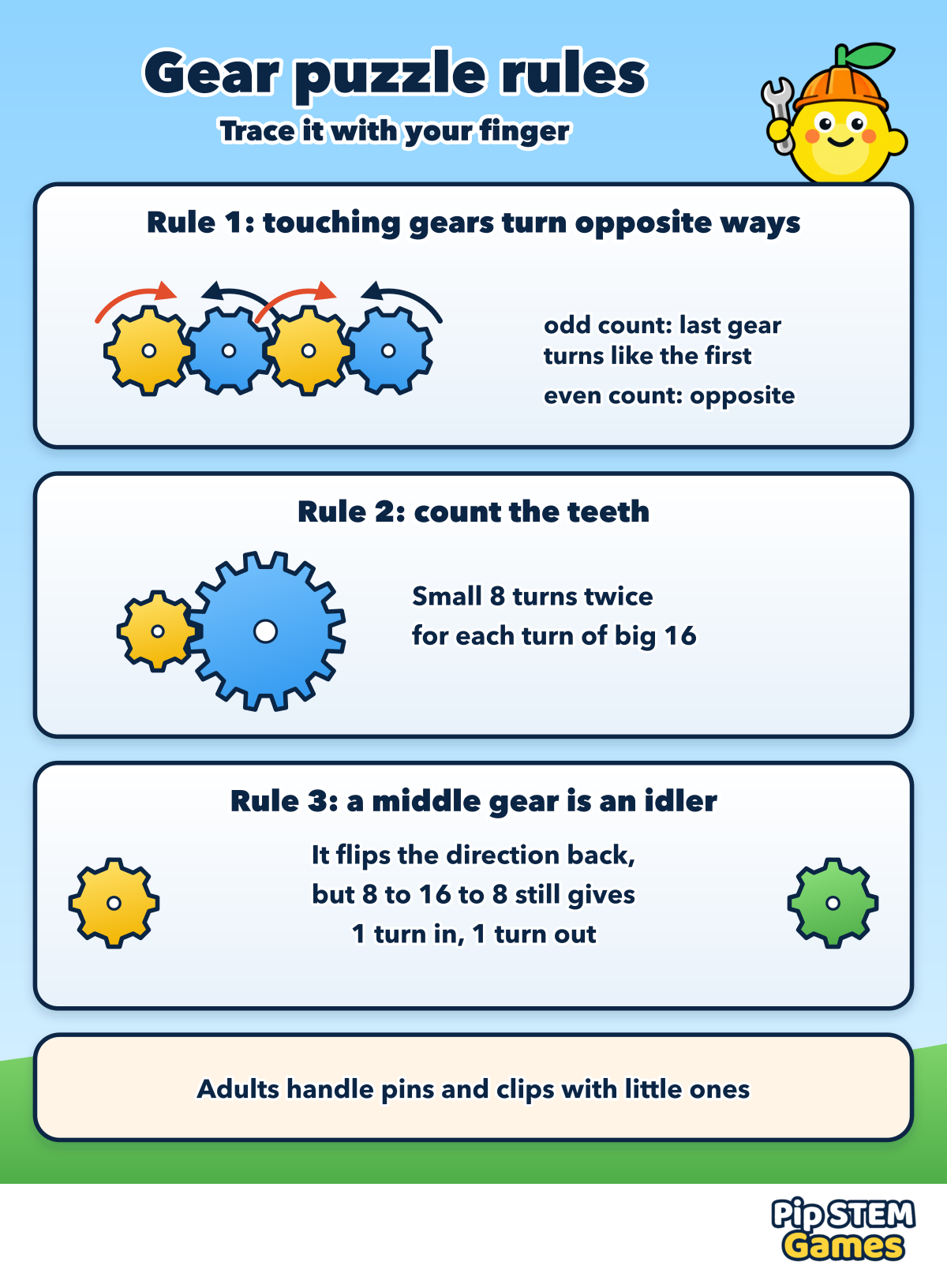
Write the result before you say it. A pattern should pop out: with an odd number of gears in a row, the last turns the same way as the first. With an even number, it turns the other way.
What is the next challenge?
Add a fourth gear and predict the last direction before you test it. Then swap gear C for a 16-tooth gear. Will the clip rise faster or slower? Test it and see.
For a quick screen version, try the Gears game, where every gear you add changes the direction of the next. Then try our four gear direction challenge.
Different ages: younger children (around 5 to 7) can use two big gears and just say which way the second one turns. Children aged 8 to 10 can count teeth and work out turns. Older children can design a puzzle for a friend, hide the answer and check it with the card model.
Questions parents ask
Why do touching gears turn opposite ways?
Where two gears meet, a tooth on one pushes a tooth on the other in the same direction at that point. That makes the second gear spin the other way around its own centre.
What is an idler gear?
A gear placed between two others. It makes the last gear turn the same way as the first. It doesn't change the overall speed ratio between the first and last gears.
How do you work out gear turns?
Count teeth. If an 8-tooth gear drives a 16-tooth gear, it must turn twice to push 16 teeth past, so the big gear turns once.
Does the weight go up or down in this puzzle?
Up. Gear C turns clockwise, and the left side of a clockwise drum moves upwards, so the rope on that side winds on and lifts the weight.
What age is this gear puzzle for?
Ages 5 to 12. Young children can answer which way the next gear turns; older children can count teeth and design their own puzzles.
What if my card gears keep slipping?
Cut deeper notches, or wrap a strip of corrugated card around each edge so the ridges act as teeth. Also check the gears are close enough to touch.
Great STEM activities to try next...
 If This Gear Turns Right, Which Way Does the Last Gear Turn?Activity
 The Four-Gear Direction ChallengeActivity
 How Gear Puzzles Help Children Understand MachinesActivity
More to try: Engineering Puzzle: Broken to Working in 3 Fixes

Pip STEM Games
We make engineering games and workbooks for kids aged 5 to 12. Every activity here is one we'd happily run at the kitchen table: test it, watch it fail, fix it, try again.




