

Key takeaways
- Water travels from reservoir to treatment works to storage to pipes to your tap.
- Treatment screens out rubbish, clumps mud, filters through sand and kills germs with chlorine.
- Height and pumps give water the push to travel.
- A jar filter model copies the first steps, but its water is never safe to drink.
- A fair test changes one thing at a time, such as the depth of the sand.
Water gets to your tap from a reservoir or river, through a treatment works, into covered tanks and then along pipes under the ground. This guide shows each stop, a jar filter model to build with a grown-up, and printable sheets. The jar water is never safe to drink.
How does water get to your tap?
Rain fills reservoirs and rivers. The water is cleaned at a treatment works, stored in a covered tank, and pushed through pipes under the ground until it reaches your tap. The whole trip can take hours or days.
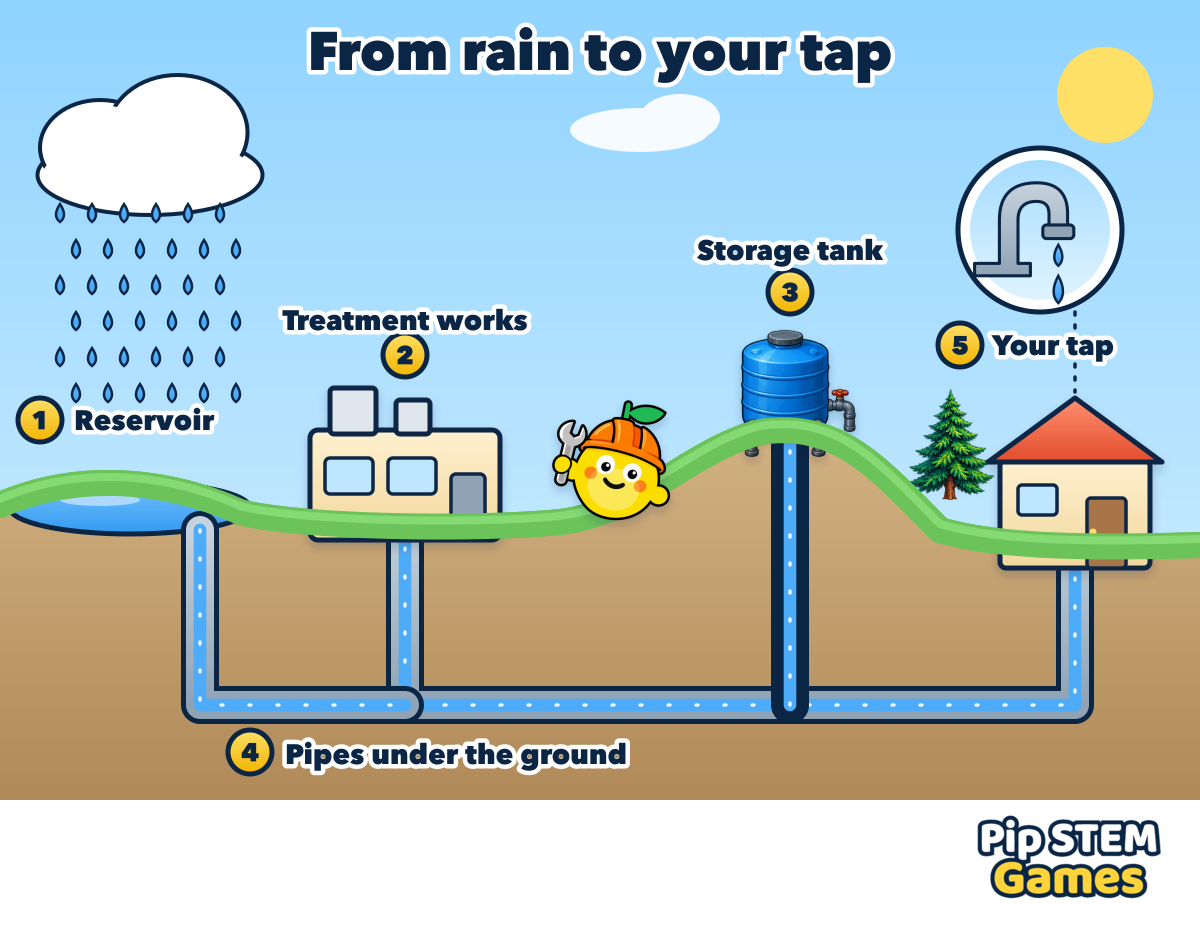
That is five stops. You turn the tap and the last stop is over in a second, but a lot of engineering sits behind it. In this guide you will see what happens at each stop, then build a small jar filter that copies the first few steps. Never drink the water from it.
How is the water made clean?
A treatment works cleans water in steps. Each step removes something different.
- Screen. Bars and mesh catch leaves, sticks and bigger rubbish.
- Settle. At some works, a little chemical makes tiny bits of mud clump together. The clumps are heavy, so they sink.
- Filter. Water trickles down through thick beds of sand. The sand catches the tiny bits that are left.
- Disinfect. A very small amount of chlorine kills germs you can't see. Clear water can still hold germs, so this step matters.
- Store. The clean water waits in covered tanks, so nothing falls in.
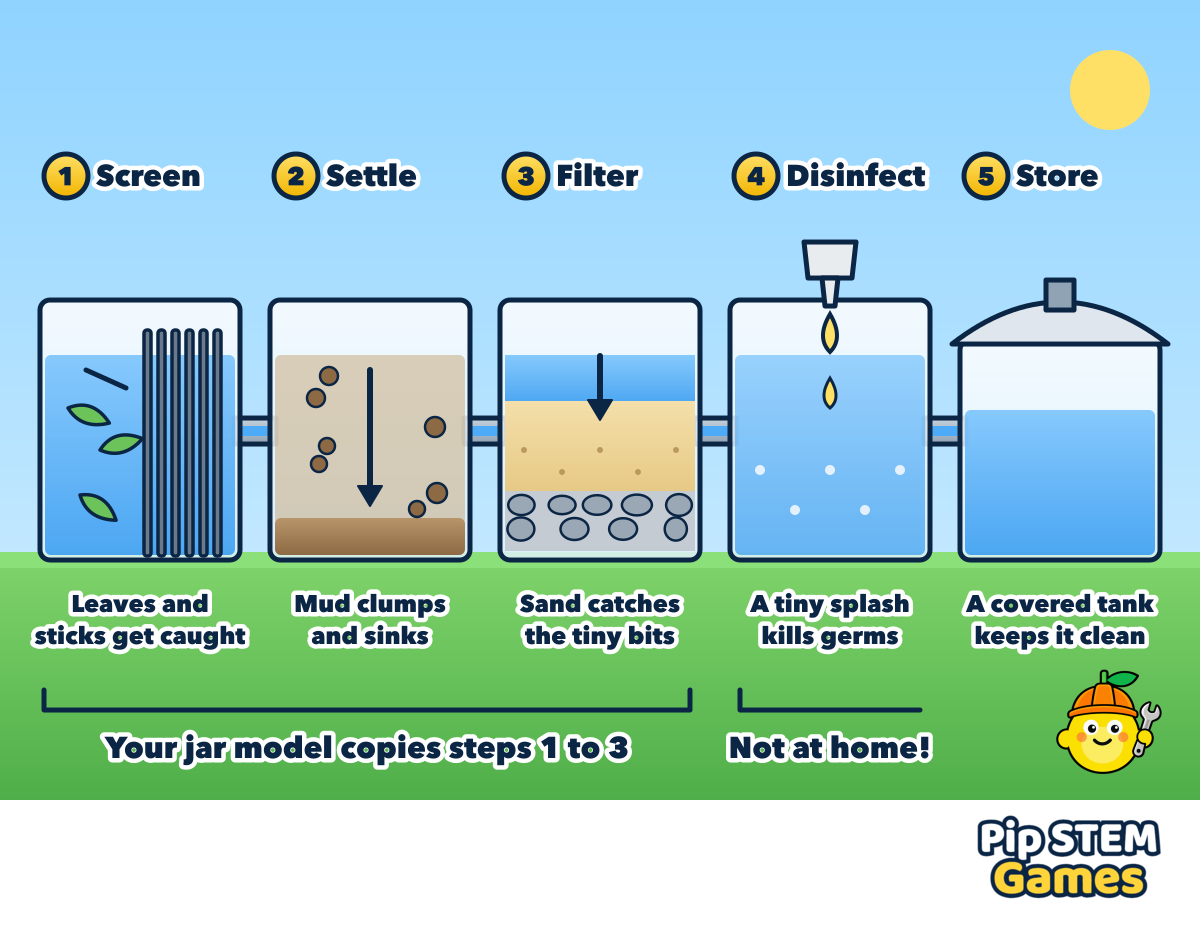
Not every works does exactly the same steps, but this is the usual order. Engineers test the water all the way along, because your eyes can't tell you whether water is safe.
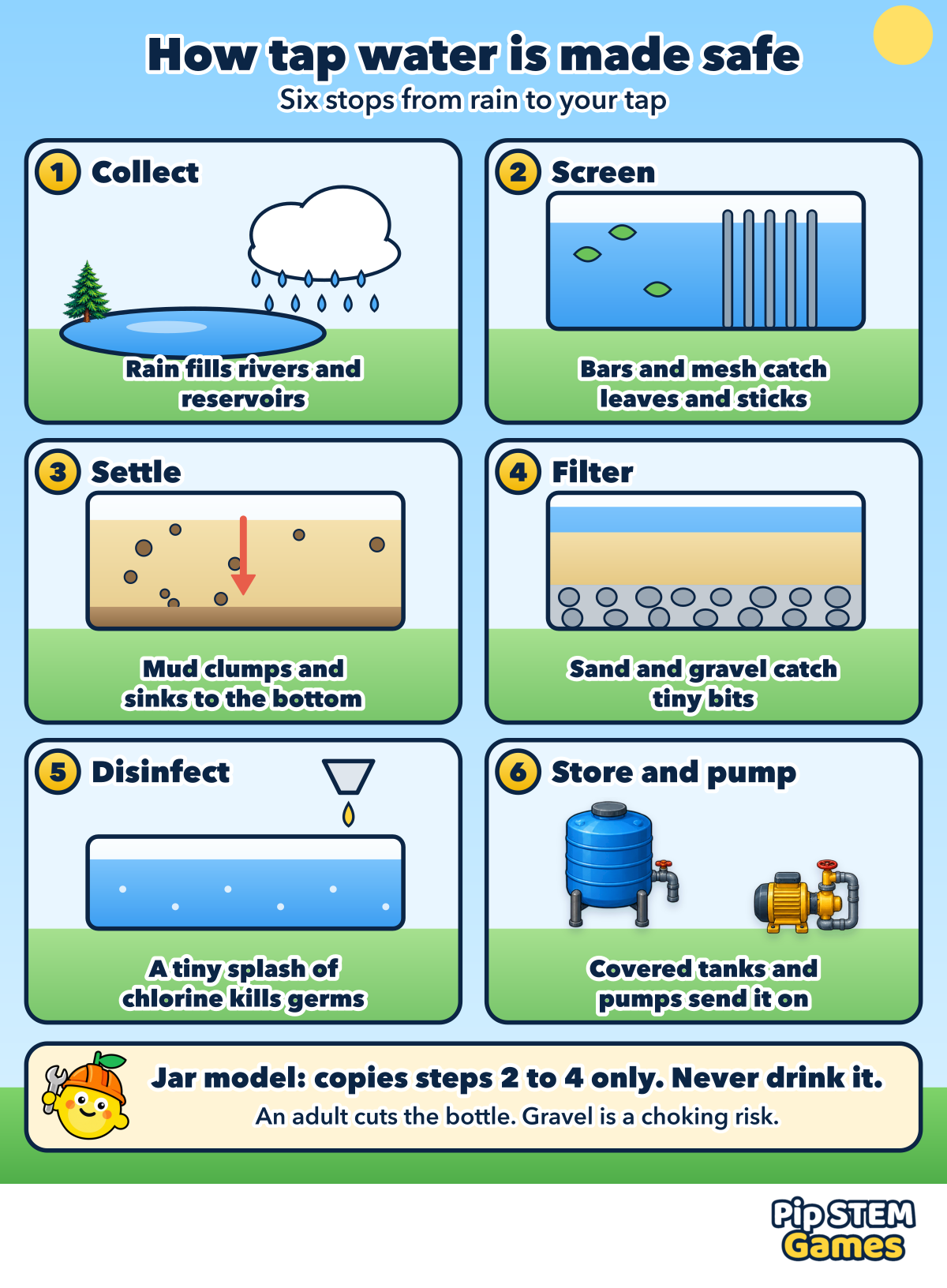
Print or save this cheat sheet to keep the six stops in order.
What pushes water along the pipes?
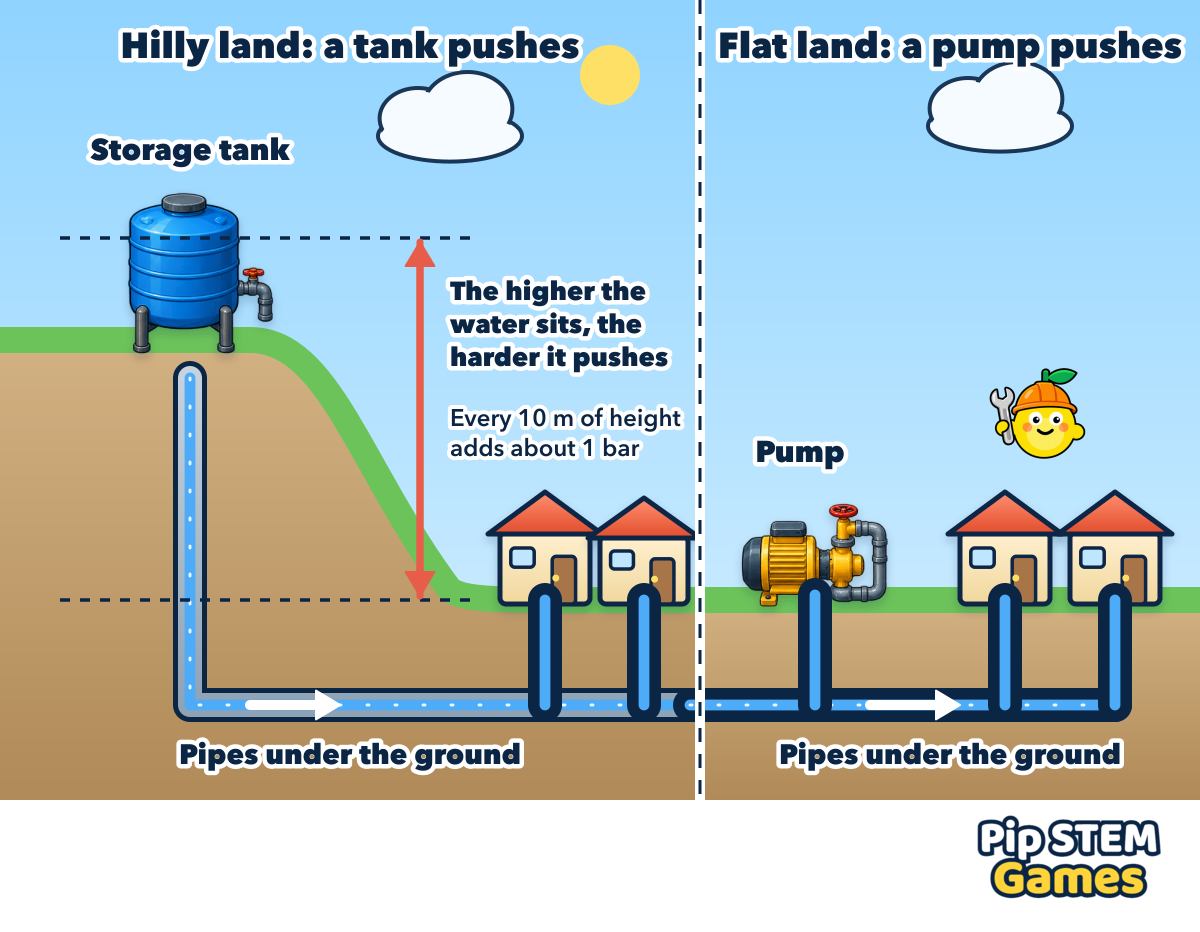
Water needs a push to travel, and there are two main ways to give it one. Both are on the picture below.
On hilly land, engineers put a storage tank high up. Water sitting higher up pushes harder on the pipes below it. As a rough rule, every 10 metres of height gives about 1 bar of push, which is a bit less than the air pressure around you. No power is needed, because gravity does the work.
On flat land there is no hill to use, so pumps push the water instead. Pumps need electricity, so engineers plan for power cuts too.
Want to try this on screen? In our Pressure Towers game, you can see how height changes the push. For a pipe puzzle, try the which pipe fills the tank first challenge.
How can you build a jar filter model?
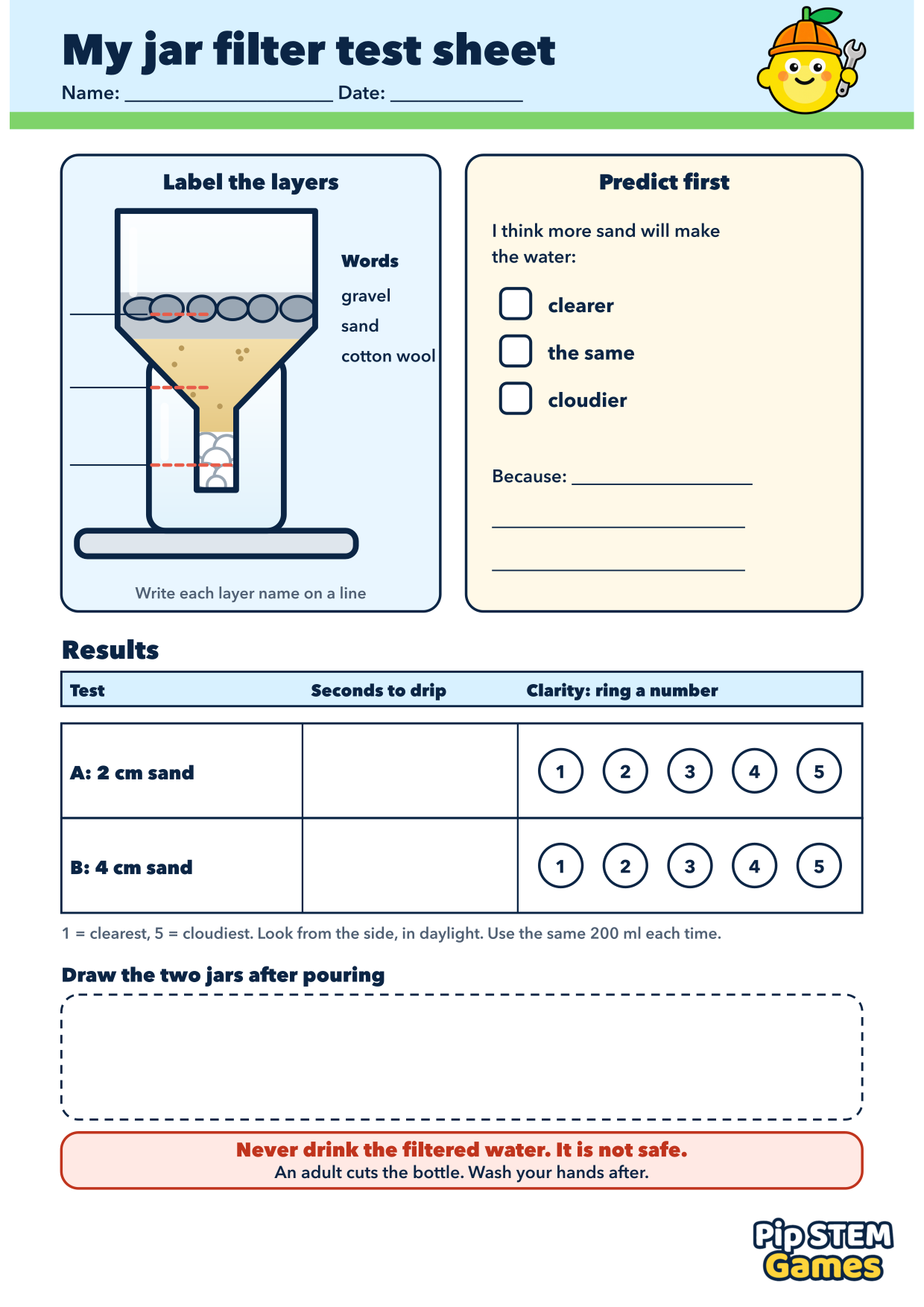
This model copies the screen, settle and filter steps with things from your kitchen. It takes about 20 minutes and a grown-up must help.
You need: a clean 2 litre clear plastic bottle, cotton wool, clean sand, small pebbles or aquarium gravel, a clean glass jar, a tray, a ruler, and 200 ml of muddy water. To make the muddy water, stir a spoonful of garden soil into a jug of water.
- An adult cuts the base off the bottle with scissors, then tapes over the sharp edge.
- Turn the bottle upside down, so the neck points down. Pack a plug of cotton wool into the neck.
- Add 2 cm of sand on top of the cotton wool. Then add a layer of pebbles on top of the sand.
- Stand the bottle in the jar, with the whole thing on a tray to catch spills.
- Pour the muddy water in slowly. Let it drip through.
- Compare the water in the jar with the muddy water you started with.
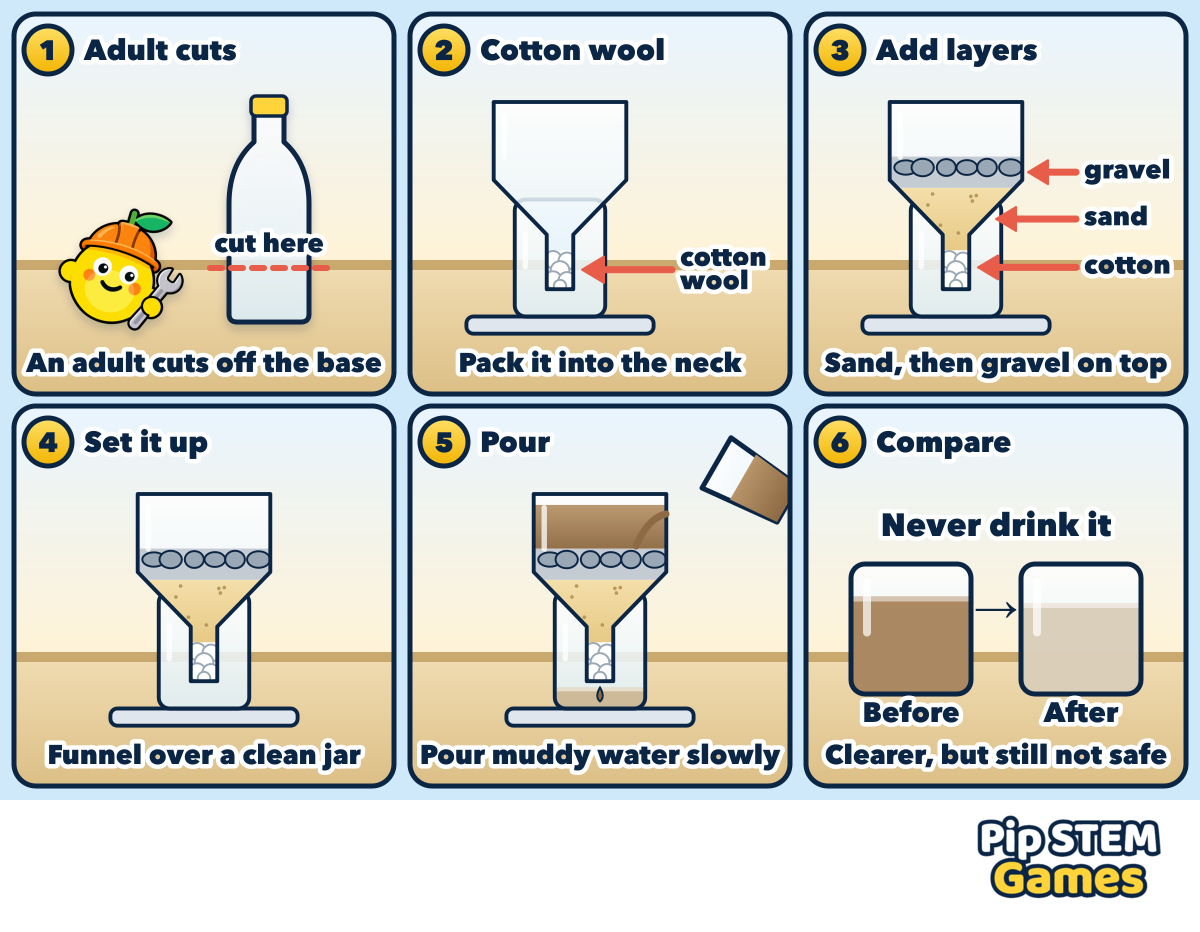
Safety: the water that comes out is cleaner to look at, but it is never safe to drink. Real works also use chlorine, and a jar model can't do that. Keep pebbles and gravel away from children under 3, because they can choke. Wipe up spills and wash your hands when you finish.
What you should notice: the water usually looks clearer, but not perfect. A model like this catches mud and leaves. It does not remove germs, and the layers here are a simple version of a real sand filter.
How do you make it a fair test?
A fair test changes one thing and keeps everything else the same. Here the one thing is the depth of the sand.
Build two filters. Put 2 cm of sand in the first and 4 cm in the second. Use the same bottle, the same pebbles and 200 ml of the same muddy water, poured at the same speed. Then judge each jar from the side, in daylight, using a clarity score from 1 (clearest) to 5 (cloudiest).
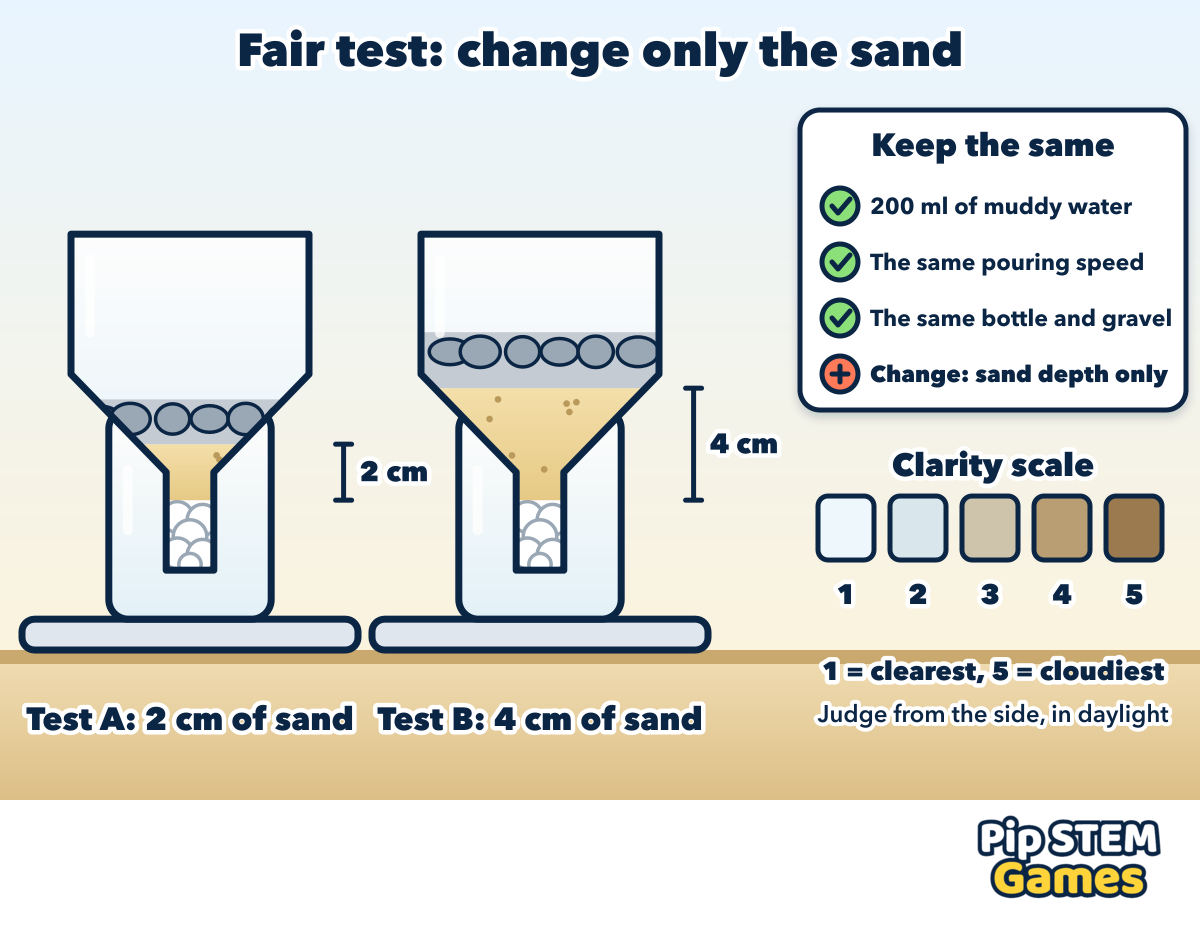
Predict before you pour. Do you think more sand will make the water clearer, or just slower? Time how many seconds it takes to drip through, and write down both numbers. Your results may not match anyone else's, and that's fine. Real engineers get surprises too.
What if the filter doesn't work?
Most problems have a quick fix. Change one thing, then test again.
- Water leaks round the sides. Press the layers down and pack the cotton wool tighter.
- Water drips very slowly. Use a thinner sand layer, or coarser sand.
- Water is still very cloudy. Pour it through a second time.
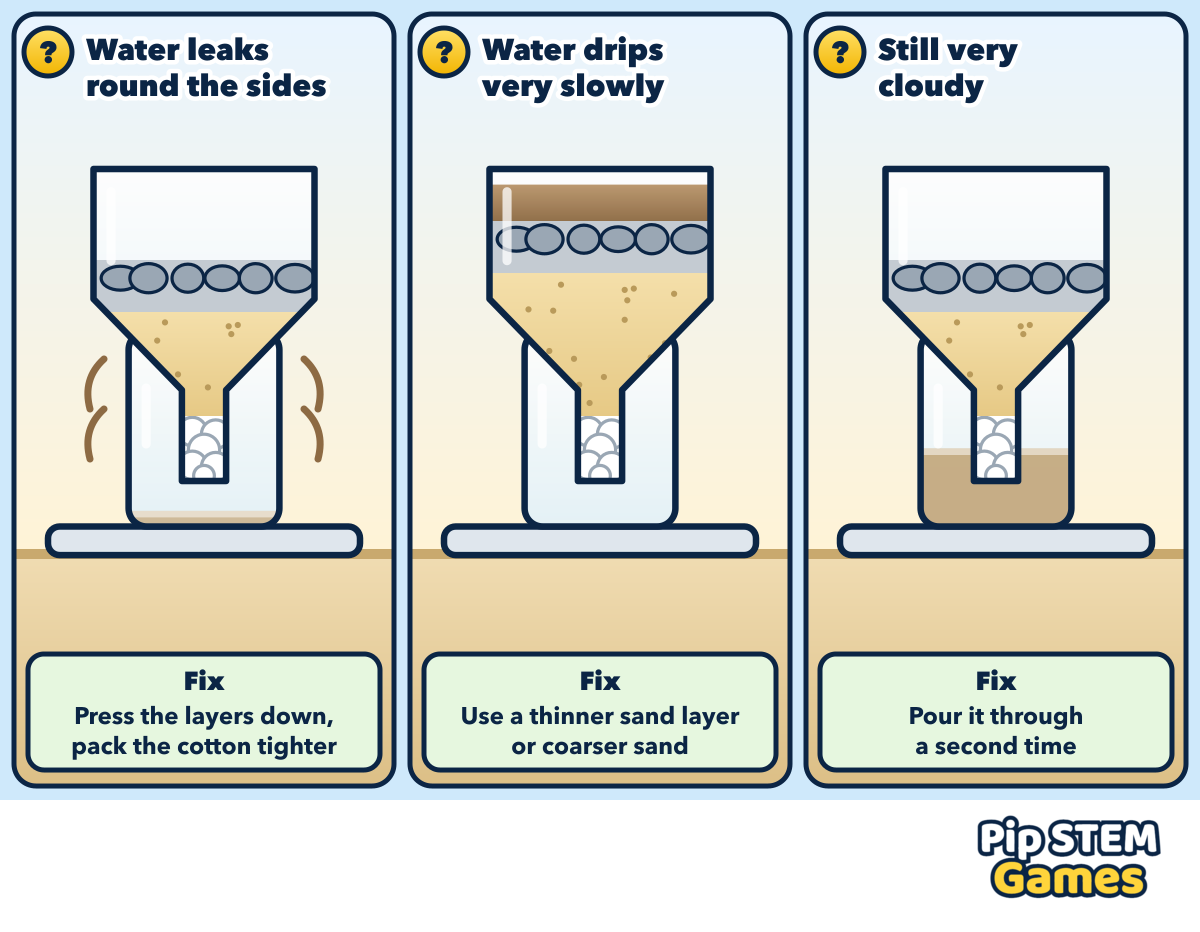
Fixing a problem like this is exactly what engineers do. Try it as a game too. In Filter Factory, you can sort the layers on screen. Then read who designs clean water systems to meet the people behind the pipes.
How do you change it for each age?
Match the job to the child.
- Ages 5 to 6 (easier): an adult does the cutting and pouring. The child adds the cotton wool and watches the drips.
- Ages 7 to 9: run the two-depth fair test and fill in the sheet below.
- Ages 10 to 12 (harder): try three sand depths, time every run, and draw a bar chart of the results.
Print this test sheet and fill it in as you go.
For more activities, see the Junior Engineers workbook. The aim isn't a perfectly clear jar. It's for your child to see that clean water is planned and made, step by step.
Questions parents ask
How does water get to your house?
Water is collected in reservoirs, cleaned at a treatment works, stored in covered tanks and sent through underground pipes. Gravity from high tanks or pumps gives it the push to reach your tap.
Why is tap water treated?
Water can look clear and still hold germs. Treatment removes dirt and kills germs so the water is safe to drink.
What does chlorine do to water?
A very small amount of chlorine kills germs. Works add just enough to keep the water safe on its way to your home.
Can I drink water from a homemade filter?
No. A jar model catches mud and leaves, but it can't remove germs. Never drink the water from it.
Why do water towers and tanks sit up high?
Water in a high tank pushes harder on the pipes below it. About 10 metres of height gives about 1 bar of push.
What age is the jar filter model for?
Children aged 5 to 12 can try it with a grown-up, who should cut the bottle. Younger children watch and add the cotton wool.
Great STEM activities to try next...
 Who Designs Clean Water Systems? [Printable]Careers
 Which Pipe Will Fill the Tank First? A Pipe Puzzle with a Home Test [Printable]Logic puzzle
 Why Is the Water System Blocked?How it works
More to try:

Pip STEM Games
We make engineering games and workbooks for kids aged 5 to 12. Every activity here is one we'd happily run at the kitchen table: test it, watch it fail, fix it, try again.




