

Key takeaways
- Water can only flow along a path with nothing blocking it.
- A closed valve stops the water, and every pipe after it stays dry.
- To solve a pipe map, start at the source and follow every split with a finger.
- The word first is a trick here, because the blocked tanks never fill at all.
- A bottle, three bendy straws and some clay let you test the puzzle at home.
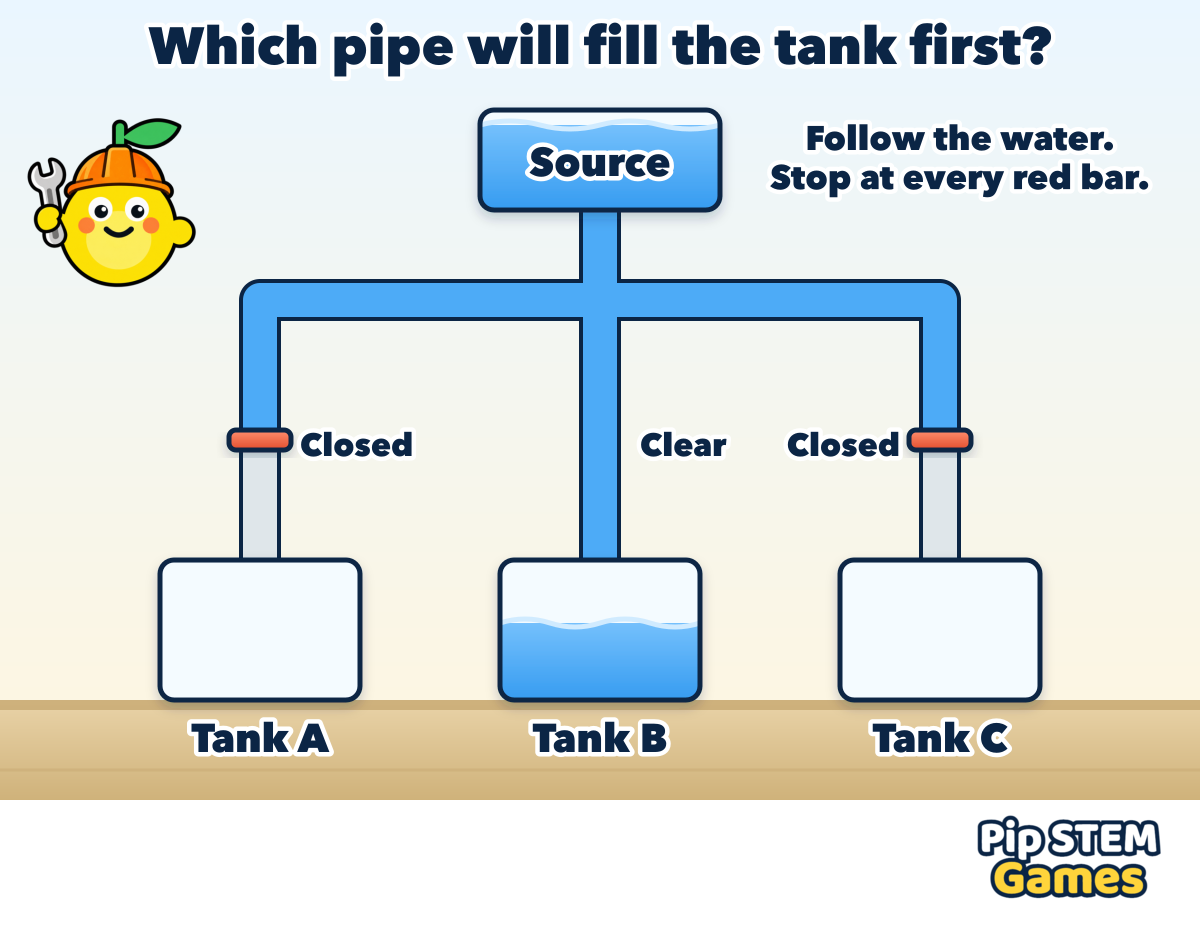
Which pipe will fill the tank first? In this puzzle the answer is pipe B, because it is the only pipe with a clear path. Pipes A and C each have a closed valve, so no water gets past them. This page shows you how to trace the water, how to test it at home with a bottle and straws, and a printable pipe map with a trickier layout.
What does the pipe puzzle show?
The map has one source tank at the top. Its pipe splits into three branches, A, B and C. Each branch ends at its own empty tank. Red bars sit across pipes A and C. Those are closed valves. Pipe B has nothing in the way.
The question is which tank fills first. Try it with a finger before you read on.
How do you trace the water through a pipe map?
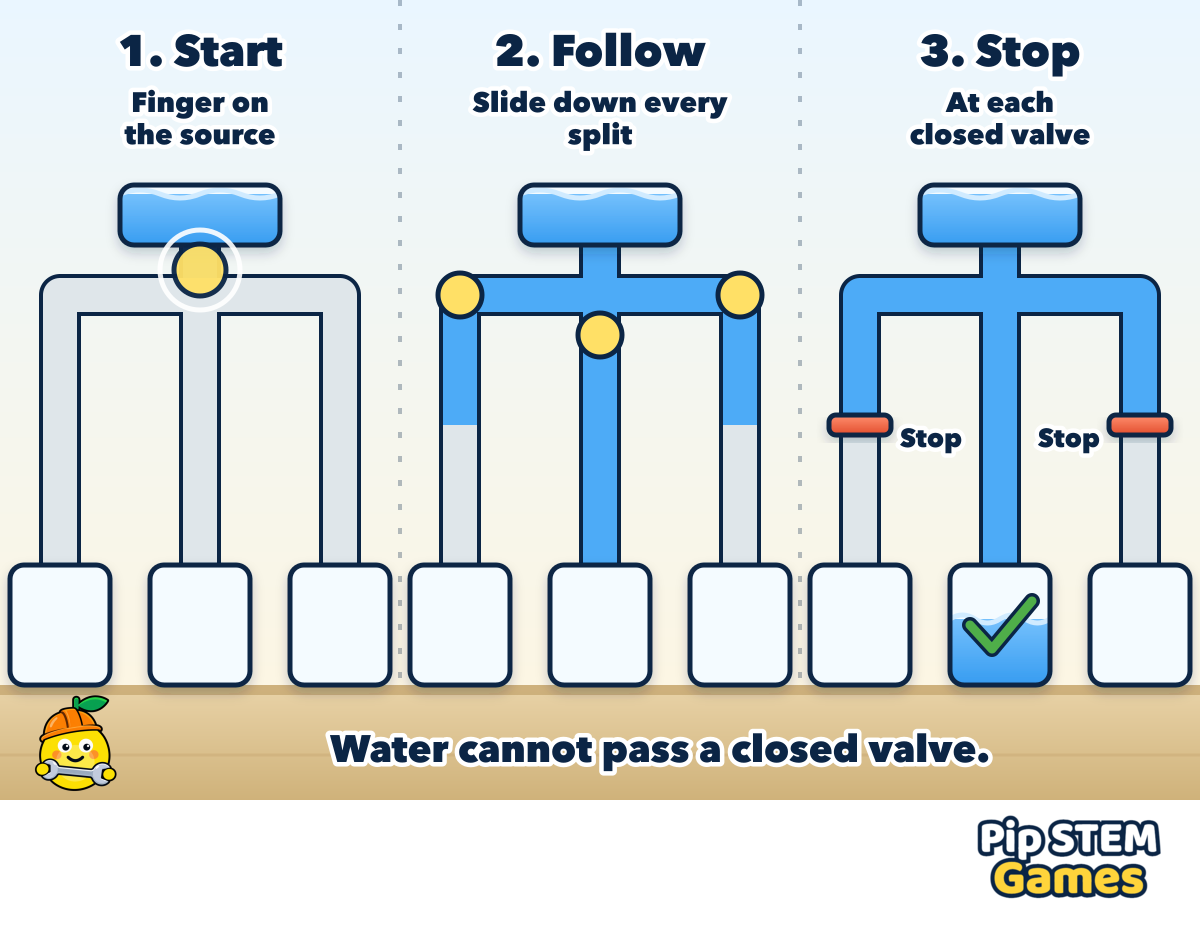
Use your finger as the water. It only goes where the water can go.
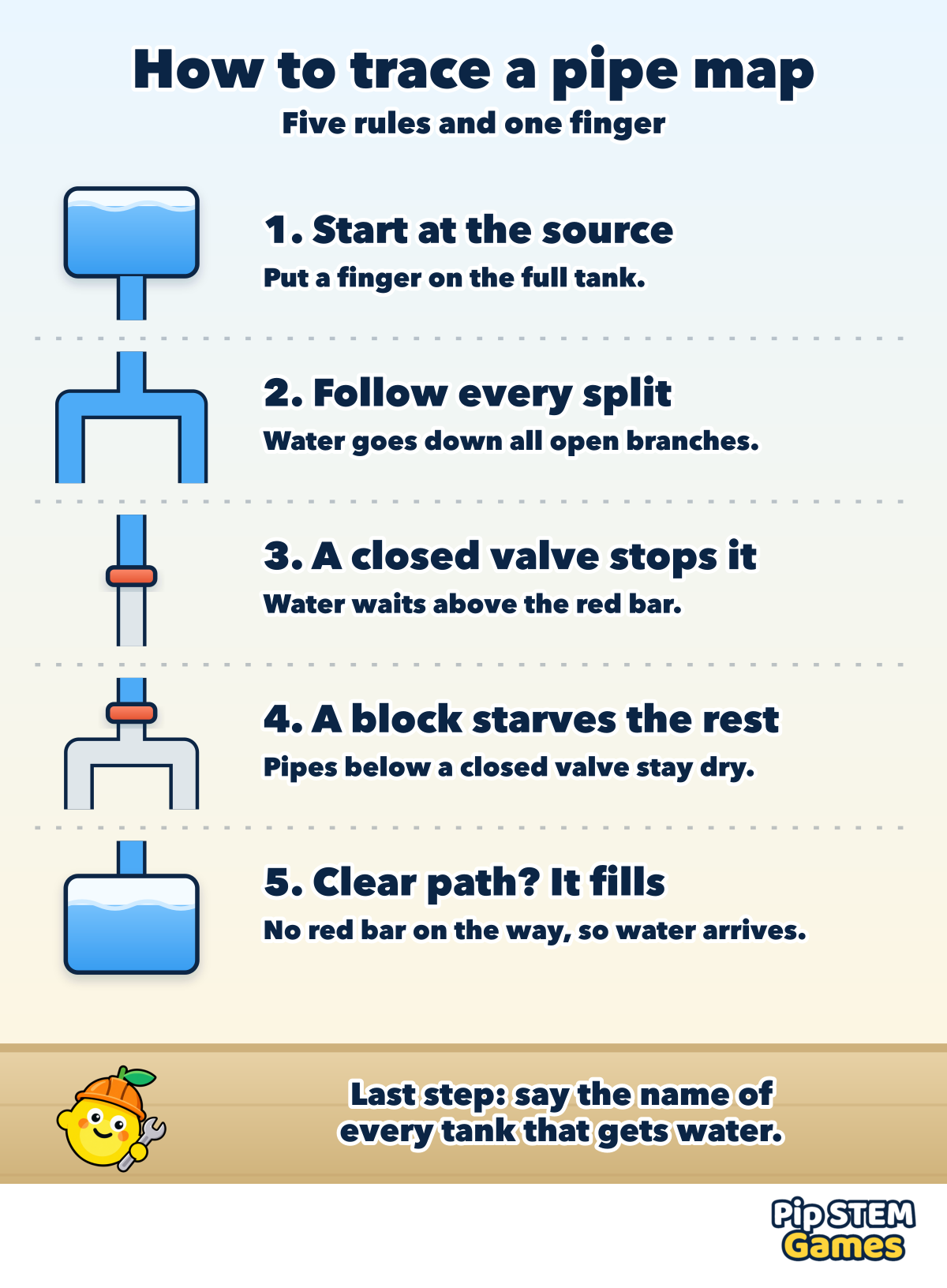
- Put a finger on the source tank. The water starts here.
- Slide down the pipe until it splits. Follow each branch, one at a time.
- Stop at every red bar. A closed valve is like a shut door, and water cannot get through.
- Keep going along any branch with no red bar, all the way to a tank.
- Say which tanks you reached. Those are the tanks that fill.
In our map your finger stops on A and C. Only B reaches a tank.
Why is the answer pipe B and not the shortest pipe?
It is easy to treat this like a race. The title says first, so we look for the shortest, widest or straightest pipe. But a race needs every runner to be able to start. Pipes A and C are blocked, so no water ever reaches their tanks. Pipe B is the only one that works, so its tank fills first, and it is also the only one that fills at all.
Speed starts to matter only when two or more paths are open. Then a wider, shorter or straighter pipe lets more water through, and its tank fills sooner. For this puzzle we say the valves are shut tight and do not leak.
How can you test it at home with a bottle and straws?
Do this outside, over a sink, or in a big tray. An adult should make the holes. It takes about 20 minutes.
- A clean plastic bottle, with the cap off
- 3 bendy straws
- Modelling clay
- 3 plastic cups
- A tray or baking tin, and a jug of water
- A skewer for the adult to make the holes
- A few books or boxes to stand the bottle on
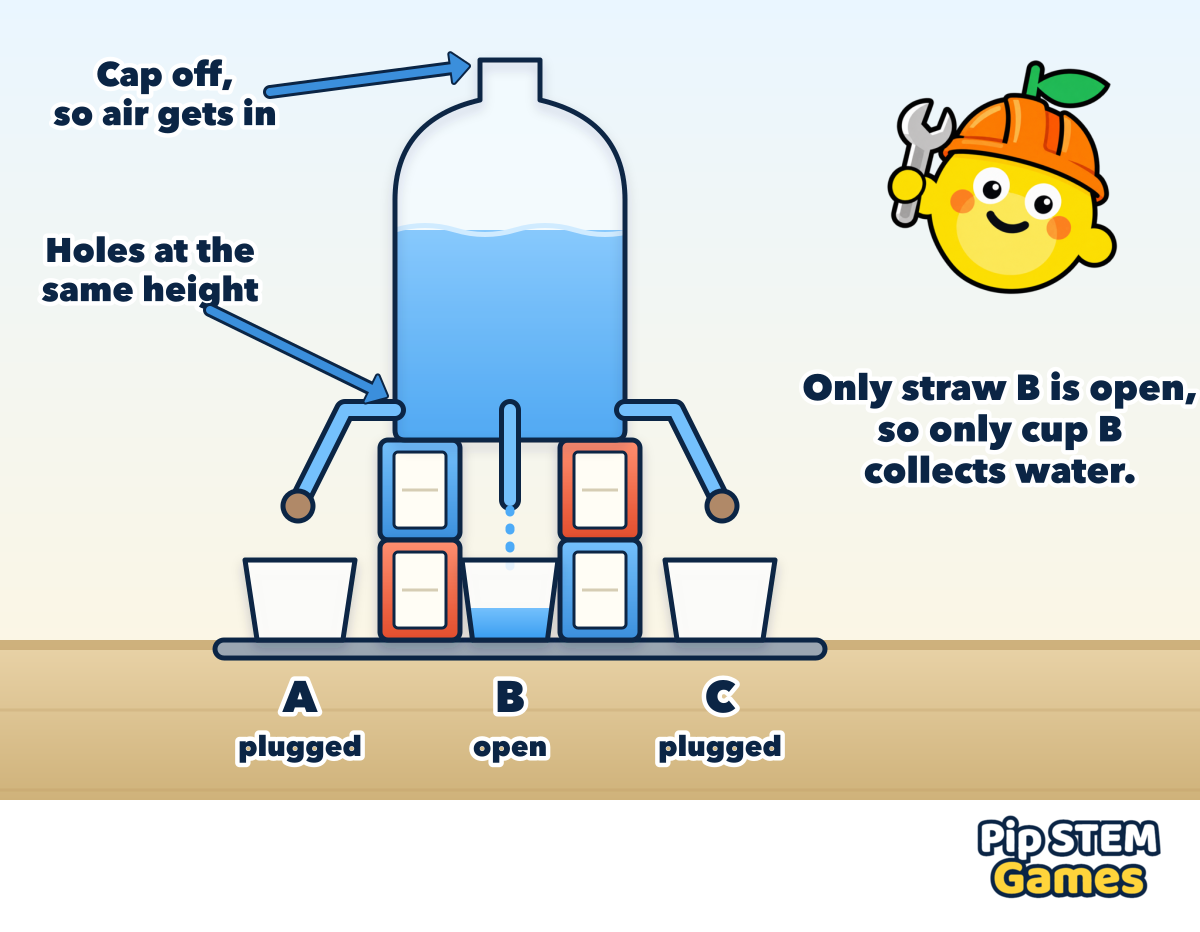
- Ask an adult to make three holes in the bottle, all at the same height, about 3 cm above the base.
- Push the short end of a bendy straw into each hole. Bend the long ends down.
- Press clay around each straw where it meets the bottle, so it does not leak.
- Plug straws A and C: push a clay ball into the end of each one.
- Stand the bottle on the books, over the tray, so the straw ends hang above the cups. Put one cup under each straw.
- Pinch straw B shut. Pour water into the bottle until it is about three-quarters full.
- Let go of straw B. Watch the cups. Which one collects water?
The flow slows down and stops when the water level drops to the hole. That is normal.
Grown-up note: an adult makes the holes. Clay plugs are a choking risk for children under 3, so keep them away from little ones. Nobody should drink from the straws or cups. Wipe up spills so the floor is not slippery.
How do you keep the test fair, and what if it leaks?
Change only one thing: which straw is open. Use the same bottle, the same hole height and the same starting water level each time. Do three rounds, moving the open straw to A, then B, then C. Move the clay plugs between rounds.
- Water dribbles around a straw. Press more clay around it.
- A plugged straw drips. Push the plug in further or add more clay.
- Nothing comes out of the open straw. Check that the straw is not squashed, the cap is off and the water is above the hole.
Each time, the cup under the open straw should collect water and the other two should stay dry. It does not matter which straw is open. The water finds the open path.
Where do valves stop water in real life?
Valves are everywhere. Every tap has one. Many homes also have a main stopcock where the water pipe comes in, and small valves under sinks and behind washing machines. Each one works like a red bar on the map. Close one valve and the water stops on that pipe, while other pipes keep running.
Real water systems are much bigger, and engineers use maps like ours to plan them. Read how water gets to your tap and why a water system gets blocked, or meet the people who design them in who designs clean water systems. You can also practise joining pipes in the Pipe Connect game.
What is the next challenge?
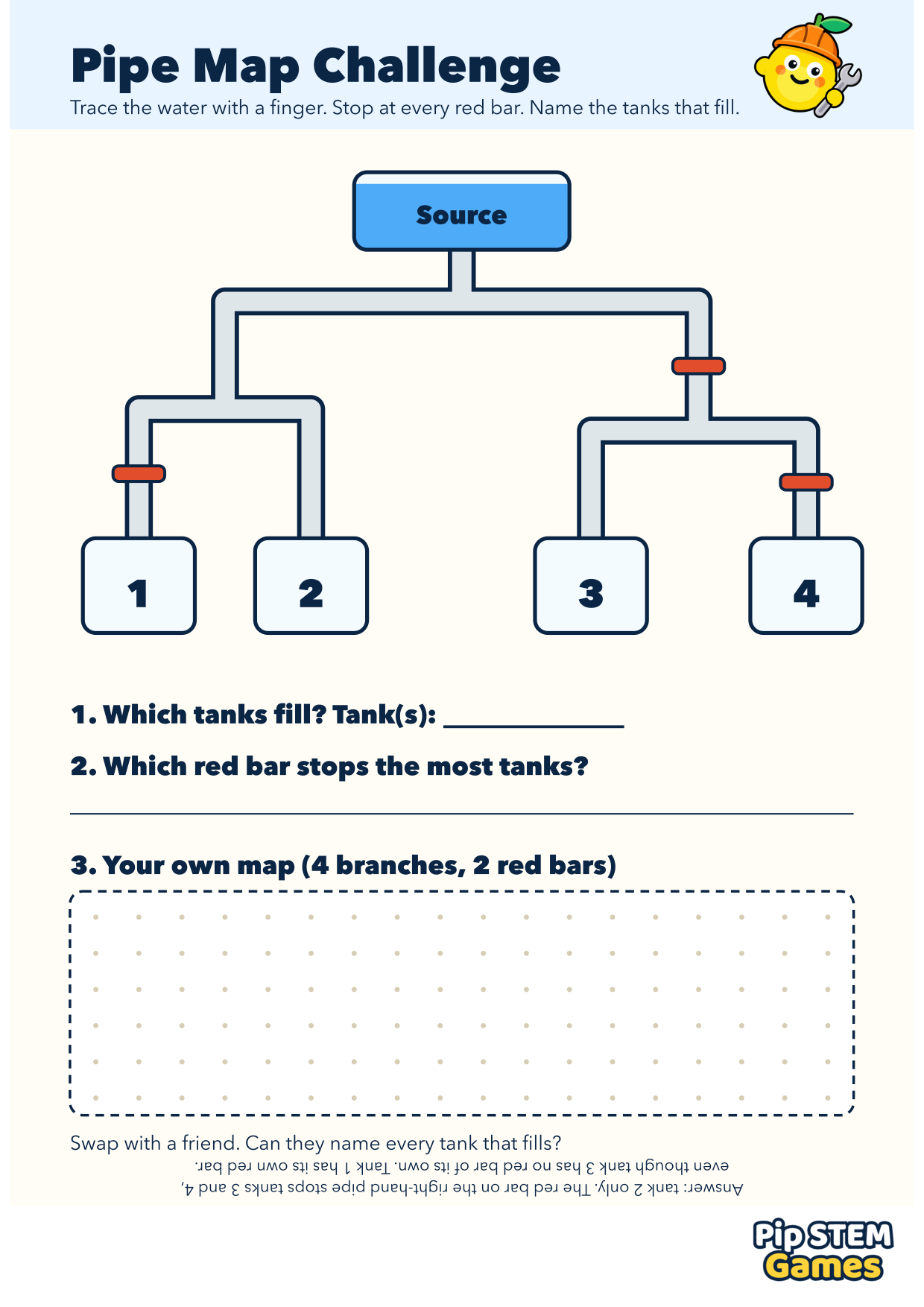
Print the sheet below. The map has four tanks and three closed valves. Trace the water with a finger and write down which tanks fill. Then draw your own map in the empty frame, with four branches and two red bars, and give it to someone else to solve.
Stuck? The answer is printed upside down at the bottom of the sheet. Here is the short version: only tank 2 fills. The red bar on the right-hand pipe stops tanks 3 and 4, even though tank 3 has no red bar of its own.
How can you adapt the puzzle for different ages?
Ages 5 to 7: draw a map with just two branches and one red bar. Let your child colour the open path with a blue crayon. Do the bottle test together, with an adult doing the holes and the pouring.
Ages 8 to 12: use the printable map. Ask what would change if two pipes were open, and which tank would fill first then. Try a wider straw against a thin one and compare. The workbook has more pages like this: Senior Engineers for ages 8 to 12.
This is a simple model. Real pipe networks also have pumps, pressure and air in the pipes.
Questions parents ask
Which pipe fills the tank first?
Pipe B. It is the only pipe with no closed valve, so it is the only one that gets water. The tanks on pipes A and C stay empty.
What does a red bar on a pipe puzzle mean?
It is a closed valve. Water cannot pass it, so every pipe and tank after it stays dry.
Does a shorter pipe fill a tank faster?
Only when the pipe is open. If two paths are open, a wider, shorter or straighter pipe lets more water through, so its tank fills sooner. A blocked pipe fills nothing, however short it is.
Can water get past a closed valve in real life?
A worn valve can leak a little. In the puzzle we say every closed valve is shut tight.
Why does the bottle cap need to be off?
Air has to replace the water that leaves. With the cap on, the flow slows down or stops. Leaving it off lets air in.
What age is this pipe puzzle for?
Ages 5 to 12. Younger children can trace a simple map with two branches. Older children can use the printable map and think about which tank fills first when two pipes are open.
Great STEM activities to try next...
 How Does Water Get to Your Tap?Activity
 Why Is the Water System Blocked?How it works
 Who Designs Clean Water Systems? [Printable]Careers
More to try: Newton's First Law Examples and Experiments for Kids · Engineering Puzzle: Broken to Working in 3 Fixes

Pip STEM Games
We make engineering games and workbooks for kids aged 5 to 12. Every activity here is one we'd happily run at the kitchen table: test it, watch it fail, fix it, try again.




