


Key takeaways
- Water slows or stops where the path is narrowest, closed or clogged.
- Water backs up before a blockage, which shows you where it is.
- A filter holds back lumps bigger than its holes, but the lumps can fill the holes.
- Use the same 500 ml, the same jug and the same height, and time each pour three times.
- Use cold tap water only and never drink water from this model.
A water system is blocked where the flow path gets narrower, closed or clogged. Follow the water from the pump to the outlet, and the spot where it slows or piles up is the blockage. This kitchen model uses a jug, a sieve, rice and a tube to show why. It takes about 20 minutes, suits ages 5 to 12, and needs an adult for cutting and safety.
Why is the water system blocked?
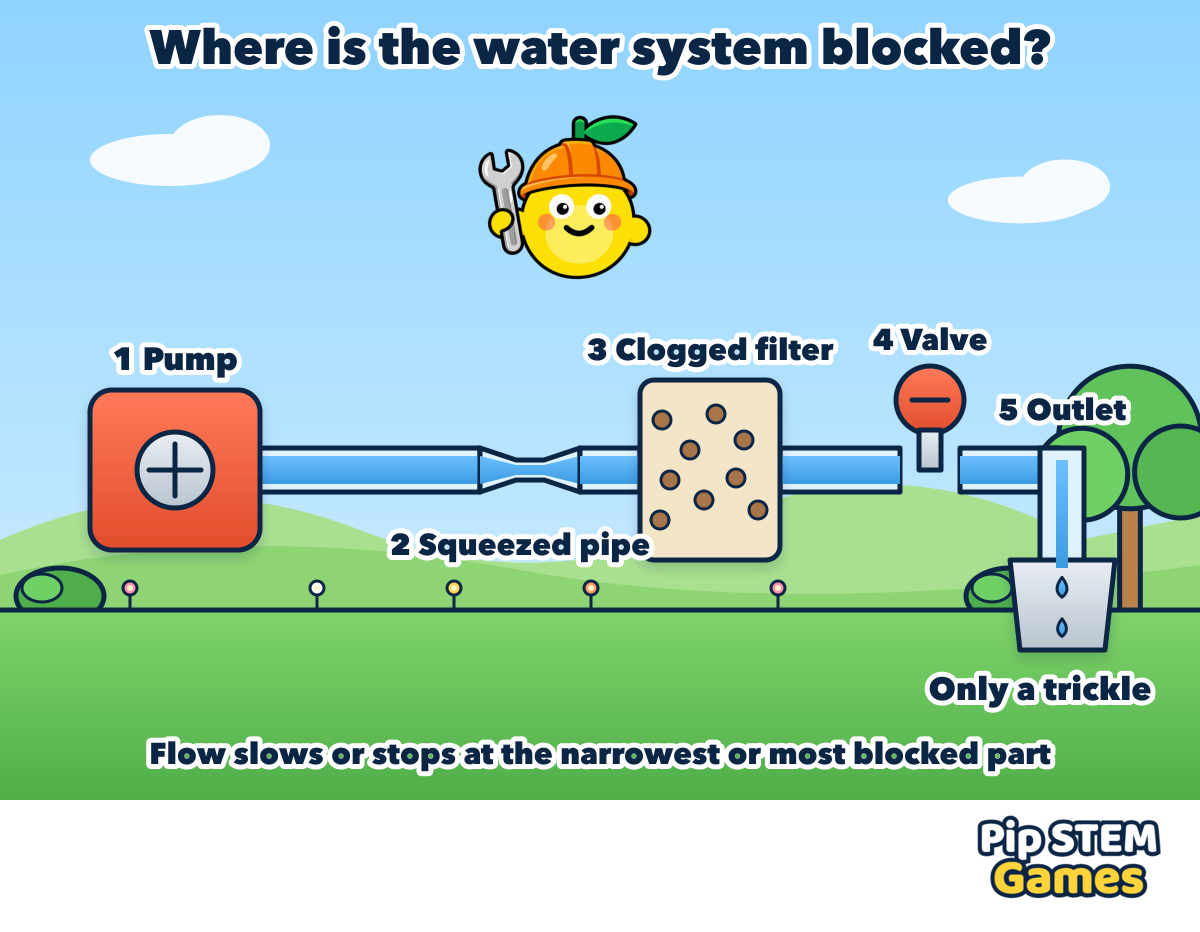
The water is blocked where its path gets narrower, closed or clogged. Follow it from the pump to the outlet, and the blockage is the spot where the flow slows or stops, and where water piles up behind.
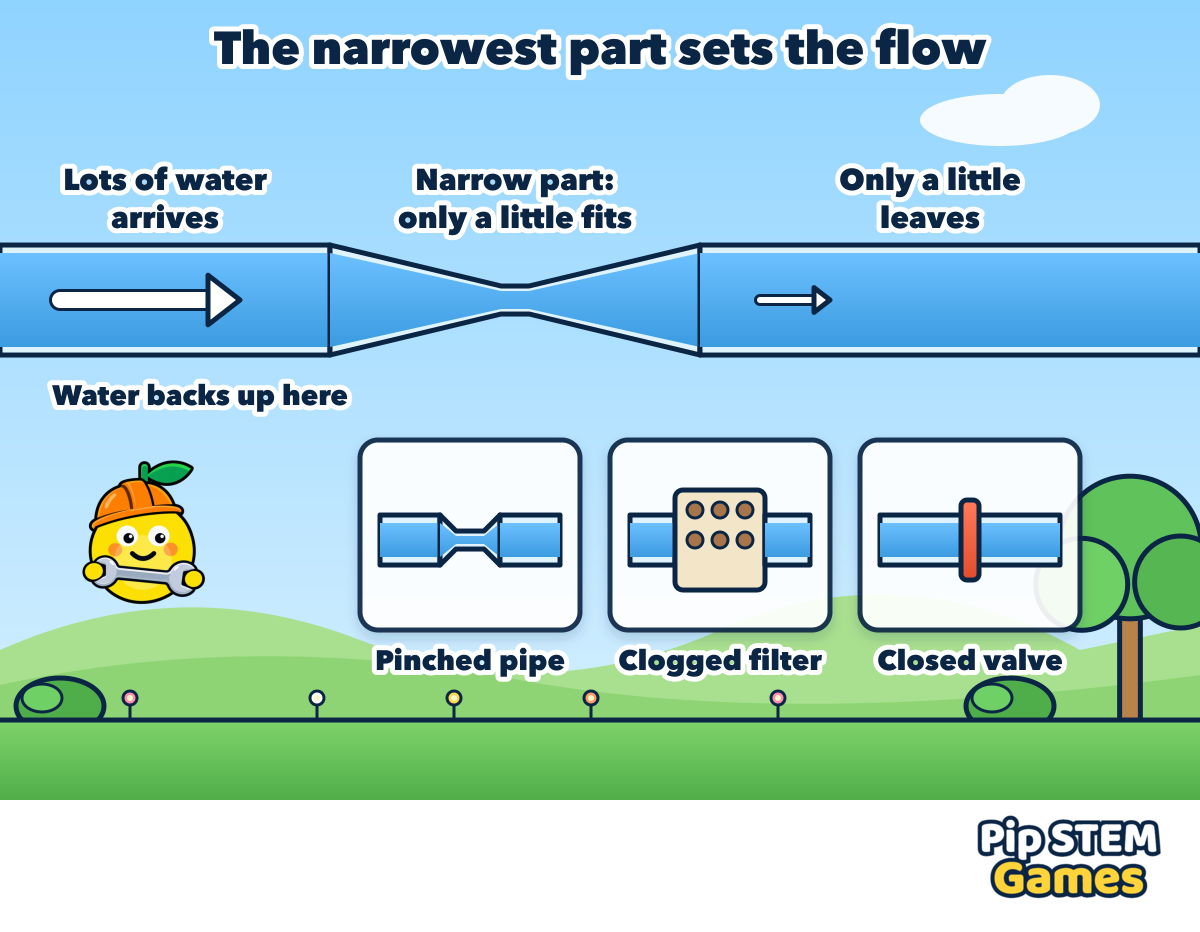
A water system works like a line of jobs done one after another. Every part has to let the water through, so the tightest part decides how much reaches the end. Engineers call this the bottleneck. A big pump cannot fix a pinched pipe, because the water still has to squeeze through the same gap.
What do you need for a simple water system model?
You need a jug, a sieve, a bowl and a few things to clog it with. All of it is kitchen kit. This is a home model of how real water systems work, not a real water supply.
- A jug that holds 500 ml, to act as the pump
- A small kitchen sieve or a scrap of mesh cloth
- A bowl big enough to catch all the water
- A short length of flexible clear tube or a drinking straw (ask an adult to cut it)
- Dry rice or coarse sand for the clog
- A tray and a towel, a spoon and a clock or phone timer
Safety: use cold tap water only, and do not drink any of it, even after it goes through the sieve. Filtering with a sieve does not make water clean enough to drink. Dry rice and sand are choking hazards for under threes, so keep them out of reach. An adult should do any cutting. Keep the whole activity well away from plug sockets and anything electrical.
How do you trace the flow and test each part?
Draw the system first, guess where it will slow down, then time three tests. Water that is poured the same way every time gives numbers you can trust.
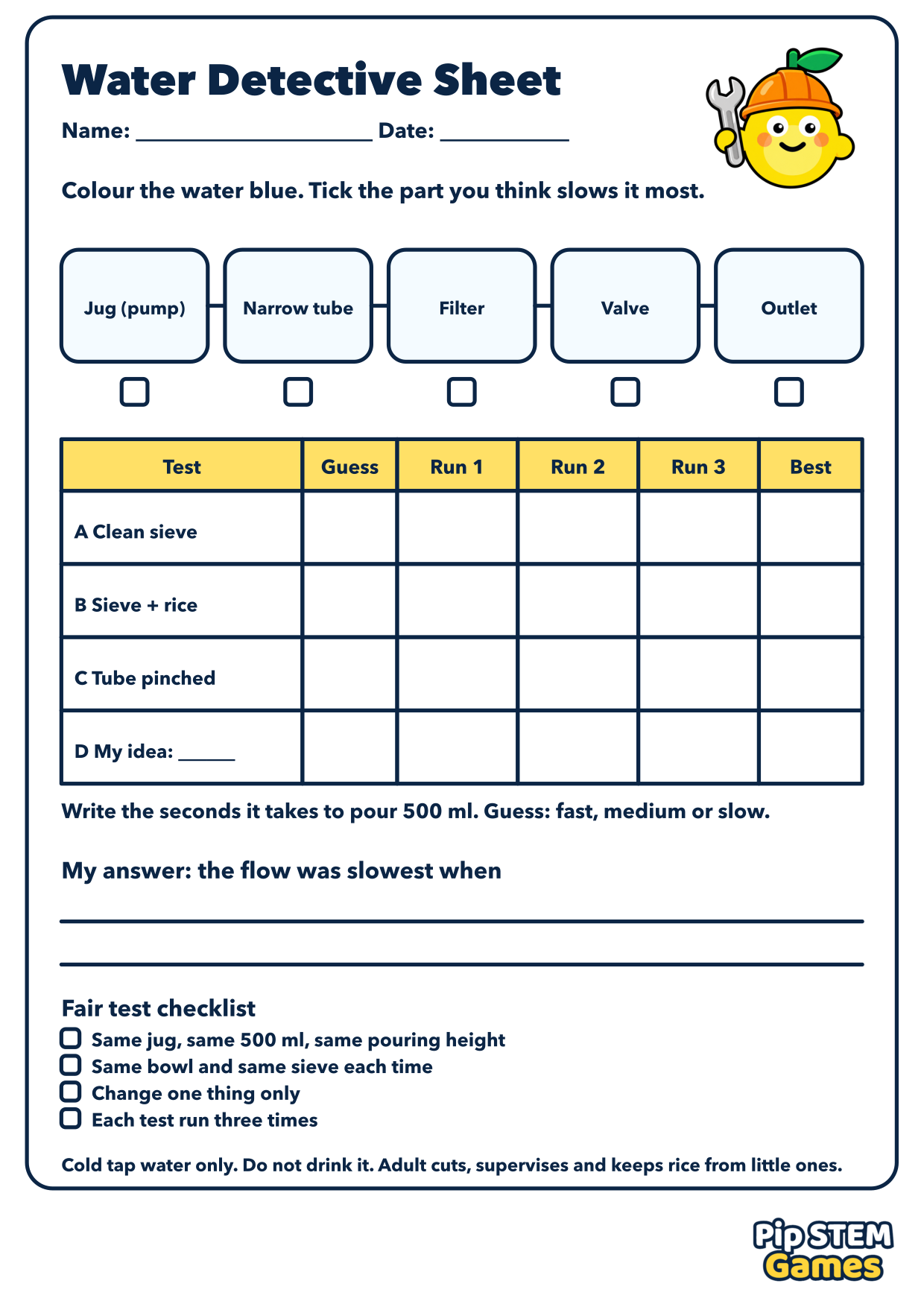
- Draw the loop on paper: jug, tube, filter, valve, outlet. Use the sheet at the bottom of this page if you like.
- Predict. Point to the part you think will slow the water most.
- Test A: hold the clean sieve over the bowl. Pour 500 ml from the jug and time it. Do it three times.
- Test B: put two spoonfuls of dry rice in the sieve. Pour 500 ml again and time it.
- Test C: take away the rice. Push the tube over a funnel or hold it under the jug spout, pinch the tube gently, and pour again.
- Write down the seconds you really see, even if they are not what you guessed.
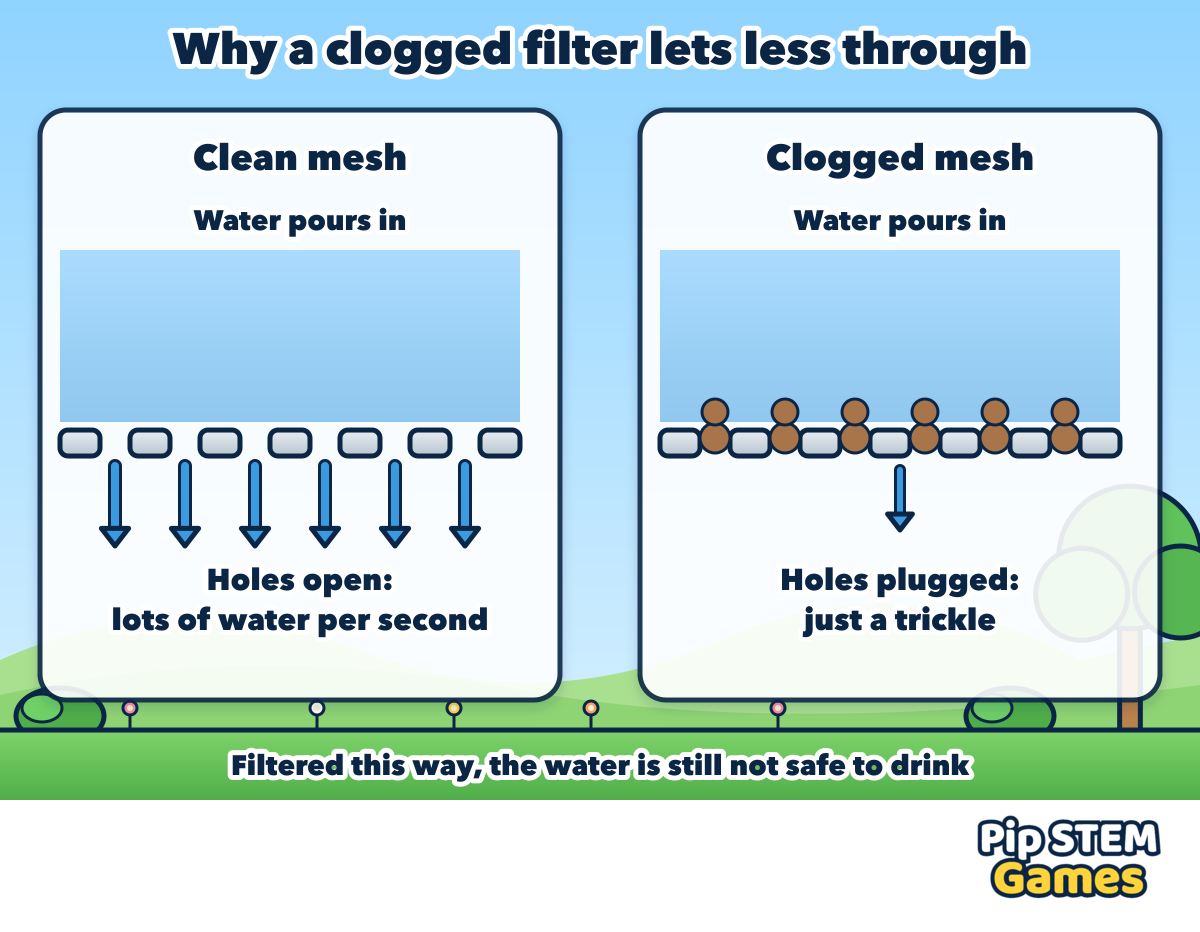
Watch for the water backing up above the rice. That pile of water shows exactly where the blockage is. In a real town, engineers look for the same signs: low pressure after the blockage and a build-up before it.
Why does a blockage slow the water?
Water can only go through the gaps it can fit through. A smaller or plugged gap lets less water pass each second, so the outlet gets less.
A filter works by holding back pieces that are bigger than its holes. That is useful, because it catches lumps. But the lumps pile up, fill the holes and slow the flow down. A pinched pipe and a closed valve do the same job in a different way: each makes the path smaller.
Want to see this in a puzzle? Try your hand at the Pipe Connect game, then read how water gets to your tap and who designs clean water systems.
What if the water model does not work?
Check for kinks, spills and different amounts of water before you blame the blockage.
- The water barely moves, even with no rice: check the tube for kinks or a squashed end.
- The sieve overflows: pour more slowly and keep the jug close to the sieve.
- The numbers look random: fill the jug to the same line every time and pour from the same height.
- The water goes everywhere: stand the sieve over a tray and use a deeper bowl.
Rice that drops through the sieve is a clue too. The holes are bigger than the grains, so those grains are not blocking anything.
How do you make it a fair test?
A fair test changes one thing at a time. Try clean sieve, then a little rice, then lots of rice. Keep the amount of water, the pouring height and the container the same.
Time each pour three times and write every number down. Don't just keep the fastest one, because pouring by hand changes a little each time. The middle number is usually the most honest.
What can you try next, and how do you adapt it by age?
Try a finer mesh, a wider tube or a clean filter, and predict which gives the fastest flow. Change one thing at a time and rank the results.
Ages 5 to 7: an adult does the pouring and timing. The child watches and says "fast" or "slow", points to the squeeze and tells the story of the water. The Engineering Workbook for Junior Engineers has similar watch-and-guess pages.
Ages 8 to 12: time each pour, draw a bar chart and explain which restriction mattered most. The Engineering Workbook for Kids has harder tests to try. Remember, a real water system is much bigger and cleaned in more steps than this model.
Questions parents ask
Why does a clogged filter slow the water?
The clog fills the holes the water goes through. Fewer open holes means less water passes each second, so the flow at the outlet drops.
What is a bottleneck in a water system?
A bottleneck is the narrowest or most blocked part of the path. The whole system can only move as much water as that part lets through.
Why does water back up before a blockage?
The pump keeps pushing water in, but the blockage lets less out. The extra water has nowhere to go, so it builds up behind the blockage.
Is water from this experiment safe to drink?
No. A sieve only holds back big lumps. It does not remove germs or chemicals. Use cold tap water, tip it away afterwards and do not drink it.
Does a wider pipe always give faster flow?
Usually it lets more water through, as long as nothing else in the path is narrower. The narrowest part still sets the limit, so test your own system to see.
What age is this water system test for?
Ages 5 to 7 can watch, guess and describe with an adult pouring. Ages 8 to 12 can time, chart and explain the results.
How do real engineers find blockages in water pipes?
They watch pressure and flow in different places along the system. Low pressure after a point and high pressure before it point to a blockage between the two.
Great STEM activities to try next...
 How Does Water Get to Your Tap?Activity
 Which Pipe Will Fill the Tank First?Activity
 Who Designs Clean Water Systems?Activity
More to try: What Is a Pulley? How They Work + DIY Pulley System · How Hydroelectric Power Works: Water Wheel Model · Potato and Lemon Battery Experiment for Kids

Pip STEM Games
We make engineering games and workbooks for kids aged 5 to 12. Every activity here is one we'd happily run at the kitchen table: test it, watch it fail, fix it, try again.




