


Key takeaways
- Each machine has one flaw that stops it working.
- Trace the movement path with a finger to find where it breaks.
- Gears must touch, a lever is easiest with the pivot near the load, a pulley rope must run over the wheel and a ramp must have no gap.
- Predict first, test, fix, then test again.
- Keep it fair: same car, same ramp height, same push, three tests each.
The Spot the Engineering Mistake game asks children to find the one flaw in each machine: gears that do not touch, a lever with the pivot in the wrong place, a pulley rope that misses the wheel and a ramp with a gap. Finding the flaw teaches kids to test ideas instead of just guessing. It takes about 30 minutes, needs only household materials and suits ages 5 to 12.
What is the Spot the Engineering Mistake game?
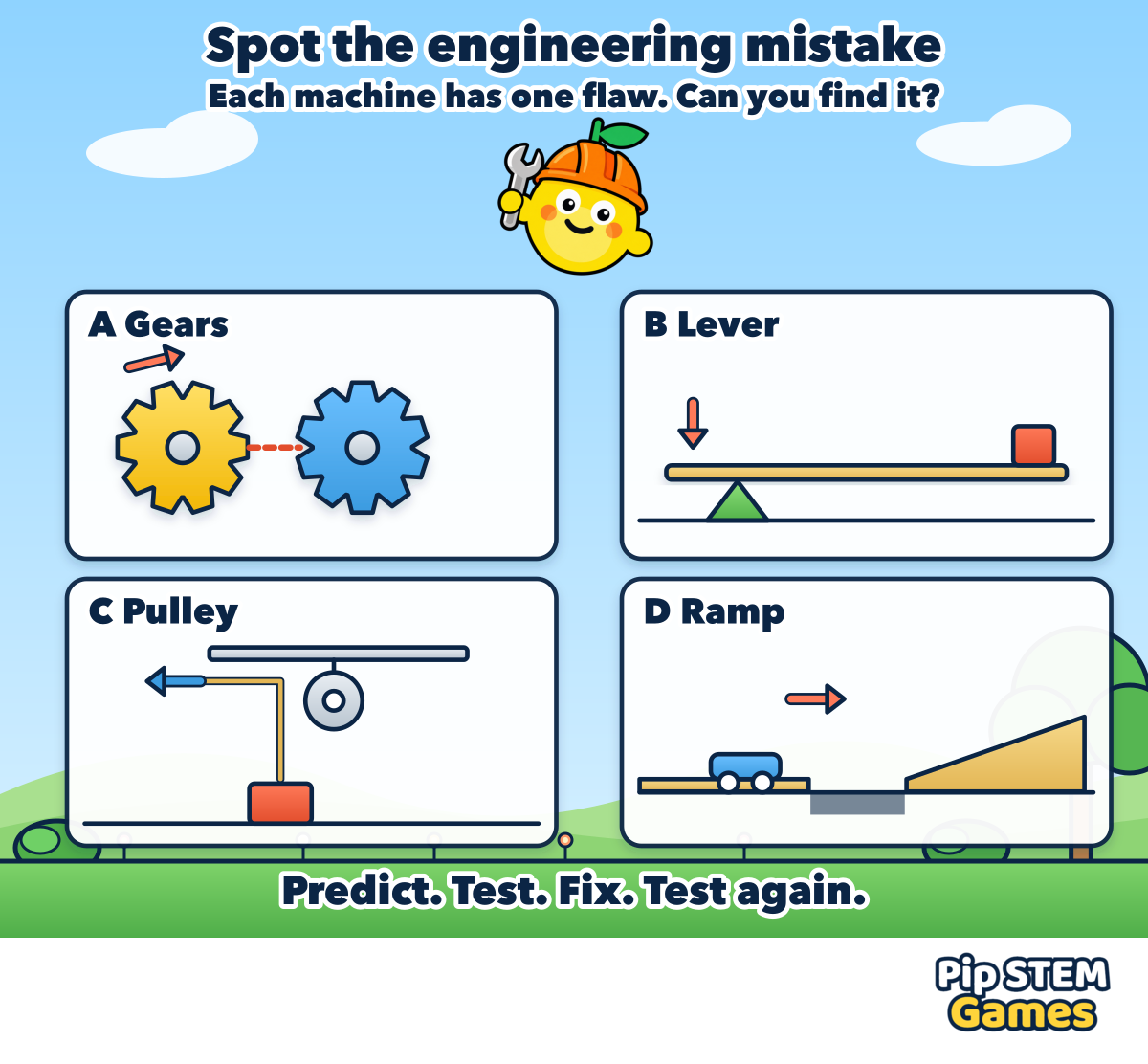
It is a look-and-reason game where your child hunts for the one flaw that stops each machine working: gears that do not touch, a lever with the pivot in the wrong place, a pulley rope that misses the wheel and a ramp with a gap. Finding the flaw, testing it and fixing it is how engineers think.
Your child studies four pictures, predicts which part will fail, then proves it with a quick home model. These are small models to practise thinking, not real machines. It takes about 30 minutes and suits ages 5 to 12.
What materials do you need?
You need cardboard, a few paper plates and some kitchen-drawer bits. Nothing has to be new or expensive.
- Thick cardboard, scissors and a pencil (an adult cuts the card)
- Two paper plates or card circles, and sticky tape (for gears)
- A 30 cm ruler and a pencil, plus a few 10p coins (for the lever)
- String, a cotton reel and a paper cup with a few 10p coins in it (for the pulley)
- A few books, a flat strip of card and a small toy car (for the ramp)
Safety: an adult does the cutting. Cotton reels, coins and any small parts can be choking hazards for children under three, so keep them out of reach and supervise closely. Tie the pulley to something steady, never to a person or pet.
How do you play, step by step?
Pick a machine, predict what will go wrong, then test it. Always write your guess down before you try it.
- Look at the four machines in the picture. Pick one.
- Ask: what will happen when we use it? Write your prediction down.
- Trace the path of movement with a finger, from the push to the result. The flaw is where the path breaks.
- Build the broken version with card and string. Test it.
- Fix the flaw and test again. Compare the before and after.
It is fine to guess wrong. A wrong guess that you test tells you something. A wrong guess you never test tells you nothing.
What is the flaw in each machine, and how do you fix it?
Each machine has one flaw, and each fix is small. Here is the answer for all four.
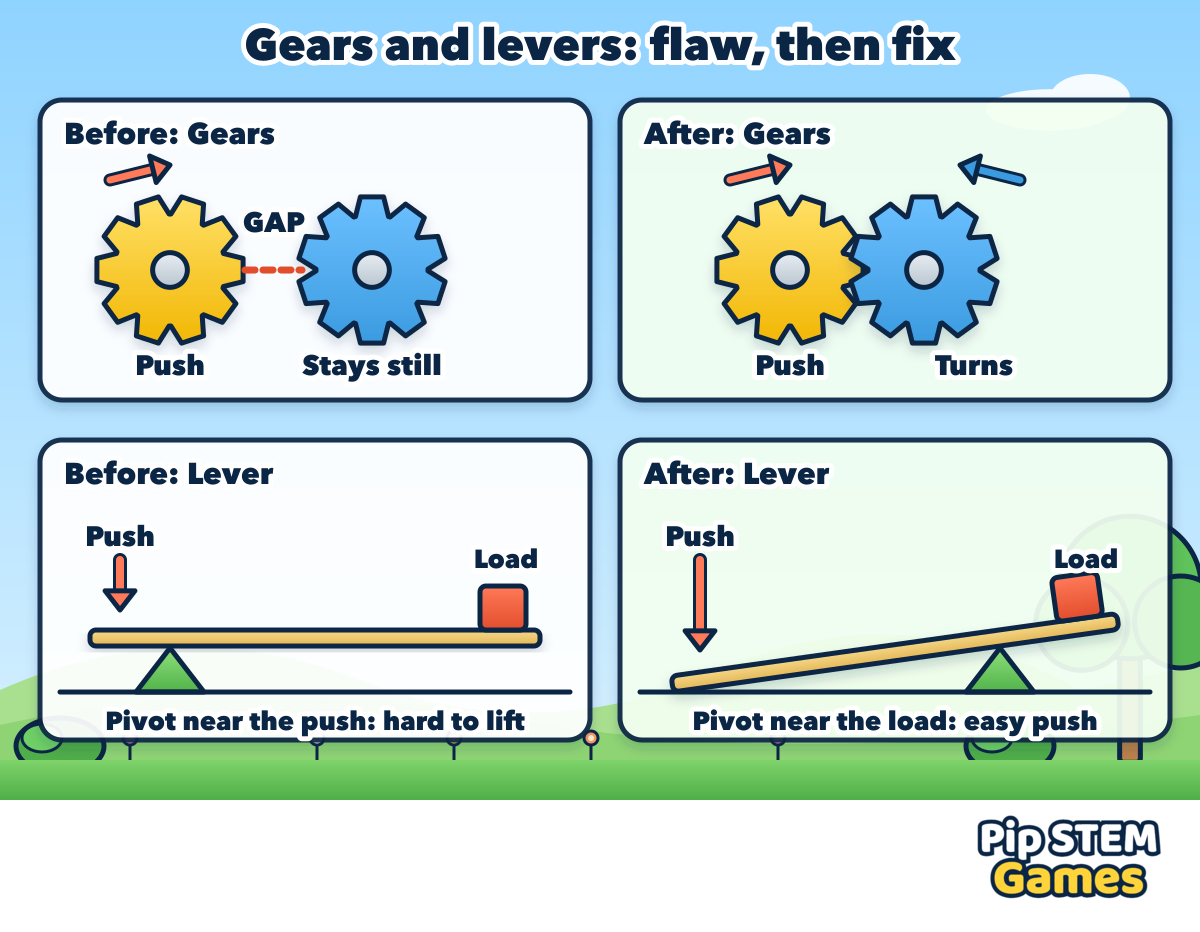
A: Gears
Two gears must touch, with their teeth fitting together, or turning one will not turn the other. Cut card teeth, put the plates edge to edge and turn one. If the teeth miss, nothing moves. Slide them closer until they mesh. When they do, the second gear turns the opposite way. See the four gear direction challenge for more on that.
B: Lever
A lever is a stiff bar that turns on a pivot. Put the ruler on a pencil, a few coins at one end, and press down at the other. With the pivot near your finger, the coins are hard to lift. Slide the pivot close to the coins and they lift easily, because your end is now the long end. There is more in what is a lever.
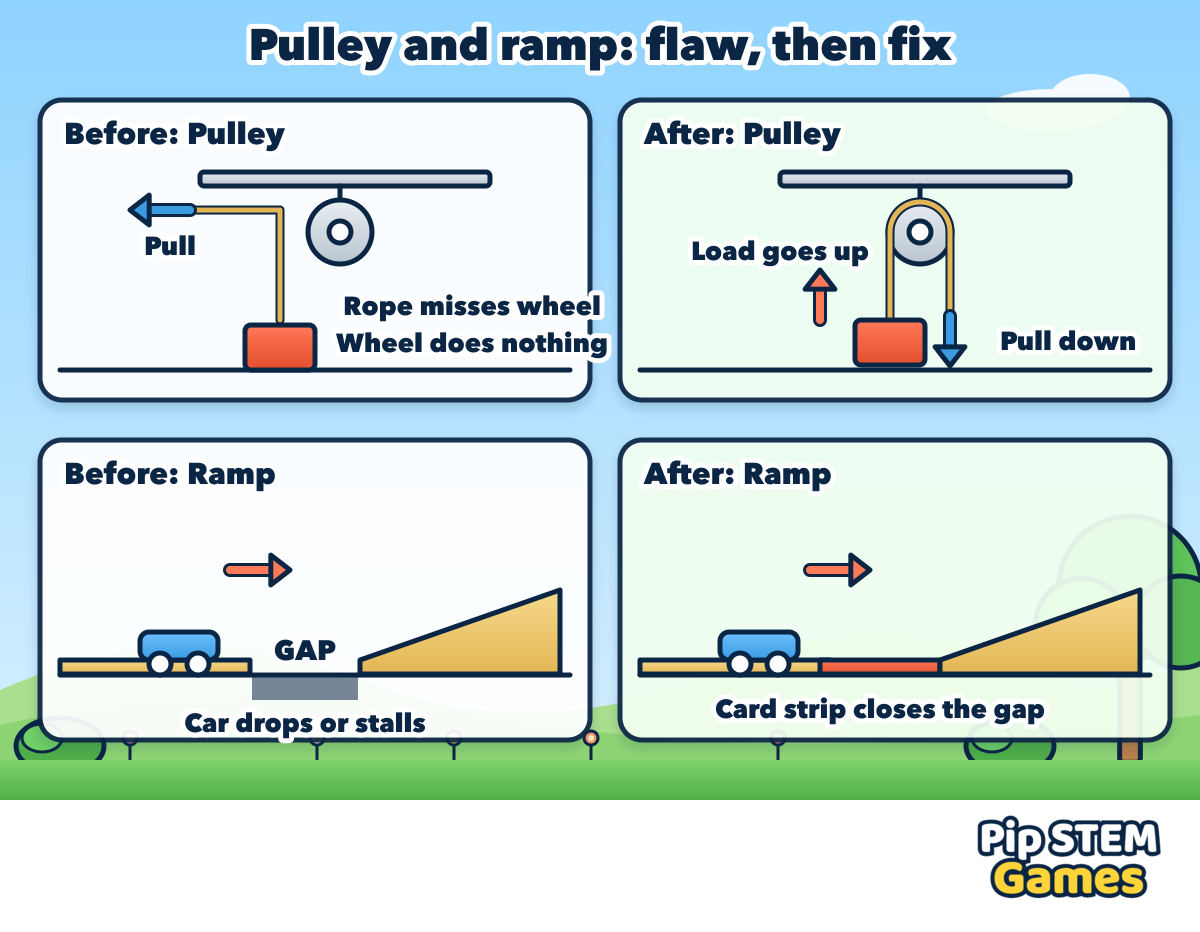
C: Pulley
A pulley wheel only works if the rope runs over it. If the rope hangs beside the wheel, pulling just drags the load sideways. Thread the rope over the wheel, and pulling down makes the load go up. A single pulley does not make the load lighter. It turns a downward pull into an upward lift, which is easier to do. Try the full build in build a simple pulley.
D: Ramp
A ramp is a path, and a path with a gap is not a path. A toy car will drop into the gap or stall at the edge. Close the gap with a flat card strip so the car rolls smoothly on to the slope.
What if the test does not work?
Most problems come from loose parts or a wobbly set-up, not from your idea.
- Gears slip: make the teeth deeper and fix each plate at its centre with a split pin, with an adult helping.
- The lever will not lift: the pivot may be too close to the push end. Slide it nearer the load.
- The ramp stalls the car: check for gaps, and make sure the joins are flat.
- The string jams: use a smooth cotton reel and keep the rope straight over the wheel.
How do you make it a fair test?
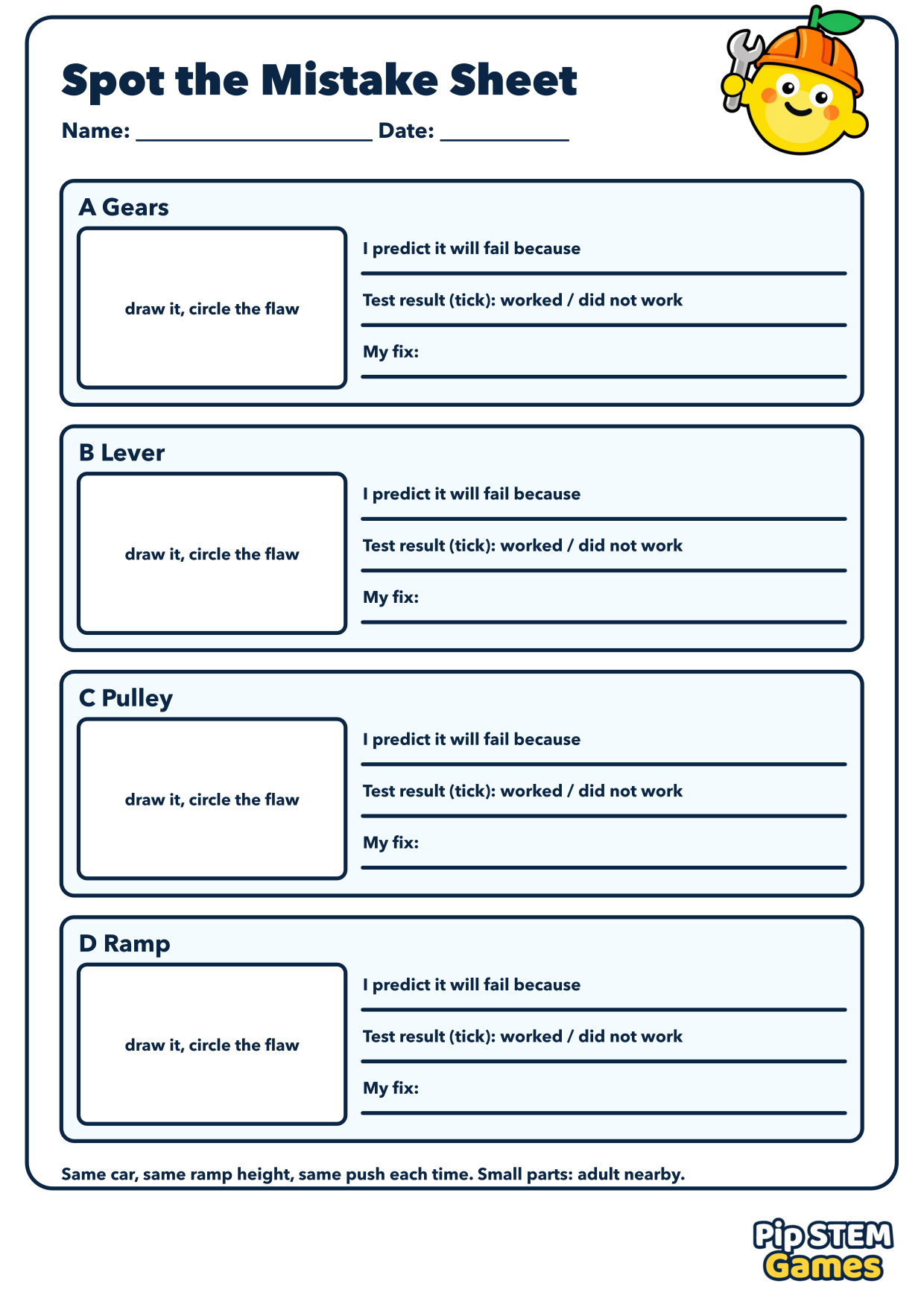
Change only one thing at a time. Keep the same car, the same ramp height and the same push. Test each version three times and write down what you actually see.
Don't write what you hoped would happen. If the broken ramp still worked once, record that too, then ask why. You can print the sheet below and use it for all four machines.
What can you try next, and how do you adapt it by age?
Ask your child to build a machine with one hidden flaw and challenge a family member to find it. Then swap roles. You can also try the same ideas in the Gears game.
Ages 5 to 7: pick one machine, spot the flaw and say why. The Engineering Workbook for Junior Engineers has similar look-and-fix pages.
Ages 8 to 10: write a prediction first, then test and compare before and after.
Ages 11 to 12: measure the pivot distances with the ruler and explain the lever result in words. The Engineering Workbook for Kids has harder challenges, and the five-step fix-it checklist gives a routine for any broken machine.
Questions parents ask
What is the Spot the Engineering Mistake game?
It is a look-and-reason game with four machines, each with one hidden flaw. Children predict which part will fail, test a simple home model and fix it.
Why is it good for kids to find mistakes?
Finding a flaw and fixing it is how engineers work. It shows children that a mistake is something to test and learn from, not something to hide.
Why must gears touch?
The teeth of one gear push the teeth of the next. If there is a gap, nothing pushes, so the second gear stays still.
Where should the pivot go on a lever?
Closer to the load makes it easier to lift, because your push end is the long end. Test it with a ruler and coins to see the difference.
Does a pulley make a load lighter?
A single fixed pulley does not make it lighter. It changes the direction of the pull, so you can pull down to lift up.
What age is this activity for?
Ages 5 to 7 can spot and describe one flaw with an adult helping. Ages 8 to 12 can predict, test, measure and explain.
Is it safe for young children?
Yes with supervision. An adult cuts the card, and small parts such as cotton reels and coins need to stay away from children under three.
Great STEM activities to try next...
 The Four-Gear Direction ChallengeActivity
 What Is a Lever? Three Everyday ExamplesActivity
 The Engineer’s Five-Step Fix-It Checklist for KidsBuild challenge
More to try: Can You Solve This Engineering Game Puzzle? · Engineering Puzzle: Broken to Working in 3 Fixes

Pip STEM Games
We make engineering games and workbooks for kids aged 5 to 12. Every activity here is one we'd happily run at the kitchen table: test it, watch it fail, fix it, try again.




