

Key takeaways
- A flat sheet of paper sags under a few coins, but the same sheet folded into pleats holds many more.
- Rest an A4 sheet short side across a 15 cm gap, so 3 cm sits on each book.
- The ridges must run along the span, from book to book, or the pleats fold flat.
- Pleats make the sheet deeper, and a deeper shape is much harder to bend.
- Change only the shape, test each bridge three times and use the middle result.
Can you design a stronger bridge from one sheet of paper? Yes. A flat sheet sags under almost nothing, but the same sheet folded into pleats can hold a small pile of 10p coins. This guide shows you how to compare the two, test them fairly and then redesign the weaker one.
What will you need?
- 4 sheets of A4 printer paper, all the same type
- 2 hardback books, or two stacks of magazines, the same height
- A ruler
- Sticky tape
- A small plastic pot or paper cup
- About 30 UK 10p coins
- A pencil and the results sheet at the end of this guide
Safety: coins are a choking hazard, so an adult stays close with younger children and keeps coins away from toddlers. Test over a table or a soft mat so nothing lands on toes.
These are simple paper models. They show ideas that real bridge designers use, but they can't tell you how a real bridge would behave.
How do you set up the gap?
- Put the two books on a table.
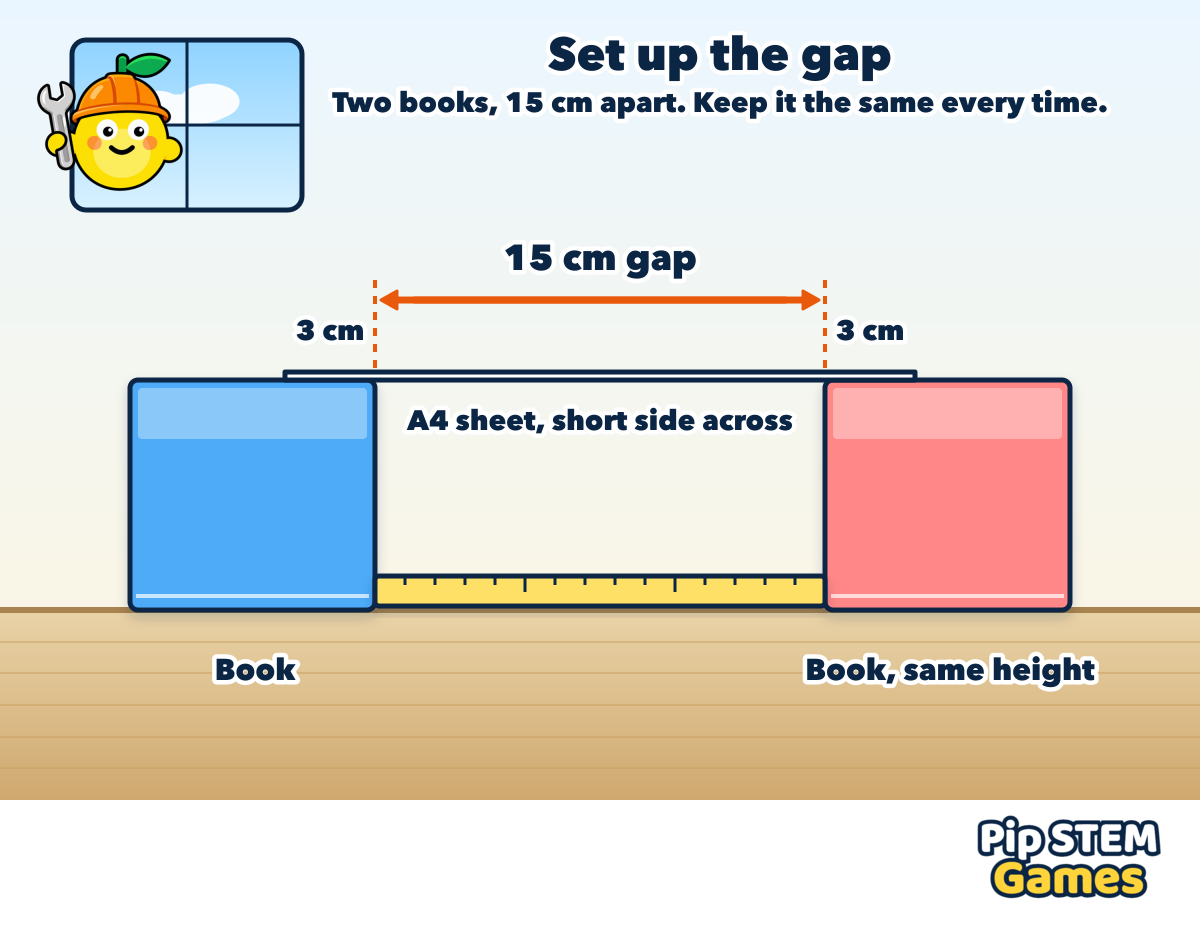
- Use the ruler to make a gap of 15 cm between them.
- Lay a sheet of A4 across the gap with its short side going from book to book.
- Check that about 3 cm of paper rests on each book.
- Don't move the books again until every test is done.
An A4 sheet is 21 cm on its short side, so a 15 cm gap leaves 3 cm on each book. Keeping the gap and the overlap the same makes it a fair test later on.
How do you test Bridge A, the flat bridge?
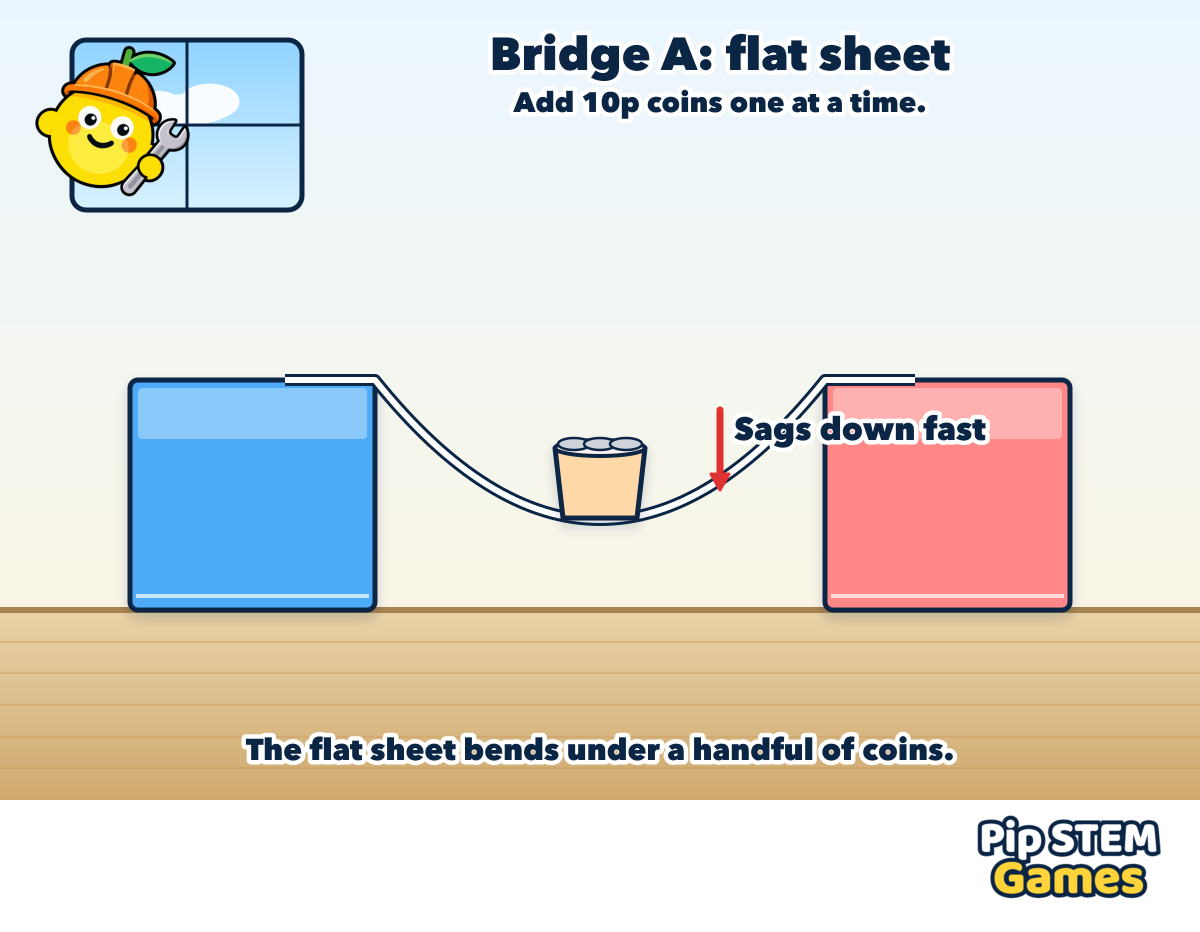
- Lay one flat sheet across the gap. This is your control.
- Stand the empty pot in the middle.
- Add 10p coins one at a time, gently.
- Stop when the pot touches the table or the paper slips off.
- Write down how many coins it held.
Most flat sheets hold very little before they sag. That's the point. You need a baseline to beat, and the flat sheet gives you one.
How do you test Bridge B, the pleated bridge?
Before you start, write a guess on the sheet: which bridge will hold more, and why? Writing a guess first is part of the science.
- Take a fresh sheet.
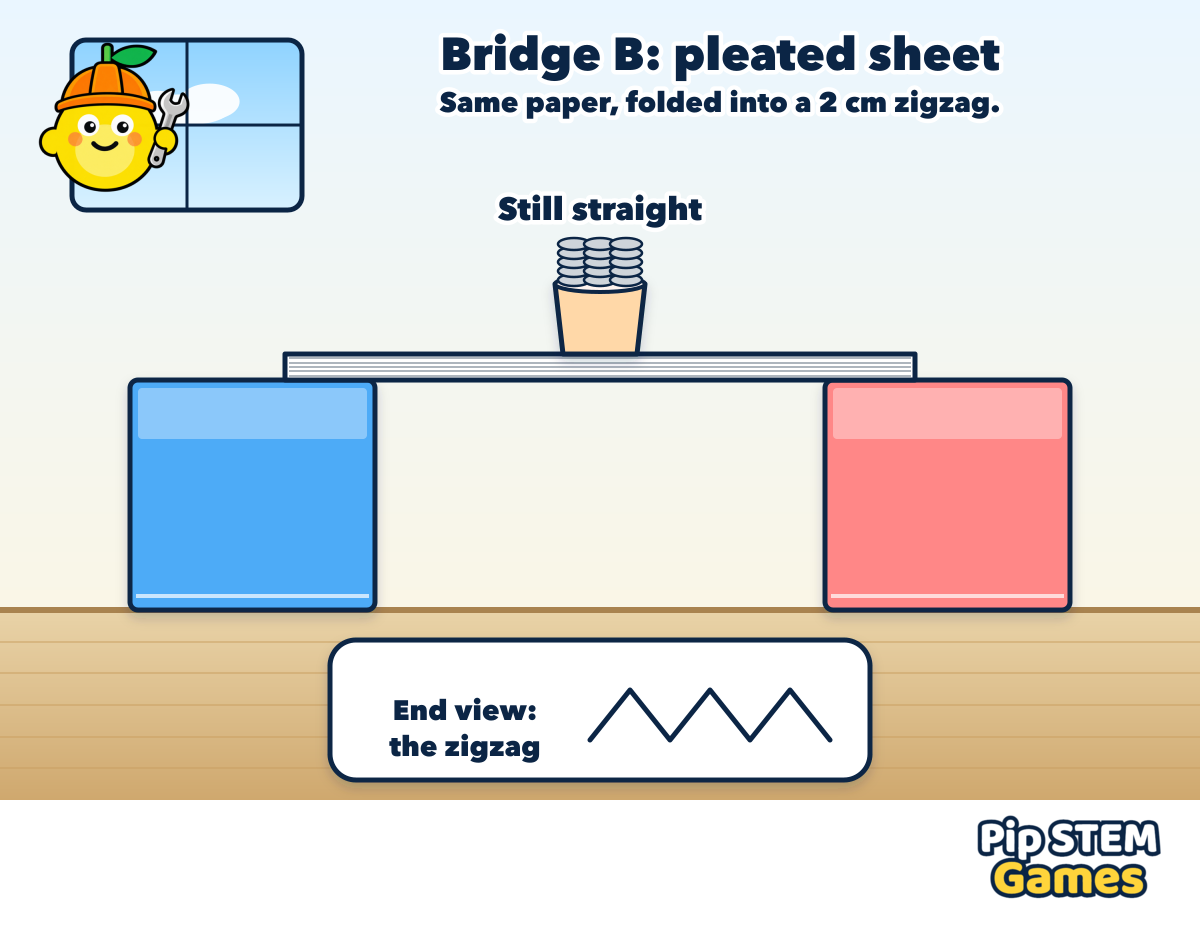
- Fold it back and forth like a fan, with folds about 2 cm wide.
- Press each fold firmly with your nail.
- Rest it across the gap so the ridges run from one book to the other.
- Add coins to the pot the same way as before.
- Write down the number.
One thing trips people up: if the ridges run across the gap instead of along it, the pleats fold flat at once. Turn the sheet so each ridge reaches both books. A 10p coin weighs 6.5 g, so 20 coins is 130 g, which is far more than a single sheet of paper. You can try a bridge on screen in the Bridge game too.
Why does the pleated bridge hold more?
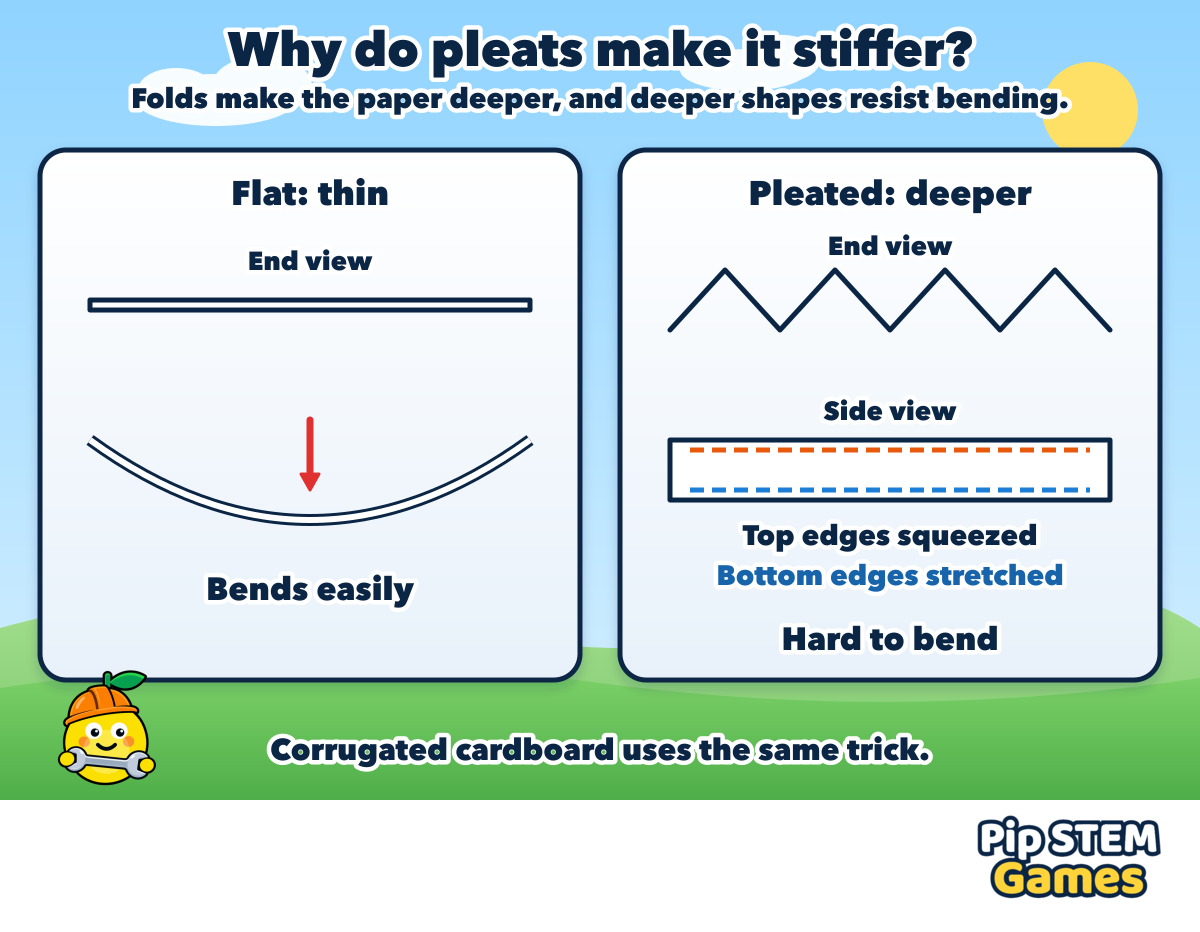
The folds make the paper deeper. When a deeper shape bends, its top edges have to squash together and its bottom edges have to stretch apart. Paper is good at resisting a stretch, so the deeper zigzag stays stiff. A flat sheet is so thin that it hardly has a top or a bottom, so it just flops.
It's the same trick inside corrugated cardboard and folded metal roof sheets. They're stiff for their weight because of their shape, not because they use more material. Watch what happens when you fold paper shows more folds to try.
How do you make it a fair test?
Change only one thing: the shape of the paper. Keep the same paper, the same 15 cm gap, the same 3 cm overlap, the same pot and the same way of adding coins. Add coins gently and never drop them in.
Test each bridge three times with a fresh sheet each time, because paper gets weaker once it has bent. Write down all three counts and circle the middle one. If your three numbers are 8, 12 and 10, the middle result is 10. That middle number is fairer than the best or the worst try.
What if it doesn't work?
- The bridge slips off: tape each end to its book, the same way for every bridge.
- Results jump around: check the gap is still 15 cm and the folds are even.
- The pleats flatten: fold them more firmly, and check the ridges run along the span.
- Both hold very little: close the gap to 10 cm, and use it for every test.
- The pot tips over: use a wider pot, or press a small flat strip of card under it.
What is the redesign challenge?
Now make the weaker bridge better. Try one change at a time: tape along both edges, deeper folds, or two layers of paper. Guess first, test three times, then compare with your first results.
After that, try a new shape. Roll a sheet into a tube, or add a triangle support under the deck. You can also widen the gap to 20 cm and see which design copes best. Three bridge designs, same materials, different results has more shapes to compare, and can one sheet of paper hold 20 coins? is a good follow-up challenge.
How do you change it for each age?
Ages 5 to 7: make just the flat and pleated bridges. Count the coins together while an adult adds them.
Ages 8 to 12: do three tries, find the middle result and fill in the table. Then write one sentence about the best design using the words load, span and stiff.
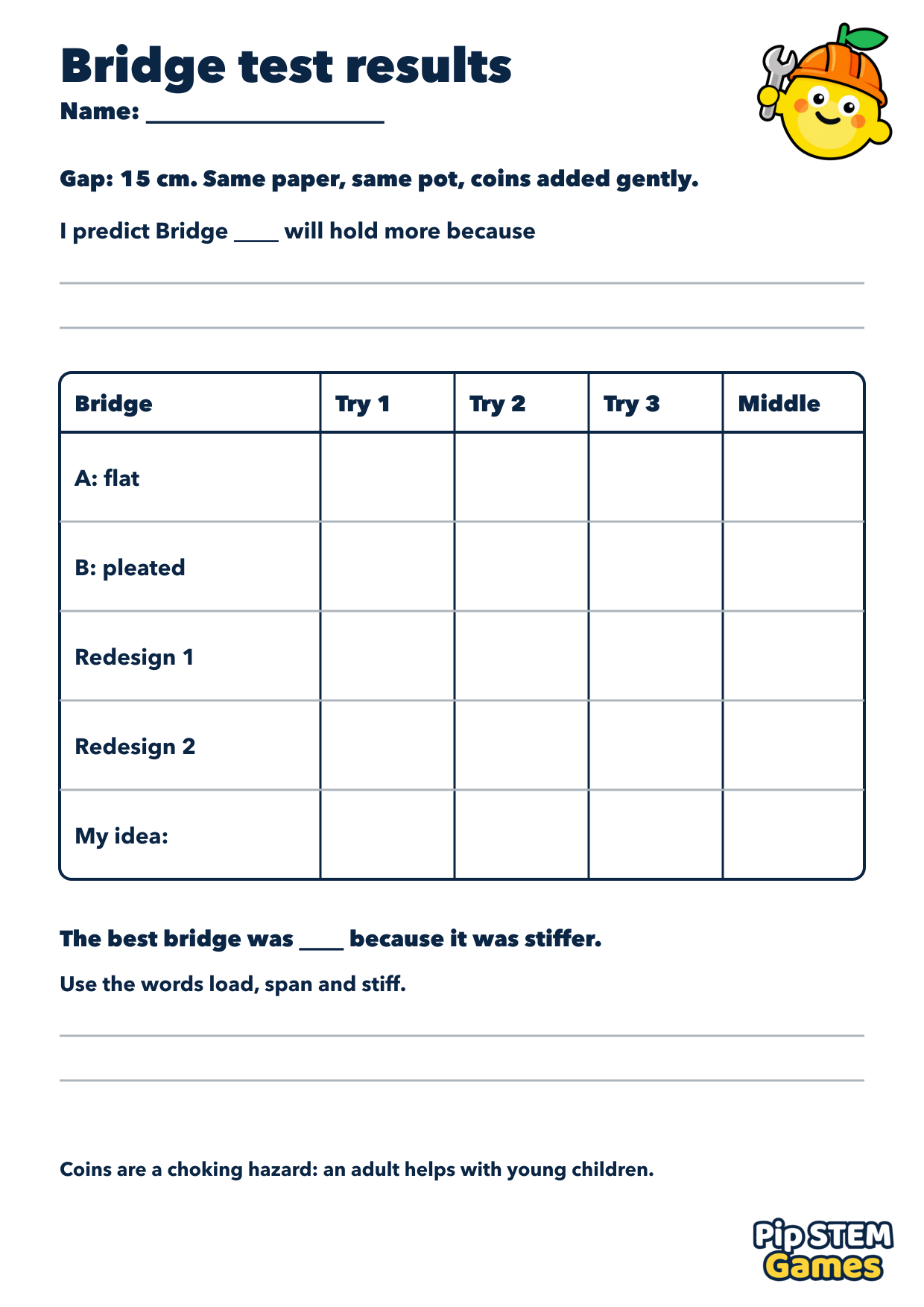
Print it on A4, or right-click and save it. For a bigger build, try the paper bridge challenge.
Questions parents ask
Why does a pleated paper bridge hold more than a flat one?
The folds make the paper deeper. When a deeper shape bends, its top squeezes and its bottom stretches, and paper resists that, so it stays stiff.
Which way should the pleats run?
Along the span, so every ridge reaches from one book to the other. If they run across the gap, the folds open and the bridge flops.
How big should the gap be?
15 cm works well with A4 laid short side across, leaving 3 cm on each book. If both bridges hold very little, use 10 cm for every test.
How much does a 10p coin weigh?
A UK 10p coin weighs 6.5 g, so 20 coins weigh 130 g.
Why test each bridge three times?
Paper and folding vary a little each time. Three tries with fresh sheets, and the middle result, give a fairer answer than one try.
Is this safe for young children?
Yes, with an adult close by. Coins are a choking hazard, so keep them away from toddlers and test over a table or soft mat.
Great STEM activities to try next...
 Paper Bridge Challenge: Build a Bridge From One Sheet of Paper [Printable]Build challenge
 Can One Sheet of Paper Hold 20 Coins?Activity
 Three Paper Bridge Designs, Same Materials, Very Different ResultsBuild challenge
More to try:

Pip STEM Games
We make engineering games and workbooks for kids aged 5 to 12. Every activity here is one we'd happily run at the kitchen table: test it, watch it fail, fix it, try again.




